















































Solana Pay Is Coming to KSNET, With Access to 330,000 South Korean Merchants
Solana Pay is being added to KSNET, the South Korean payment network used by more than 330,000 merchant locations. Announced today, the deal could put Solana payments in front of a sizable group of shops and customers. My take: that matters more for adoption than a fresh token listing or a price jump that disappears after a few days.
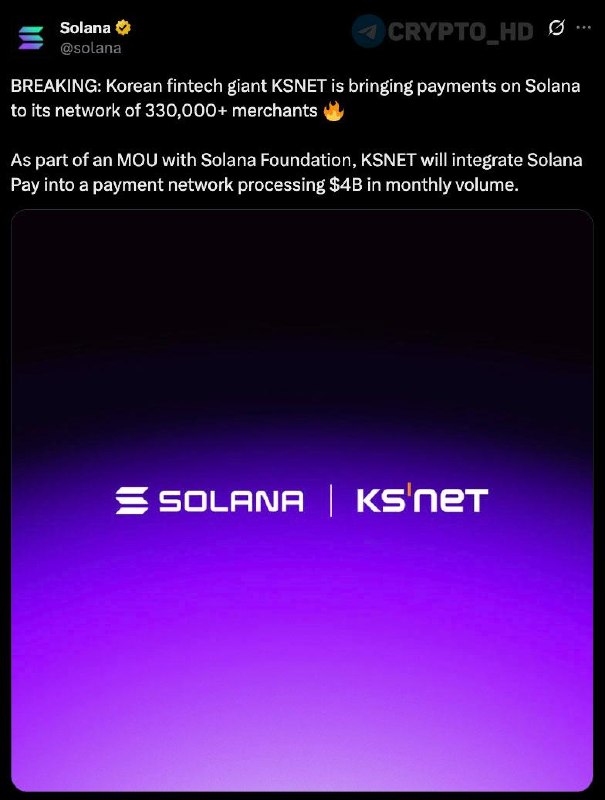
KSNET is one of South Korea’s largest payment operators, processing roughly $4 billion each month. Its merchants will gain access to payment options built on Solana. This is not merely a test involving a handful of stores; it connects Solana Pay to an existing payment system. That distinction matters. Plenty of crypto payment projects never make it beyond the pilot.
The timing is awkward. Persistent inflation and the Federal Reserve’s hawkish position have weighed on crypto prices. Bitcoin (BTC), for instance, has struggled to hold above $61,400 in recent weeks amid fears that interest rates will stay high. Can KSNET make those concerns disappear? No. It does, however, give Solana a practical story: people may soon use the network at ordinary businesses, regardless of what SOL does this week.
More payment activity might support SOL during a weak market, but calling it a price floor would be premature. There was a loose parallel in late 2021, when large payment companies began experimenting with crypto and ETH rose above $4,000 while the Federal Reserve discussed tapering. Most bullish readings stop there. That is only half the story, because the same outcome is not guaranteed to repeat. I would put more weight on months of regular use than on a brief burst of market hype.
South Korea is a logical market for the rollout. Crypto trading is popular, while digital payments are already part of daily life for many consumers. Yet regulators have tightened their supervision of crypto companies. The announcement does not explain how Solana Pay will meet every local financial rule. Questions remain.
KSNET’s involvement suggests that the companies have found a route through those rules, or at least believe one exists. I’ll be honest: I would not reach a firm view until we know how settlement works and what merchants must agree to. Who handles compliance matters too. The climate differs from the United States, where SEC scrutiny of altcoins and staking services continues to cool interest in parts of the market.
SOL traded between $120 and $180 over the past month. The KSNET agreement gives investors a specific use case to assess instead of another vague adoption promise. If merchants activate the service and customers keep returning, Solana may draw more users. Developers could follow. If hardly anyone pays with it, though, the headline figure of 330,000 locations will mean very little.
What this means
This integration could move Solana payments beyond crypto trading and into everyday purchases. Transaction volume may rise. Still, availability is not demand, despite how these deals are often presented. A shop that can accept Solana Pay is one thing; a shop processing hundreds of those payments each day is another. What should we watch? Actual payment volume.
The agreement also moves Solana closer to established payment providers. Blockchain transactions can settle quickly and might cost less, depending on KSNET’s fees. The result also depends on whether merchants hold or convert the assets they receive. Counter to the usual optimistic pitch, fast settlement alone does not prove that a payment system is cheaper. KSNET has not released all of those details, so lower costs remain possible rather than demonstrated.
Investors should watch the rollout schedule, especially which businesses join first. Solana’s transaction volume and active address data may show whether the partnership produces regular use. If both rise while SOL breaks above its recent resistance near $180, traders may be responding well to the rollout. I would ignore one noisy week. A few busy months would say much more.
South Korean financial authorities could determine much of what happens next. They may decide which assets merchants can accept and how payments must be reported. Customers might also face extra identity checks. Those decisions could shape this partnership—and other crypto payment deals across the country.
FAQ
What is Solana Pay?
Solana Pay is a payment protocol on the Solana blockchain. Customers can send funds directly to merchants. Network fees are low, and settlement is quick.
What is KSNET?
KSNET is one of South Korea’s largest payment processing networks. It handles about $4 billion in payments each month and connects over 330,000 merchant locations. That is real scale.
How many merchants will be able to accept Solana Pay through KSNET?
According to the announcement, more than 330,000 locations on KSNET’s network will be able to access Solana payment options. Does that mean all 330,000 will enable them immediately? No. Access is not the same as activation.
What does this integration mean for Solana (SOL)?
It gives Solana a practical payment use case in a major market. In my view, repeat customer activity is the key test: it could bring more transactions to the network and increase the number of active users.
Will this integration affect SOL’s price?
It might, but nothing is guaranteed. SOL still moves with the wider crypto market and interest rates. Regulation matters, as does investor demand. Merchant activity would need to persist before making a persuasive case for higher long term value.
What could merchants gain from using Solana Pay through KSNET?
Merchants might receive quicker settlement and lower fees. They could also reach customers who want to spend cryptocurrency. My take: the advertised benefits matter less than KSNET’s actual pricing and settlement conditions.
Are there regulatory concerns in South Korea?
Yes. South Korea’s crypto rules are still changing, and the announcement leaves several compliance questions unanswered. KSNET appears to believe the service can operate within those rules. Even so, its participation does not amount to blanket approval from regulators.
When will Solana Pay be available across the KSNET network?
The announcement says the integration is underway, but it provides no date for onboarding every merchant. Even after the technical work is complete, broad customer use could take time. Rollouts rarely happen overnight.
How does this compare with other crypto payment deals?
Its potential reach makes it worth following: KSNET processes about $4 billion each month and connects more than 330,000 locations. But the biggest number is not automatically the most useful one. What will matter is how many merchants activate Solana Pay—and how often customers select it at checkout.
What should investors monitor?
Investors should track merchant onboarding and payment volume. Active Solana addresses deserve attention as well, along with SOL’s behavior around $180. They should also watch South Korean regulators, whose decisions may limit or extend the partnership’s reach.