















































Trump on Abraham Accords and Iran tests Bitcoin risk trade
“Trump’s comments on the Abraham Accords and Iran are no longer background diplomacy. Traders are starting to treat them as part of the risk setup for Bitcoin and the wider crypto market.” Donald Trump said talks with the Islamic Republic of Iran are “going well.” He also warned that the outcome would be either a “Great deal for all” or no deal, with fighting returning on a larger and harsher scale. For crypto traders, that is not just foreign-policy noise. A calmer Middle East can pull money back into BTC, ETH, and exchange-linked names like COIN. A failed deal can bring the Bitcoin (BTC) insurance trade back fast. That part is easy to miss.
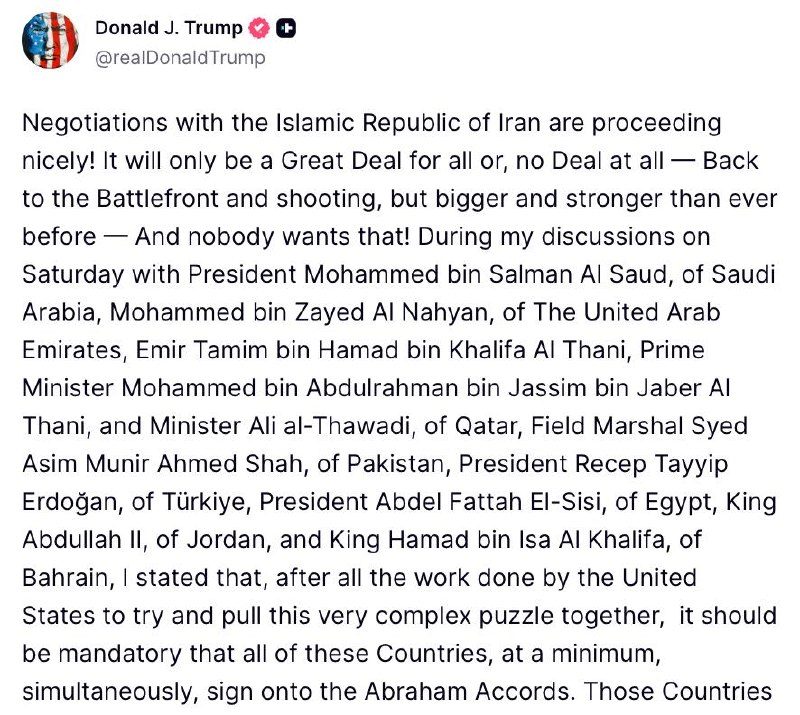
“Trump said his latest calls with Middle Eastern and regional leaders focused on expanding the Abraham Accords, and he expects more countries to join.” The comments came after Trump said he spoke Saturday with leaders from Saudi Arabia, the UAE, Qatar, Pakistan, Turkey, Egypt, Jordan, and Bahrain. His ask was blunt. After what he described as the United States’ work to resolve an extremely difficult conflict, those countries should join the Abraham Accords. My take: Saudi Arabia and Qatar are the real tells here. Pakistan, Turkey, Egypt, and Jordan matter too, but the UAE and Bahrain are already in, so traders will watch who actually moves next.
“Trump acknowledged that one or two countries may have real reasons not to sign, but he still described most of the group as ready to turn the Iran peace process into something historic.” He said one or two countries might have legitimate reasons to stay out, and that would be accepted. Then he turned around and described the larger group as ready to make the Iran peace process a historic event. Yes, that sounds like a contradiction. It is also how these deals usually get framed: leave a door open for holdouts, then talk like the train is already leaving. He pointed to the UAE, Bahrain, Morocco, Sudan, and Kazakhstan as current participants that, in his view, have gained financial, economic, and social benefits from the accords, even with wars and conflicts still going on. He also said none of them had considered leaving or pausing their role.
“The crypto angle is simple enough. BTC and ETH trade like liquidity assets when markets are calm and insurance assets when stress comes back.” That is the geopolitical headline. The market story sits right underneath it. BTC was around $77,084.61 on May 25, 2026, after a 0.4203% daily move. ETH was near $2,113.23, up 0.73% over 24 hours. COIN, Coinbase Global, closed at $184.99 on May 22, 2026, down 4.43% on the day. I will be honest: crypto is not floating in its own little market anymore. It trades with macro. Sometimes brutally.
“Warmer language from Washington, Riyadh, Doha, and Tehran can lower risk premiums before anything changes on the ground.” Markets often move before reality does. If investors think a wider Middle East deal lowers the odds of an oil shock, inflation hedges can cool and real rate fears can ease. BTC and ETH would usually feel that first. Exchange linked stocks like COIN may follow if volume improves. Why does this matter? Because the Federal Reserve meeting on June 16-17, 2026 gives traders the next obvious macro checkpoint, and crypto tends to front-run those nerves.
“A believable path toward Middle East de-escalation would make financial conditions feel easier, and crypto usually likes that.” The macro logic is not complicated. Less war risk means less chance of a sudden energy price spike. That lowers the chance that inflation expectations push the Fed into a tougher stance. Most guides stop there. That is only half right. Crypto benefits from easier money, but it also benefits from the hope of easier money before the policy actually changes. BTC near $77.1K on May 25, 2026 is close enough to the $75K area that a clean diplomatic boost could matter on the chart. If BTC breaks higher from there, traders may read it as macro buyers returning, not just dip buyers doing their usual thing.
“Ethereum is more tied to risk appetite and on-chain activity, so reduced war risk would likely help it differently than Bitcoin.” ETH reads a little differently. At about $2,113.23 on May 25, 2026, it still reacts more to risk appetite and on-chain activity than to pure geopolitical hedging. If Trump’s Iran push lowers war risk, ETH could benefit from the same rotation that helps tech shares. Crypto infrastructure names get pulled into that move too. COIN at $184.99 on May 22, 2026 is a useful proxy because more spot volume and retail activity usually show up in exchange economics faster than big adoption stories do.
“Trump’s warning keeps the Bitcoin safe haven trade alive, even if the base case turns more optimistic.” Still, the insurance trade has not disappeared. Trump was blunt. He said that without a deal, the world could go back to fighting and shooting in a much larger and harsher form. That gives BTC traders a second scenario to price. De-escalation supports a risk rotation. Failure revives the “digital insurance” bid. Gold still owns the old safe haven lane, but BTC can be the faster weekend trade when geopolitical headlines hit outside banking hours. We have seen that pattern before.
“Bitcoin has reacted quickly to Middle East headlines before, especially when traditional markets were closed.” Traders have seen this before. BTC rallied during the January 2020 U.S.-Iran shock after the Soleimani strike, though the move was messy and did not prove Bitcoin had replaced gold. That matters. The lesson was narrower and more useful: when Middle East headlines break outside banking hours, BTC trades immediately. Is that enough to make Bitcoin a true safe haven? No. But it is enough to make it the first liquid crypto instrument traders reach for in a headline shock.
“If the Abraham Accords expand toward Iran, regional finance could become more connected. Stablecoin issuers and crypto firms will pay attention.” There is an adoption signal buried in the politics. Trump said leaders told him it would be an honor to see Iran join the Abraham Accords after a peace agreement with the United States. He also pushed Saudi Arabia and Qatar to join immediately, with others to follow. If even part of that becomes policy, Gulf capital markets, energy settlement systems, cross border payment channels, and dollar liquidity routes could become more connected. That is not a crypto adoption announcement. Still, stablecoin issuers, exchanges, and tokenized treasury desks watch this kind of financial plumbing closely.
“A wider Abraham Accords framework could make Middle East capital flows easier to price, which would get crypto firms’ attention.” The clean crypto read is not “Iran joins, BTC pumps.” Too neat. A better read is that a larger Abraham Accords framework could reduce regional fragmentation and make Middle East capital flows easier for investors to underwrite. Saudi Arabia, Qatar, the UAE, and Bahrain already sit near the center of sovereign wealth, energy finance, and dollar liquidity. Counter to the usual advice, the biggest crypto signal may not be a token headline at all. It may be banking access, clearer licenses, and institutional demand across the region.
“Trump’s “Great deal” or “no deal at all” framing can make BTC, ETH, and COIN jump around as traders price two very different outcomes.” His language also carried a threat. He said refusal would be treated as a bad faith approach to the deal. Markets hate that kind of binary setup. They prefer stages and off ramps. Deadlines help too. A “Great deal” versus “no deal at all” structure can create headline gaps in BTC, ETH, and COIN because traders have to price peace and conflict at the same time. Peace premium on Monday. War premium by Friday. Crypto does this fast.
“This market read is about probabilities, not confirmed reaction, because the source statement gives no analyst quote, market response, or clear timetable.” The source statement does not include a market reaction, an analyst quote, or a schedule beyond the Saturday talks and Trump’s instruction to his representatives to start and complete the accession process. So the interpretation needs to stay grounded. The facts are Trump’s claim that Iran talks are going well, his call for Saudi Arabia and Qatar to join immediately, his list of involved countries, and his claim that the Abraham Accords can bring strength, stability, and peace to the Middle East for the first time in 5000 years. My read is probability, not proof.
What this means
“Middle East diplomacy is moving back into the macro feed, and BTC and ETH already trade there.” If Trump’s Abraham Accords push gains traction with Saudi Arabia, Qatar, Pakistan, Turkey, Egypt, and Jordan, the first crypto impact should show up in risk appetite. Watch whether BTC can hold above the $75K area, whether ETH defends the $2.1K zone, and whether COIN stabilizes after closing at $184.99 on May 22, 2026. The question is whether traders treat de-escalation as a reason to buy crypto, not just as a reason to sell traditional safe havens. That is the trade.
“The next checks are specific: the June Fed meeting, CME Bitcoin futures positioning, and BTC’s behavior around $75K and $80K.” The dates and levels matter now. The June 16-17, 2026 FOMC meeting is the big macro marker. CME Bitcoin futures positioning into the May 29, 2026 weekly close should show how aggressively traders are leaning. BTC’s reaction around $75K and $80K will tell the cleaner story. A move above $80K would suggest risk buyers believe diplomacy is lowering oil shock and inflation tail risk. A break below $75K would suggest the market doubts the deal path or is preparing for a harsher outcome. In this setup, Trump’s next Iran headline can move crypto long before anyone signs a treaty.