
















































Russia’s VPN/AI Crime Law: Another Regulatory Headwind for Crypto?
Russia’s Investigative Committee (SK RF) has drafted a law that would make the use of VPNs, AI, proxies, or similar tools an aggravating factor in a crime. If passed, it would apply throughout the Criminal Code whenever the technology helped commit the offense or worsen the damage—including cases involving fraud, illegal data trafficking, terrorism, and murder. The scope is unusually broad. My take: that breadth is the story. For crypto investors and traders, the proposal adds regulatory risk in Russia, especially around privacy services. It also tests a bigger claim: can crypto really offer a dependable refuge when governments tighten their grip on financial activity?
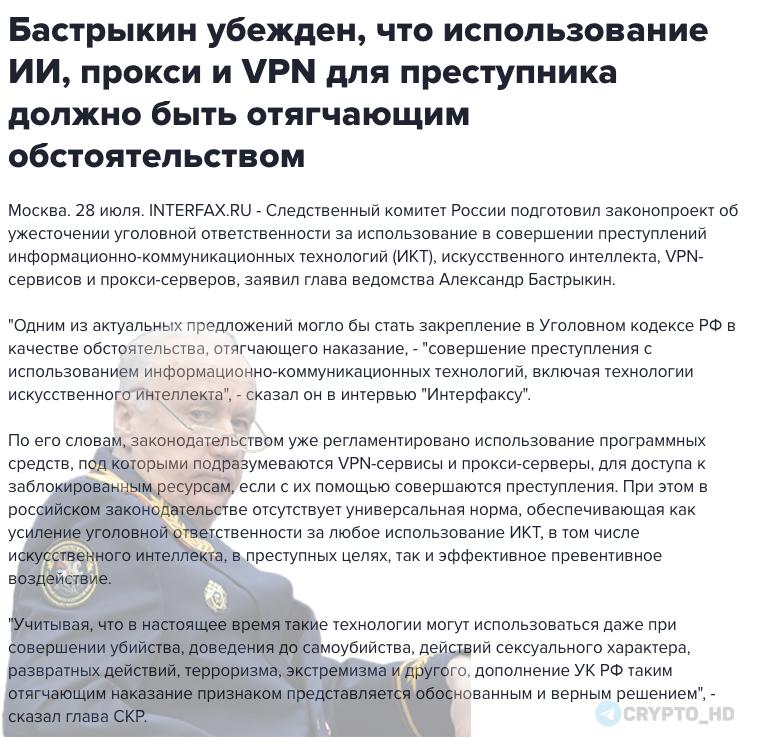
The proposal goes well beyond cybercrime. SK RF wants it to cover “any articles of the Criminal Code” when investigators can connect the technology to the offense or the harm caused. So a defendant might receive a harsher sentence for using a VPN, AI tool, or proxy while committing a crime. The original report jokes, “Now the main thing is not to forget to delete VPN before fingerprints.” Dark? Yes. But it lands because the underlying issue is uncomfortable. Ordinary privacy software could suddenly look far more suspicious in a criminal case. Crypto users should pay attention: the same tools can protect exchange accounts and conceal locations. They can also shield transaction details.
The most immediate concern for the crypto market is the adoption signal. Crypto has long appealed to people seeking pseudonymity or greater control over their financial information. That does not make every privacy-minded user suspicious. Quite the opposite. Someone accessing an exchange over public Wi-Fi may use a VPN simply to protect the connection. Most regulatory arguments blur that distinction. That is only half right. If Russian law starts treating the software as a reason to increase a criminal penalty, even legitimate users may decide crypto is not worth the added exposure. It could be that simple.
That could slow digital asset use in Russia, where government policy on crypto has often pointed in conflicting directions. Still, I would not read too much into the first headline. The draft has not produced an identifiable BTC or ETH price move in the source material. Any effect is more likely to creep in through registrations and trading activity. Demand for privacy products is another indicator, but it would emerge over time—not in one spectacular candle. Why does this matter? Because a quiet adoption decline can be economically meaningful without ever producing a dramatic chart. It is too early to claim a major market impact without changes in those figures. A chilling effect, though, is entirely believable.
The proposal also puts pressure on Bitcoin’s safe-haven argument. Supporters often describe BTC as an alternative when geopolitical tensions rise or confidence in conventional financial channels falls. After the Soleimani strike in January 2020, Bitcoin rose 8% within 72 hours. People still cite that move as evidence that some investors buy BTC during a crisis. I’ll be honest: one 72-hour move does not settle the safe-haven debate. It does, however, explain why the argument persists.
The Russian draft presents a different problem. A crypto asset might remain technically accessible even as the software needed to reach or secure it becomes a legal liability. That distinction is crucial for people living under restrictive governments. If VPN use can add to a criminal penalty, privately accessing an exchange or wallet carries more danger. The proposal does not sanction Bitcoin itself. Counter to the usual framing, that may not be reassuring enough. Pressure on the privacy tools around Bitcoin can make BTC less useful for the people who most need discretion. Is it still a safe haven if reaching it creates a new risk? In practical terms, no.
What this means
The Russian draft is part of a wider government push to monitor online activity. It does not follow that every country will adopt the same approach; that conclusion would outrun the evidence. The striking part is narrower and more concrete: VPN or AI use could count against a defendant under any section of the Criminal Code if prosecutors prove that it assisted the offense or increased the harm. I keep coming back to those words, “any section.” They turn a technology rule into something much broader.
Crypto companies operating in Russia might respond by collecting more customer information or limiting privacy features. Some may block services that create compliance trouble. Users, meanwhile, could shift toward privacy functions built into a protocol rather than a separate VPN. That sounds like a workaround. It isn’t. A feature that is difficult to detect may appeal to users while inviting closer regulatory attention. Yes, that complicates the earlier adoption argument: restriction can suppress mainstream use and push determined users toward less visible tools at the same time. If the draft affects the market, the likelier result is a gradual decline in activity within Russia rather than an abrupt BTC or ETH selloff.
Investors should follow the Russian legislative process instead of treating the proposal as law already. Watch the official statements first. Then read the final enacted text, enforcement guidance, and reactions from exchanges or wallet providers. In my view, Russian registration and trading volume data would reveal more about adoption than another round of vague warnings about regulatory fear. Binance could offer useful regional figures. Coinbase is also worth watching for policy changes, although the platforms differ in both access and reporting. The details will matter.
This story has no scheduled FOMC decision or single market date. Its timing depends on whether the proposal moves forward—and, if it does, how Russian authorities enforce it. Similar bills in other countries would also matter, particularly those aimed at privacy software rather than crypto itself. Users of privacy coins and decentralized applications face a blunt conflict: they want anonymity. Regulators may view the software providing it as evidence of suspicious behavior. My take is that the tension itself is not new; it has been around for years. What changes here is the possible consequence. This draft could make it much more concrete.