















































Trump’s US Economic Boom Claims: What They Mean for Crypto
Donald Trump says the US economy is booming, citing faster business activity and record stock prices. Crypto investors should be cautious about that claim. If the economy is as strong as Trump says, more capital may reach risky assets such as Bitcoin and Ethereum. But that strength could also keep interest rates high, weakening Bitcoin’s appeal as protection against trouble in traditional markets. That cuts both ways. My take: the crypto outlook is messier than the sales pitch suggests.
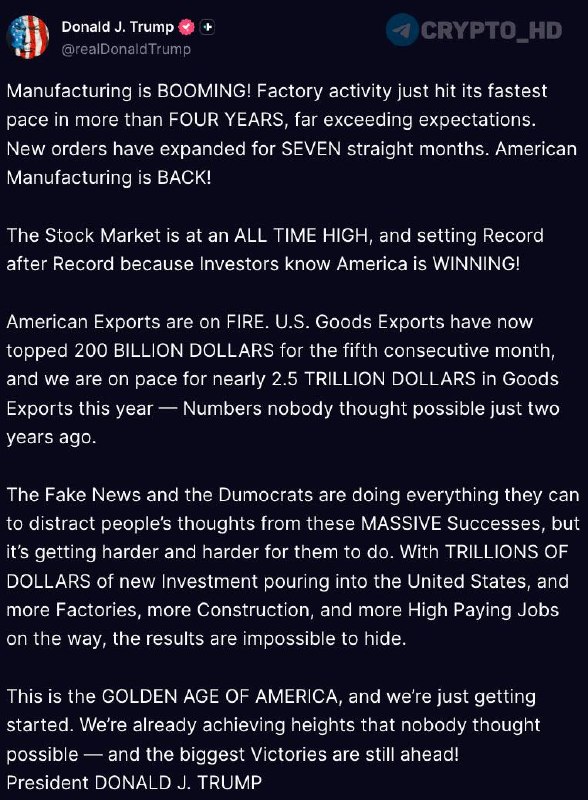
Trump describes an “American industry boom,” with business activity expanding at its fastest pace in more than four years. Growth has beaten expectations, he says, while new orders have risen for seven straight months. The message is blunt: American manufacturing is back. He also points to a stock market at an “historical maximum,” breaking record after record because investors believe “America is winning.”
Then there are exports. US goods exports have topped $200 billion for five months in a row and could approach $2.5 trillion by year end, according to Trump. Two years ago, he called figures like these “impossible.” He also cited trillions of dollars in investment and new factories. Better-paid jobs were part of the pitch too. At the same time, he accused “fake media and Democrats” of trying to distract people from the results. I’ll be honest: that rhetoric makes it even more important to separate the figures from the victory lap. He finished in familiar style, declaring that America has entered a “golden age,” with “the biggest victories” still ahead.
If his description holds up, a strong US economy could both help and hurt crypto. Growth and high employment usually leave households and institutions with more money to invest. Some of that capital reaches risky markets. Something similar happened in late 2020 and 2021: the recovery from COVID, combined with enormous stimulus programs, came as Bitcoin climbed to $69,000 in November 2021. Most bullish arguments stop there. That’s only half right.
If trillions of dollars are pouring into US businesses, investors may remain comfortable taking risks. Ethereum could gain more than Bitcoin in that setting because ETH often moves faster when crypto traders turn bullish. Is that enough to confirm the trade? No. A clear move above resistance near $3,800 would suggest buyers are genuinely ready to take bigger chances.
The catch is interest rates. A strong economy gives the Fed room to keep them high, or raise them again if inflation stays stubborn. Speculative assets tend to suffer under those conditions. Bonds become more appealing. So do savings products, leaving investors with less incentive to gamble on crypto. The 2022 selloff showed how quickly the damage can spread: Bitcoin dropped from more than $45,000 in April to under $20,000 by June while the Fed tightened policy. Counter to the usual boom narrative, strong growth can become an expensive problem for crypto investors.
Trump’s talk of American strength could also weaken Bitcoin’s safe haven pitch, at least temporarily. Bitcoin is often called “digital gold,” an asset people can own when banks or currencies appear unstable. Governments can create the same concern. That argument gained traction during the March 2023 banking crisis, when BTC rose more than 25% in a week. Bitcoin also briefly outperformed traditional assets during the early days of Russia’s invasion of Ukraine in February 2022. I wouldn’t dismiss those episodes, but neither one proves Bitcoin always behaves like a safe haven.
If US stocks keep breaking records and the dollar appears secure, investors may see little reason to move money into a decentralized alternative. Why pay for insurance when nothing seems wrong? Under Trump’s account of the economy, this may be the weakest part of Bitcoin’s case. Simple as that.
Bitcoin’s appeal does not rest entirely on weak economic growth, however. Some buyers hold it as protection against government debt or inflation. Currency debasement is another concern. Others focus on geopolitical shocks that have little connection to US jobs or factory production. Bitcoin gained 8% around the Soleimani strike in January 2020, for instance, even though the US had just released strong employment figures. Yes, that complicates the argument from the previous paragraph. It should. Confidence at home can coexist with anxiety abroad, and markets rarely fit into one neat story.
What this means
If Trump is right, crypto could benefit from abundant capital and confident investors. Higher interest rates may erase much of that advantage. Bitcoin and Ethereum often rise when traders feel comfortable taking risks. Yet a stock market at an “historical maximum” also gives investors less reason to seek shelter outside the conventional financial system. My take: liquidity helps, but the price of that liquidity matters more.
I would watch the Fed first. If solid growth prompts officials to postpone rate cuts or consider more tightening, interest in BTC and ETH could disappear quickly. Is an economic boom automatically bullish for crypto? Not even close. It is neither automatically good nor automatically bad. Inflation’s response will matter, followed by the Fed’s reaction.
Inflation and employment reports will test Trump’s claims more reliably than his speeches. Both releases shape interest rate expectations, which traders can follow with the CME FedWatch Tool. If markets begin pricing in higher rates, crypto will probably come under pressure—particularly if the dollar strengthens too. I keep coming back to that transmission mechanism because it is where upbeat economic headlines can turn into falling crypto prices.
Bitcoin’s price offers another reality check. A sustained break above $70,000 could signal fresh institutional buying despite elevated interest rates. If Bitcoin cannot hold support near $60,000, the message would be far less encouraging. A stronger dollar may be drowning out optimism about US growth. Tighter financial conditions could do the same. Right now, those two price levels tell us more than talk of a “golden age.”