
















































Trump pushes Senate on Crypto Clarity Act, points to China
Donald Trump is pushing the U.S. Senate to pass the Clarity Act, a crypto market bill he is now tying directly to China’s moves in digital finance and AI. He also dedicated the appeal to Senator Lindsey Graham, who, according to the statement, died Sunday night. The politics are not subtle. My take: Trump is trying to drag a dry regulatory fight out of the committee-room fog and turn it into something sharper, namely who gets to control the next version of money.
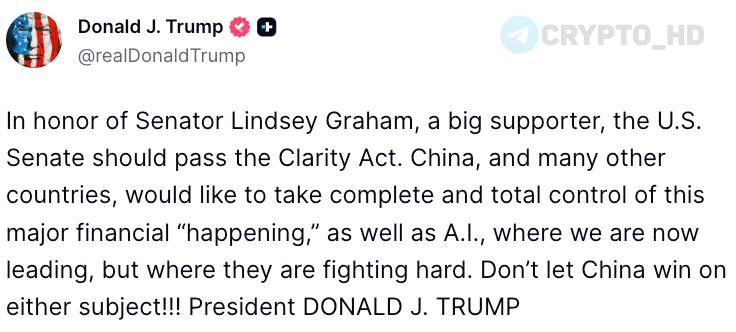
In the statement, Trump urged the Senate to adopt the CLARITY Act and tied the appeal to Graham’s death. He warned that “China and many other countries want to gain total control over this crucial financial direction, as well as over the field of artificial intelligence, where we are currently leading, but where they are fiercely fighting.” Then he added: “Do not let China win in either of these areas!!!” Subtle, it is not. Useful messaging for his base? Probably. Most crypto policy talk gets framed as an SEC turf fight. That is only half right. This frames crypto regulation beside AI, trade, national power, and the China argument, which is a much louder lane.
That part matters. Crypto regulation has spent years stuck between agencies and court cases, with campaign slogans layered on top. The Clarity Act is supposed to give digital assets a clearer rulebook, especially on when a token is a security and when it is a commodity. That distinction affects listings on exchanges such as Coinbase (COIN), staking services, token launches, and the products institutions are willing to touch. I’ll be honest: this is the boring plumbing that decides whether money actually shows up. The market has already shown how much it hates regulatory fog. In early 2023, when the SEC increased pressure on staking services, Ethereum (ETH) fell nearly 5% in one week as traders worried about wider crackdowns. The reverse is true too. Even a hint of clearer rules can lift prices because large investors can model the risk instead of guessing what a regulator might say six months later.
Trump’s China argument gives crypto a different story. Bitcoin (BTC) is usually pitched as a hedge against inflation or banking stress. Sometimes it is pitched as a hedge against government overreach. This version is more nationalistic: the U.S. should back crypto because China might otherwise shape the rails of digital finance. I am not sure the argument holds together cleanly, but politically it has force. Counter to the usual advice, the point here is not whether Bitcoin behaves perfectly as a hedge. It is whether lawmakers start treating it like strategic infrastructure. Geopolitical stress has helped Bitcoin before, at least briefly. In February 2022, during the first shock of Russia’s invasion of Ukraine, BTC moved above $44,000 and gained more than 10% in a week as some investors looked outside traditional markets. This is not the same kind of crisis. Still, talk of a “fierce fight” over AI and finance could make crypto look less like a speculative corner of tech and more like a national asset class.
What this means
Trump’s support for the Clarity Act suggests crypto is getting harder for Washington to treat as a niche market. The debate is moving into national security and China policy. U.S. competitiveness is now part of the pitch too. Why does this matter? Because a bill that sounds like market plumbing can move faster once senators can sell it as a China bill, or at least as a competitiveness bill. Yes, this contradicts the old view that crypto regulation is mostly about investor protection. Bear with me: in Washington, the label often decides the timeline. A clearer framework would probably help larger U.S. platforms such as Coinbase (COIN), since they would know which rules they are operating under. It could also remove one of the bigger overhangs on Bitcoin (BTC) and Ethereum (ETH), especially if institutions read the bill as permission to put more money into digital assets.
Investors should watch for Senate movement on the Clarity Act, or any competing crypto market structure bill, over the next few months. Committee hearings on financial innovation, technology, or market oversight will matter, but I would pay closer attention to senators who can actually move the bill than to the loudest people on cable. For Bitcoin, the $70,000 level is still worth watching. Is that too simple? No, because clean round levels still shape positioning when policy headlines are flying. A clean break above it could point to renewed institutional demand, especially if it comes alongside real progress in Congress. Talk is cheap. A bill with momentum can move crypto for longer.