
















































US PDT Rule Change Could Pull Traders From Crypto Markets
The US PDT rule change takes effect on June 4, 2026. It removes the $25,000 Pattern Day Trader threshold for US retail stock traders. My take: that is not a footnote. It could make crypto a little less attractive as the easier home for small accounts.
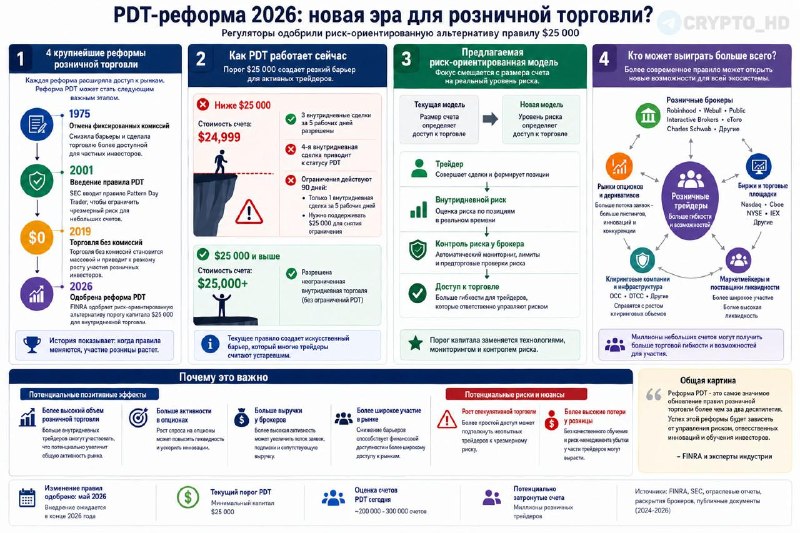
Under the old US rule, a trader who made 4 day trades in 5 business days needed at least $25,000 in a margin account. The source says that hard cutoff is going away. Brokers will use intraday account level risk checks instead. The rule starts on June 4, 2026, although some platforms may keep limits during a transition period that runs until October 20, 2027. Simple enough.
This does not rewrite crypto regulation. Keep that separate from the trading angle. Crypto has benefited from one blunt comparison for years: stock day trading had a $25,000 gate, while BTC and ETH did not. Why does this matter? Because small-account traders often choose the market that lets them act now. If they can trade stocks more easily, some short-term traders may spend less time in BTC, ETH, and crypto-linked stocks like COIN, then drift back toward regular equities when the setup looks cleaner.
The history helps, but only up to a point. In March 2020, BTC fell with other risk assets during the COVID liquidity shock, then recovered later that year. Traders treated it like part of the same risk pile. In November 2021, BTC traded above $69,000 before a long drawdown as liquidity tightened. I’ll be honest: I do not think the June 4, 2026 rule change belongs in that same category. Most market takes will try to make it sound macro-sized. That is only half right. The cleaner lesson is smaller and more practical: when access changes, attention and capital can move with it.
The macro point is not that the Fed changes policy on June 4, 2026. It does not. The point is more mechanical. Small accounts that used BTC or ETH because equities were annoying to trade intraday may now have an easier route into stocks. That may matter most on volatile US sessions, when traders want liquid tickers and tight spreads. They also want a fast-moving story. BTC and ETH still have one major edge: they trade all weekend while Nasdaq is closed.
The regulatory contrast is hard to miss. Crypto traders complain about unclear US oversight all the time, and sometimes they have a point. Equities, at least in this case, get clear dates: June 4, 2026 for the rule to take effect, and October 20, 2027 for the transition deadline. Counter to the usual crypto-bullish framing, clarity can be a product feature. That difference can affect how traders think about crypto venues, ETFs, staking products, and listed crypto names such as COIN. If stock brokers offer more flexible intraday access while crypto platforms keep dealing with legal pressure, some traders may prefer the regulated wrapper.
This is not automatically bearish for BTC or ETH. I would push back on that reading. Crypto still has 24/7 trading, global liquidity, self-custody, token-native leverage, odd market stories, and a culture that stocks usually cannot copy. Is this overkill as a concern? For a 50-page rule memo, maybe. For traders watching where retail volume goes after June 4, 2026, no. A US retail trader may still want BTC on a Sunday night when the stock market is closed. But removing the $25,000 PDT barrier means crypto has to compete more directly for attention. I would not brush that off.
There is no quote in the source, and no broker is named. That matters. Implementation probably will not look the same everywhere on June 4, 2026. Yes, this contradicts the neat “rule change equals instant rotation” version of the story. Bear with me. The source says platforms have until October 20, 2027 to transition, so traders should not assume every brokerage account changes overnight. For crypto investors, this may become slow pressure rather than one dramatic rotation out of BTC or ETH.
What this means
The signal is simple: US retail stock trading is becoming more flexible for smaller accounts, and that removes one practical advantage crypto had over equities. BTC, ETH, and COIN are the tickers to watch because they sit close to retail risk appetite, exchange activity, speculative volume, and the brokerage-versus-crypto venue decision. My read: COIN may be the cleanest equity-side tell, while BTC and ETH show whether crypto-native demand is actually thinning. If intraday stock access improves after June 4, 2026, crypto has to win traders with volatility and liquidity. Easier access will not be enough by itself.
Watch the June 4, 2026 effective date first. Then watch the October 20, 2027 deadline for broker adoption. For confirmation, track BTC and ETH spot volume, COIN trading activity, CME crypto futures positioning, and whether BTC holds major psychological levels during busy US equity sessions. If crypto volume fades while equity day trading picks up, the PDT change will look less like a dry rule update and more like a real rotation signal. We tried to treat it as boring plumbing. It may not stay boring.