















































Bitcoin Long-Term Holder Transfers to Exchanges Hit 2015 Low
Long term Bitcoin holders are sending fewer coins to exchanges than at any time since 2015, according to CryptoQuant data. My take: that points in one direction, even if it does not prove the whole case. Older wallets are not acting like they are desperate to sell. I would not treat it as a price guarantee, because Bitcoin has a gift for making tidy narratives look silly. Still, one obvious source of selling pressure looks quieter than usual.
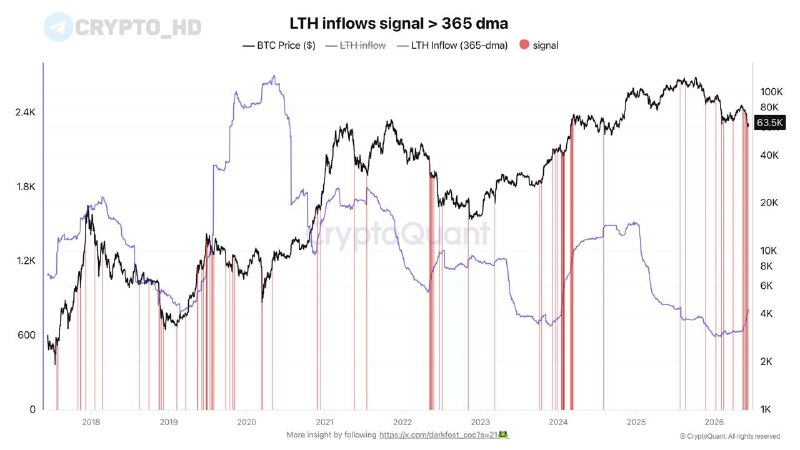
CryptoQuant data shows Bitcoin transfers from long term holders to exchanges at a level last seen in 2015. Not a small wobble. Current flows are back near a period before the 2017 mania, when BTC was still grinding below $300 before its run toward $20,000. Why does this matter? Because exchange transfers are closer to actual sell-side intent than another mood-based chart read. The comparison has limits, though. Every Bitcoin cycle has its own weirdness, and 2015 Bitcoin was not the same market as today’s Bitcoin. Still, the data suggests older holders would rather sit through current prices than cash out.
That lower selling helps Bitcoin’s supply picture. The macro backdrop still matters, maybe more than Bitcoin purists like to admit. The Federal Reserve’s rate path can move risk assets fast, and Bitcoin often reacts sharply to small changes in Fed language. During easier policy periods, BTC has often outperformed traditional assets, with gains of roughly 15% to 20% in the months after dovish Fed signals. Counter to the usual advice, this is not just a holder story. It is a holder story sitting on top of a liquidity story. If older holders keep coins away from exchanges, Bitcoin has a better chance of absorbing some of that macro noise. Less ready-to-sell supply can matter a lot when demand improves.
The same trend also helps Bitcoin’s store of value case, though I’ll be honest: that phrase still gets used too loosely. Gold still owns the safe haven label, and Bitcoin has not earned it cleanly in every crisis. It can still trade like a high beta tech stock when liquidity dries up. But holder flows are worth watching for a reason. If long term holders are not rushing to sell after big rallies, they may be treating BTC less like a quick trade and more like capital they want outside the usual system. That does not make Bitcoin gold. It does make the older cohort look more like gold holders than momentum traders.
What this means
This low in long term holder transfers points to a steadier market mood. Patient wallets are not showing much interest in selling. Some may even be adding. Is this overkill to track? For BTC, no, because exchange supply is one of the cleaner signals traders can measure. If fewer coins are available to sell while demand holds or rises, price can move quickly. Most guides say low exchange supply is bullish. That’s only half right. It becomes much more interesting when demand is also firm. I would not push the signal too far, but this kind of setup has come before stronger runs in the past.
Traders should keep watching long term holder exchange transfers, not just price. I would put them beside institutional inflows, regulation headlines, CME Bitcoin futures open interest, and the next FOMC dates. If these flows stay low while institutional inflows rise or regulation gets clearer, BTC could make another run at major resistance. The $70,000 level is still the obvious line on the chart. A clean move above it, with long term holders still holding back, would be hard to ignore. Yes, this slightly contradicts the caution above. Bear with me. Caution does not mean ignoring a clean supply-demand setup when it appears. The next FOMC dates matter too, since a softer Fed tone could bring more risk appetite back into Bitcoin. CME Bitcoin futures open interest is also worth tracking because it gives a cleaner read on how larger traders are positioned.