
















































Strategy’s Bitcoin Banking Adoption Index: a reality check for institutions
Strategy’s Bitcoin Banking Adoption Index puts a number on Bitcoin (BTC) use inside large financial firms: 32% average adoption across the 25 largest banks and financial companies. Michael Saylor’s Strategy has released its Bitcoin Banking Adoption Index, and the first reading lands harder than the usual bank-crypto headline. The 25 largest banks and financial institutions are only 32% integrated with BTC. That is lower than the hype suggests. My take: this is not a victory lap for Wall Street. For crypto investors, it says two things at once: big finance is still moving slowly, and Bitcoin still has room to run if those firms keep building.
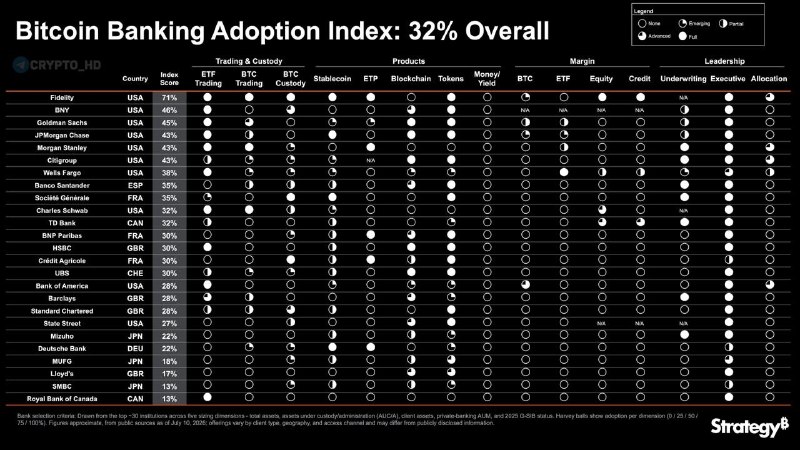
The Strategy Bitcoin Banking Adoption Index looks at BTC activity across trading, custody, Bitcoin ETFs, stablecoins, tokenization, crypto backed lending, financial instrument issuance, and direct investments. Strategy, the company led by Michael Saylor, built the index to measure how far banks and financial firms have gone with Bitcoin across eight activity buckets. It covers trading, custody, Bitcoin ETFs, stablecoins, tokenized assets, crypto backed loans, Bitcoin linked financial products, and direct BTC holdings. Most guides will frame this as another proof point for institutional adoption. That’s only half right. The first numbers are not exactly exciting if you expected Wall Street to flip a switch overnight. The top 25 firms average just 32%. Fidelity is far ahead at 71%. BNY follows at 46%, with Goldman Sachs close behind at 45%. Strategy says it will publish the full methodology later, so for now I would treat the index as a rough map, not gospel.
The 32% average shows that Bitcoin may have the attention of large institutions, but day to day use is still thin. That 32% figure matters because it separates interest from actual plumbing. Why does this matter? Because institutions have talked much more seriously about crypto since US spot Bitcoin ETFs were approved in January 2024, but talk is not custody desks, lending products, risk systems, compliance workflows, trained sales teams, or board-level comfort. Banks move slowly. Sometimes painfully slowly. Regulation, internal risk committees, old infrastructure, and plain old fear of being early all get in the way. I’ll be honest: this is the boring part of adoption, but it is also the part that decides whether flows become durable. Retail traders and crypto native firms have carried plenty of the market action, while the biggest pools of institutional capital still look partly blocked off. For traders, that points to uneven inflows rather than one clean wave. BTC has spent time around the $60,000 to $70,000 range in the period this discussion is looking at, and the index helps explain why demand can exist while the machinery to absorb it is still half built.
The index is useful, but it is also sobering. It shows who is moving and who is barely in the game. Fidelity’s 71% score makes sense. The firm has worked on digital assets for years, including custody and trading. BNY and Goldman Sachs, at 46% and 45%, look more cautious, though still serious compared with most of the group. Here is the uncomfortable bit: these are the leaders, while the average sits at 32%. A lot of large institutions have barely started. I do not read that as automatically bearish. Counter to the usual advice, slow bank adoption is not always a negative signal. It may simply mean the market has been pricing in a future that the banks have not built yet. If more firms move from pilots and internal teams into real BTC services, demand should deepen. Slowly, probably. This is bank adoption, after all. Nobody should expect it to look like a meme coin chart.
What this means
The Strategy Bitcoin Banking Adoption Index says institutional interest in Bitcoin is real, but traditional finance is still early in the integration process. The 32% average across the top 25 institutions suggests the famous “institutional wall of money” is not fully in the market yet. Some of it is waiting. Some of it is stuck behind policy, product approval, or operational work that nobody on crypto Twitter wants to hear about. Is that overkill as an explanation? No, because banks do not launch Bitcoin services just because price action looks good for three months. With BTC’s market cap hovering around $1.3 trillion in the text’s frame of reference, there is still room for growth if these institutions keep adding services. For investors, the message is less “instant upside” and more “watch the buildout.” Fidelity’s lead also matters. Firms with fuller crypto offerings may attract institutional clients before slower banks catch up.
The next things to watch are Strategy’s methodology, crypto revenue in bank earnings calls, and regulatory moves from agencies such as the SEC. Strategy’s full methodology should show where the weak spots are. Is custody lagging? Lending? Direct exposure? That detail matters. Earnings calls are another place to listen closely. If major banks start talking about more crypto revenue, larger digital asset teams, or new BTC related services, that would be harder to dismiss than a press release. Yes, this slightly contradicts the cautious tone above; bear with me. A sharp rise in the next version of this index, or in similar reports, would point to faster adoption. Regulation is the other big lever. Clearer SEC rules for new crypto products could give traditional firms more room to offer BTC exposure without feeling like they are walking into a legal trap. Watch the plumbing.
FAQ
Q: What is the Strategy Bitcoin Banking Adoption Index?
A: Strategy says the index measures how much the 25 largest banks and financial institutions have built Bitcoin (BTC) into their operations. It looks at services such as trading, custody, and investments.
Q: What is the current average adoption rate reported by the index?
A: The index reports a 32% average adoption rate across the top 25 financial institutions. In plain English, integration is still early.
Q: Which institution leads the index in Bitcoin adoption?
A: Fidelity leads with a 71% adoption score. BNY follows at 46%, and Goldman Sachs is at 45%.
Q: Why is the adoption rate relatively low?
A: Traditional finance moves slowly. Banks also have regulatory limits, internal risk rules, and operational work to finish before Bitcoin becomes part of normal service lines.
Q: What does this index imply for Bitcoin’s future growth?
A: It suggests that a lot of potential institutional demand has not fully arrived yet. If banks keep adding Bitcoin services, that could support longer term growth, though probably in stages rather than all at once.