
















































MicroStrategy Stock Hits February Low: Is the BTC Buy Thesis Cracking?
MicroStrategy (MSTR) stock just fell to its lowest level since February 2024. That matters because MSTR is not really valued like a regular software company anymore. For Bitcoin traders who want brokerage-account exposure to BTC, it has become one of the cleaner stock-market shortcuts. When it drops hard, people notice. I would too.
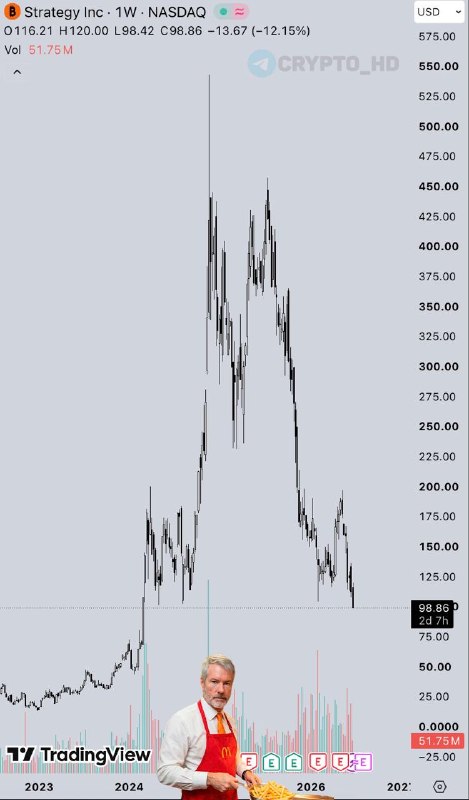
The timing is rough. Some investors have been urging the company to slow its Bitcoin purchases, or at least stop putting so much weight on one trade. Fair concern. MicroStrategy holds a large amount of BTC on its balance sheet, and for years the stock benefited from the belief that this bet was bold and early. My take: the market is no longer paying the same premium for bold.
That is the uncomfortable part. MSTR has carried more meaning for Bitcoin than one stock probably should. When a public company makes BTC accumulation its main identity, its stock stops being just a stock. It becomes a live sentiment read. Why does this matter? Because a weak MSTR chart makes traders ask whether the corporate treasury story still works, or whether it was mostly a bull market idea with cleaner branding.
One bad stretch in MSTR does not prove the Bitcoin thesis is broken. Too neat. Most guides frame this as a simple “Bitcoin proxy sells off, BTC gets nervous” setup. That is only half right. The sharper issue is whether companies will keep buying BTC in every market, and whether those balance sheet purchases can keep supporting price when shareholders get tired. Markets lose patience. They also get nervous. If MSTR keeps sliding, other boards may look at the volatility and decide they do not want to explain a Bitcoin drawdown on an earnings call.
The macro backdrop matters too, even if it is less fun to talk about. Higher rates make long-duration risk harder to hold. Sticky inflation keeps policy anxiety alive. Shaky equity flows do the rest. MSTR sits in a messy overlap: growth stock, Bitcoin proxy, financing story, sentiment trade. When money leaves high beta names, MSTR can take the hit twice, first as an equity and then again as a BTC-linked vehicle.
Bitcoin has not always acted like the inflation hedge its supporters wanted. I know that annoys the faithful, but the tape has said it more than once. Sometimes it trades more like a tech stock with a louder crowd around it. So if MSTR is selling off because investors think the company owns too much BTC, the broader crypto market may get more cautious. The $60,000 area matters here. If BTC loses that level while MSTR stays weak, traders may start reading the stock’s decline as another sign that institutional demand is cooling.
What this means
MicroStrategy’s latest drop suggests investors are getting less patient with the corporate Bitcoin treasury trade.
The old “buy the dip” logic is still there, but it is under pressure. Counter to the usual advice, the issue is not just whether MSTR bought too much Bitcoin. It is whether the stock market still wants to reward that choice. If a company keeps adding BTC and its own stock suffers, the trade starts looking less clean. Is this overkill to watch this closely? For a name tied this tightly to BTC sentiment, no. Traders should watch whether MSTR’s weakness stays contained or spills into the wider Bitcoin story. A longer slide could make other corporate adoption headlines feel thinner. In the short term, BTC’s $60,000 to $62,000 range is the first area to watch. If buyers do not defend it, selling could speed up fast.
The next MicroStrategy earnings call matters more than usual. Listen to how management talks about Bitcoin purchases and financing costs. Listen harder for shareholder pressure. Also watch whether other public companies still sound interested in BTC, or whether they stop talking. I’ll be honest: silence from copycat treasury buyers would say almost as much as a formal pullback. A sharp MSTR rebound would calm some nerves. More weakness would make the corporate adoption story harder to sell.
For BTC, $58,000 is the cleaner danger line. A break below that level would not automatically ruin the trend, but it would make this feel less like noise and more like a deeper reset. Yes, that slightly contradicts the “one stock does not prove the thesis” point above. Bear with me. MSTR is not Bitcoin, but it is one of the market’s loudest corporate BTC signals. If the market starts treating MSTR’s decline as a warning about corporate crypto strategies, Bitcoin may have to stand on its own for a while.