















































Google Phishing Scam Warning Puts Crypto Account Security Back on Tape
As of May 18, 2026, the Google phishing warning is not just another ugly email story. Jameson Lopp said he ran into the scheme himself: attackers use a real Google account recovery request form, then place a fake link near the top of the email. The legitimate Google content sits much farther down, after several pages of blank space. Nasty trick. My take: for BTC and ETH holders, Gmail is often the first domino, not some boring side account.
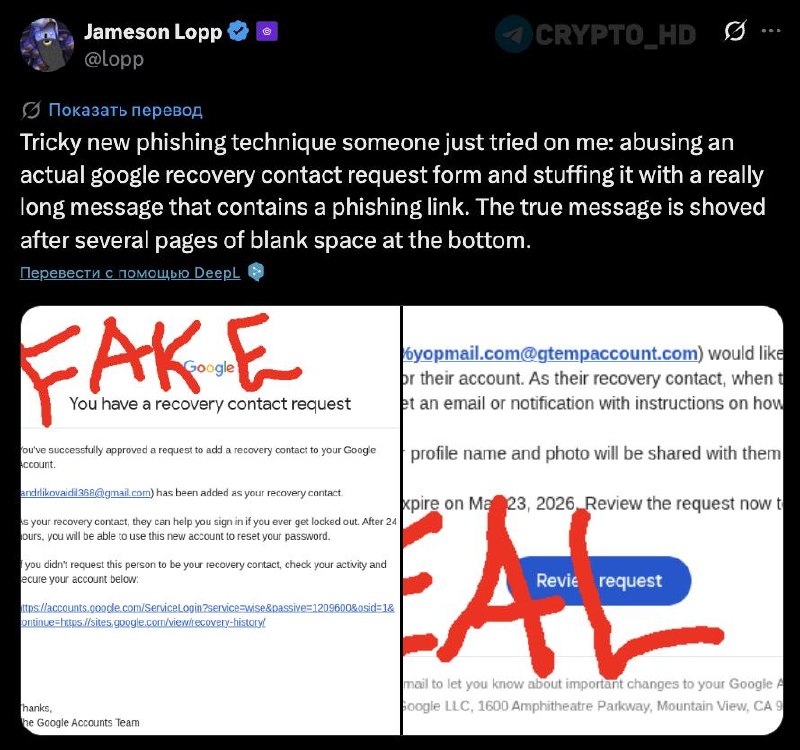
The setup Lopp described, and he is the founder of Casa, turns Google’s own account recovery flow against the user. The trick is almost irritatingly simple. The victim sees the attacker’s message first, clicks the fake link, and never reaches the real Google content buried at the bottom. It targets five account layers crypto users commonly connect: Gmail, centralized exchanges, password vaults, wallet recovery paths, and 2FA apps. That is the whole problem.
Crypto adoption has made personal security part of the market’s basic plumbing. After the Jan. 10, 2024 spot BTC ETF approvals, more capital treated BTC like a mainstream asset. But the individual investor still leans on fragile Web2 accounts. A fake Google link does not need to break Bitcoin. It only needs to break the Gmail account tied to one BTC exchange login, one ETH wallet alert, or one password manager reset. Why does this matter? Because the attacker does not have to beat cryptography if account recovery does the work for them.
That is the uncomfortable part in 2026. More people hold BTC, ETH, and stablecoins, but plenty of them still sit behind ordinary email accounts instead of professional custody systems. Casa matters here because its business is Bitcoin custody, and Lopp’s warning lands right where self custody meets human error. The protocol may be hard. The inbox is soft. I’ll be honest: that sentence sounds too neat, but it is also the practical reality for a lot of retail holders.
Regulators will pay attention to this kind of thing, even without a fresh SEC headline today. Most security advice says users just need to spot suspicious links. That is only half right. If phishing campaigns can reach Gmail, exchanges, password managers, wallets, and 2FA authenticators through a real Google recovery workflow, crypto platforms will get more questions about withdrawals and device changes. Account recovery, too. That pressure usually turns into unglamorous controls: withdrawal delays, address whitelisting, passkey support, fraud monitoring, and tighter checks on BTC, ETH, and exchange linked accounts.
The timing matters too. In November 2022, FTX’s collapse made counterparty risk impossible to ignore. In 2024, ETF approvals pulled BTC further into regulated brokerage channels. This Google recovery form scam sits between those two dates. It is not about exchange insolvency. It is not about ETF flows. It is about identity control, which can decide whether a trader can protect a BTC position when markets get messy. Different threat, same outcome.
There is a safe haven angle, though I would not push it too far. BTC supporters often compare it with gold during geopolitical stress. Traders still point to the Jan. 2020 Soleimani strike window, when BTC gained about 8%. Counter to the usual pitch, though, a safe haven asset does not help much if the owner’s recovery chain can be socially engineered. In practice, BTC’s safe haven story depends on dull habits people actually maintain: secure email and separate 2FA. Then withdrawal controls. Then hardware custody.
Macro timing adds pressure. The next FOMC decision is scheduled for June 17, 2026, and crypto traders will watch BTC and ETH around that date like high beta liquidity gauges. If risk assets rally on easier rate expectations, retail activity usually returns to exchanges and wallet apps. That is when phishing tends to bite. More attention. More logins. Faster clicks. Is this overkill for one phishing warning? No, because the worst clicks usually happen during the busiest market weeks.
The source post says Google was not hacked. Attackers used a real Google recovery request form and abused the message field that gets added to the email sent to the user. That distinction matters for traders. This is not a protocol exploit. It is not a wallet code failure. It is a workflow attack built around trust, formatting, and impatience. We tried to separate those categories cleanly here because mixing them up leads to the wrong fix.
For active crypto investors in 2026, the market link is blunt. A compromised Gmail account can unlock exchange resets, expose password manager recovery steps, intercept wallet service alerts, or help attackers push through 2FA flows. BTC and ETH can move 5% to 10% in a week during macro stress, but one bad click can turn market risk into total account loss. This warning belongs on a trading desk, not only in a cybersecurity channel. My take: treat account recovery like part of position sizing.
What this means
Crypto’s next security bottleneck may still be identity, not blockchain settlement. BTC does not need to fail for a BTC holder to lose funds. Gmail, a password manager, a crypto exchange login, or a 2FA authenticator can be enough. Yes, this sounds less exciting than talking about ETF flows or FOMC positioning. Bear with me. The risk reaches BTC self custody users, ETH DeFi wallets, and exchange linked accounts for anyone trading spot or derivatives in 2026.
Traders should watch the June 17, 2026 FOMC decision for BTC and ETH volatility. They should also watch how exchanges respond to warnings like this. On the technical side, a BTC break of a major round number like $100,000 or an ETH retest of a major round number like $3,000 should be a reason to slow account actions down. Fast markets make people careless. Phishing depends on that. Slow the click.