















































Tether Unblocks $79m in USDT Addresses, Putting Stablecoin Control Back in Focus
BlockSec says Tether removed 497 wallets from its blacklist in the past 24 hours, freeing about $79 million in USDT. By crypto standards, that is not a monster number. Still, I would not wave it away. It is large enough for traders to stop, open the address list, and check where the coins go next.
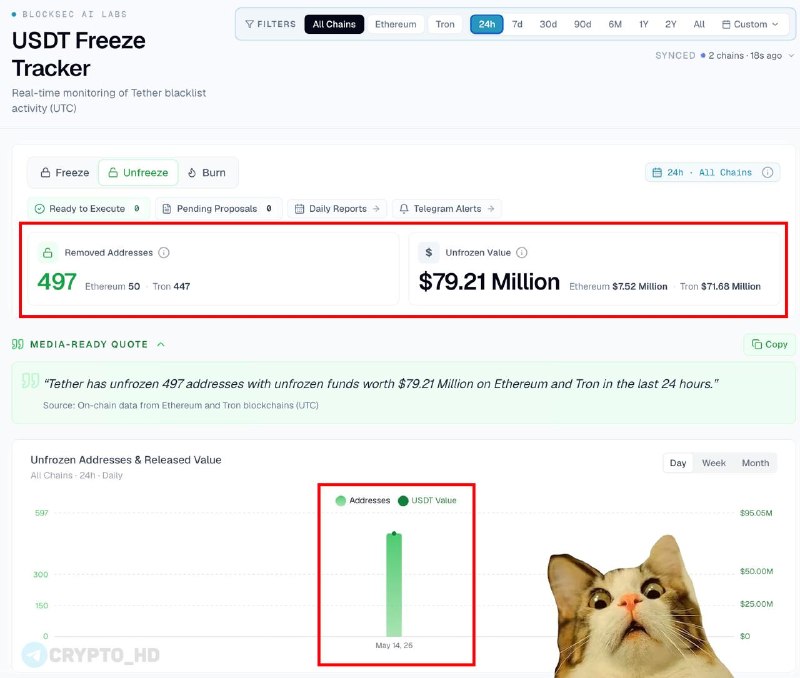
BlockSec reported that the unblocked USDT addresses held roughly $79 million after Tether took 497 wallets off its blacklist. Frozen USDT is not just a line on a block explorer. It might be collateral. It might be an exchange balance. It might be the cash side of a trade someone thought was dead yesterday.
The move reportedly includes 50 addresses on Ethereum and 447 on TRON. Together, they hold about $79 million in USDT. Tether has not publicly explained the change, so traders are reading the chain first. Why does this matter? Because in crypto, wallet activity usually moves before the statement does.
The basic issue is simple: USDT sits inside the market’s plumbing. When Tether freezes addresses, traders read it as a compliance signal. When it unfreezes 497 wallets in a day, they read it as a liquidity signal, then a risk signal. Most guides treat blacklist changes as boring issuer maintenance. That is only half right. No, $79 million will not move the whole crypto market on its own. But desks watching TRON settlement and OTC flows will care. Exchange USDT balances too.
There is a regulatory angle too, and honestly, this is where the story gets less tidy. Tether keeps coming up in arguments over sanctions, law enforcement requests, and exchange liquidity. This 24-hour unblocking gives traders one more moving part to track. For BTC and ETH desks, the question is not whether 50 Ethereum addresses or 447 TRON addresses can move the market alone. They probably cannot. The question is whether a stablecoin issuer can quietly change usable liquidity this quickly. That does affect market structure for BTC, ETH, and exchange tokens tied to spot trading.
For context, this is not a claim about today’s price action. Skip that shortcut. Regulatory shocks have hit crypto venues hard before: COIN dropped after the SEC sued Coinbase on June 6, 2023, and BTC and ETH traders treated the case as a warning about U.S. exchange risk. That is why Tether blacklist changes matter beyond the wallets involved. Stablecoin policy can affect exchange policy. Exchange policy can affect liquidity. Liquidity can move price. The chain gets blunt fast.
The other way to read this is through crypto-native money flow. Stablecoins are the cash leg of many trades. When traders move from cash into BTC or ETH, they often use USDT pairs, especially outside U.S. banking hours. A reported $79 million thaw does not mean buyers are about to rush in. My take: it mostly changes the pool of transferable stablecoin balances, not the directional trade by itself. The TRON count is the part that jumps out: 447 of the 497 addresses were on TRON, which points more toward cheap USDT transfers than Ethereum DeFi activity.
History helps, then it starts lying. During the U.S. banking stress in March 2023, BTC moved from about $20,000 to more than $28,000 within weeks as traders rethought bank risk, stablecoin risk, and crypto settlement. This is a different event. Yes, that sounds like I am pulling back from the comparison after making it, and I am. Still, that period showed how quickly “cash rails” can become a BTC trade when confidence shifts. If stablecoin liquidity starts looking more mobile, BTC is usually the first market people check. ETH tends to matter more when Ethereum addresses or DeFi venues are involved.
TRON is the obvious standout. BlockSec’s numbers show 447 TRON addresses and 50 Ethereum addresses, which looks more like payments and transfers than smart contract activity. Is that bullish? Not by default. I would be careful with that read. It does make the event relevant for anyone watching USDT velocity, exchange deposits, and liquidity split across chains. A TRON-heavy thaw can matter even if ETH DeFi barely reacts in the first few hours.
There is an adoption story inside the compliance story. Stablecoins became crypto’s most used product because they settle quickly and trade globally. They also spare traders from BTC and ETH volatility. Counter to the usual crypto-native framing, that convenience is not the same thing as neutrality. Freezes and unfreezes are a reminder that USDT is not permissionless money like Bitcoin. It is a centralized dollar token with issuer controls. That tradeoff is why institutions handle it carefully, and why on-chain traders watch Tether so closely.
The source material does not include comments from Tether, BlockSec, exchanges, or the wallet owners, so there are no direct quotes to use. I’ll be honest: that silence is part of the story, not just a reporting gap. In a market that prices risk second by second, an unexplained change involving 497 wallets pushes traders toward wallet tracking instead of official statements.
What this means
This event shows that stablecoin control remains a real market risk, even when the action looks administrative. For USDT, the affected ticker is the dollar leg used across BTC and ETH markets. The reported scale is about $79 million in unfrozen USDT, with 497 wallets removed from Tether’s blacklist in the past 24 hours. If those funds move toward exchanges, traders will watch BTC spot pairs first. ETH liquidity pools come next.
The next window is 24 to 72 hours. Traders should watch movement from the 50 Ethereum addresses and 447 TRON addresses, especially transfers into major exchange wallets or DeFi venues. CME BTC futures positioning into the next weekly close also matters, because derivatives traders often move before spot dashboards show the whole picture. The levels to watch are straightforward: BTC near the closest high-liquidity round number, and ETH around USDT-paired spot volume. Until Tether explains the move, the wallet activity is the message.