
















































Transit Finance Hack Puts DeFi Risk Back on Crypto Traders’ Screen
Transit Finance was reportedly hit for $1,880,000, according to PeckShield. Against the bridge disasters of 2022, that is not exactly an extinction event. Still, traders notice. My take: in 2026, DeFi security risk is still sitting right beside ETH, BTC, and the smaller protocol tokens that get dumped when confidence thins out.
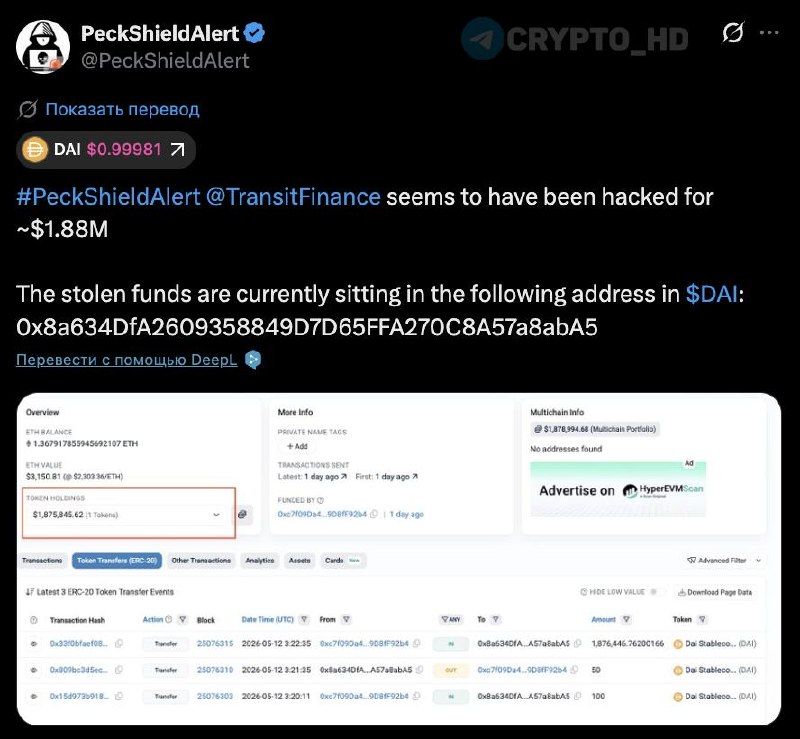
The confirmed part is narrow. Very narrow. PeckShield said Transit Finance, a DeFi protocol, was hacked for $1,880,000. That is all. No wallet trail yet. No named attacker. No recovery plan, token move, country update, or law enforcement angle. I’ll be honest: anything beyond that is analysis, not evidence. Early DeFi reports often outrun the forensic work by hours, sometimes days.
Most guides treat hacks as protocol-specific events. That’s only half right. Hacks do not stay neatly boxed in traders’ heads; they bleed into the regulation trade too. Outside the Transit Finance post, the SEC sued Coinbase on June 6, 2023, and COIN fell about 12% that day. BTC and ETH traders quickly started pricing U.S. exchange risk and staking risk. Why does this matter? Because even a smaller Transit Finance loss lands in the same mental folder: smart contract risk, custody risk, user-loss risk, and the ugly question of who pays when funds disappear.
ETH can absorb more of that pressure than BTC, but it also catches more of the blame. A lot of DeFi still runs through Ethereum-linked liquidity, wallets, bridges, stablecoin infrastructure, and the apps that depend on all four. Counter to the usual advice, this is not just a “watch the hacked token” setup. Each protocol exploit gives skeptics another reason to choose spot BTC exposure instead of on-chain finance. ETH fell more than 20% during the June 2022 liquidity crisis around Celsius and Three Arrows Capital, while BTC broke below $20,000 on June 18, 2022. This is only $1,880,000. Small headline. Familiar trade.
The other piece is macro flow. When liquidity is loose, crypto can shrug off a protocol loss because BTC and ETH beta dominate the tape. When conditions are tighter, the same hack becomes a clean excuse to cut risk. On March 16, 2022, the Fed began its rate hiking cycle with a 25 basis point increase, and risk assets spent much of that year repricing leverage. So yes, this partly contradicts the “small headline” point above. Bear with me. Size matters, but timing often matters more.
BTC usually handles this kind of news better than long tail DeFi names. That is not complicated. BTC is not a DeFi protocol, does not rely on Transit Finance, and often becomes the cleaner crypto macro trade when investors want exposure without smart contract baggage. ETH is different. DeFi activity, gas demand, wallet behavior, liquidity depth, and stablecoin routing are still part of the ETH story. Is this overkill for a $1,880,000 hack? For BTC, probably. For ETH-linked beta, no.
One guardrail matters here: the source does not show a systemic event. It gives Transit Finance, PeckShield, and $1,880,000. There is no reported contagion, named exchange exposure, BTC price move, ETH price move, or recovery percentage in the post. I would keep the bigger market read on a short leash until Transit Finance or security researchers publish more. Skip the victory lap.
What this means
The read is simple: DeFi’s security premium is still here in 2026. The protocol is Transit Finance. The reported loss is $1,880,000. The market question is whether ETH-linked DeFi risk becomes a discount again while BTC keeps the cleaner institutional story. My view: ETH/BTC is the cleaner tell after this headline. If it weakens, traders are treating the exploit as another reason to favor BTC over DeFi beta.
Next, watch for a Transit Finance post-mortem, any PeckShield wallet tracking update, and whether the $1,880,000 figure changes. For levels, BTC traders will likely care about the big round number supports. ETH traders should watch the prior weekly low. Macro desks will also keep an eye on the next FOMC decision date. What would change the read? A wider CME BTC futures basis stress after the hack headline would suggest the market is treating this as more than one protocol’s bad day.