
















































US corporate earnings season starts, and crypto may get choppy
US corporate earnings season began on July 14. Crypto investors should expect more volatility as reports from NVIDIA, Microsoft, big banks, and other market-setters start landing.
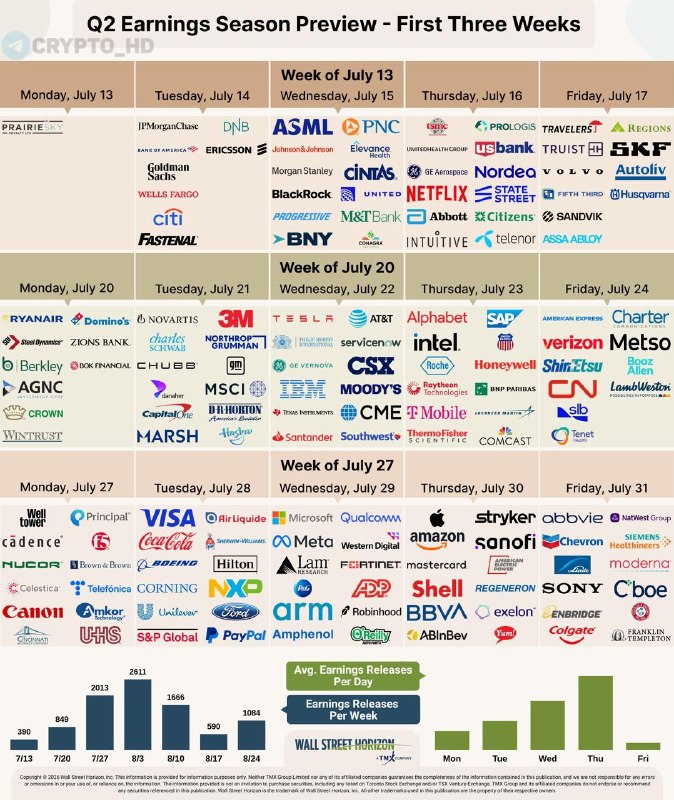
Why does this matter? Because earnings season can reset how investors price risk in a hurry. Strong earnings can lift stocks, and crypto often follows. Weak reports can drag both lower. That is the US corporate earnings season crypto impact without the market speak. Simple enough.
This season opens with cautious optimism. I would not call it clean optimism. My take: the headline numbers look strong, but the details will decide whether traders believe them for more than one or two sessions. FactSet projects +23.6% year over year earnings growth for S&P 500 companies, with revenue up +12.3%. Tech is doing most of the work, especially AI and semiconductors. No shock there. AI is still the market’s favorite story.
Goldman Sachs is close to that view, with roughly +22% S&P 500 earnings growth. The more useful detail is underneath: the median company is expected to grow earnings by only +9%. In plain English, a small group of large companies is carrying the index. Most guides say strong index earnings are automatically bullish. That’s only half right. Goldman also says AI infrastructure companies could account for about half of profit growth by 2026. They expect that growth to reach energy, industrials, defense, and infrastructure later. If that happens, the market may feel less dependent on five or six mega cap tech names. Crypto would probably welcome that. A broader equity rally usually gives investors more room to buy Bitcoin and Ethereum. Other high beta assets come later.
JPMorgan makes a similar point about tech and AI spending, but adds more caution. They point to geopolitical tension and weaker consumer demand as risks. Fair. Those are not tiny footnotes. JPMorgan also says investors are watching margins and capital spending more closely than simple revenue beats. Guidance may matter even more. That matters for crypto because the market may not reward every good headline. A company can beat on revenue and still sell off if margins are soft or management sounds nervous. For crypto, that suggests a pickier tape. Less “everything goes up.” More sharp moves around specific sectors, capex plans, and guidance.
Bank of America also expects +22% year over year S&P 500 earnings growth, helped by big tech AI spending, energy growth, and upbeat company outlooks. UBS is even more bullish. It raised its 2026 S&P 500 EPS forecast to $335, up 20% year over year, and lifted its index target to 7900. Deutsche Bank expects results to beat consensus, with about +29% year over year earnings growth versus the market’s roughly 26% expectation.
That is a lot of optimism from the big banks. It does not guarantee much. I’ll be honest: this is where crypto traders sometimes get too cute. When stocks are strong, institutions tend to get more comfortable moving further out on the risk curve. Bitcoin and Ethereum often benefit from that mood. BTC has sometimes traded like a leveraged read on market sentiment during strong equity periods, moving 2x or 3x the S&P 500’s reaction on good news. Nice when it works. Painful when it flips.
The point is simple: this earnings season is not just about the S&P 500. It is about where money goes across risk assets, including crypto. When corporate profits look healthy, especially at the tech giants that set the tone for the market, investors usually feel safer taking risk. If NVIDIA, Microsoft, or other AI-heavy names post blowout numbers, the tech rally could keep running. Crypto often gets some of that spillover.
Ethereum may be especially sensitive because ETH is tied to DeFi, Web3 infrastructure, and the broader technology trade. If earnings keep the risk mood alive, ETH could push through resistance around $3,500 and make a run toward $4,000. Is this a prediction carved in stone? No. It is the kind of setup traders will watch if institutional money starts looking for more upside. On the other side, big misses or cautious guidance from major tech names could send investors back toward safety. In that case, Bitcoin could test support around $60,000 as traders cut risk across the board.
The AI infrastructure theme also matters for crypto beyond short term price action. Goldman Sachs expects AI-related companies to drive a large share of profit growth by 2026. That gives crypto projects with real AI use cases a chance to get more attention. Some blockchain teams are using AI for smart contract optimization and decentralized applications. Data markets are another angle. Counter to the usual advice, I would not buy the theme first and ask questions later. Some of it is useful. Some of it is just a pitch deck in a fresh outfit. Investors will need to sort one from the other.
If public markets keep rewarding AI growth, crypto projects tied to AI may attract more capital. Yes, this sounds like it contradicts the warning above. Bear with me. That does not mean every AI token deserves a bid. It means the market may look harder at projects that connect blockchain and AI in ways that create actual demand. MicroStrategy could also benefit indirectly if strong tech performance supports its stock while it continues to hold a large Bitcoin position. More broadly, companies tend to experiment with new technology when cash flows are healthy and executives feel confident. If this earnings season lands well, that could mean more blockchain pilots, treasury discussions, infrastructure tests, or none of the above if CFOs get nervous.
What this means
This earnings season is a real test for risk assets. Tech and AI estimates are strong, which leaves room for more demand in growth trades, including crypto. My bias: watch the reaction, not just the beat.
If companies meet or beat expectations, Bitcoin and Ethereum could benefit as institutional capital looks for higher returns. If earnings disappoint, especially on margins or guidance, the market could turn fast. BTC could retest $60,000. ETH could slip below $3,000. Crypto rarely needs much encouragement to move hard either way.
Crypto investors should watch the big tech reports closely, especially companies spending heavily on AI. What should matter most? Not the victory-lap EPS headline. I would pay more attention to margins, capital expenditures, and what management says about the next two quarters. Guidance will probably matter more than victory laps.
The next date to watch is the Federal Reserve’s FOMC meeting on July 31. That should give the market another read on interest rate policy. Also watch CME Bitcoin futures open interest and funding rates. If those shift hard, it may show whether institutions are leaning into BTC exposure or backing away before the next move.