
















































AscendEX exchange closure: insolvency risk signals regulatory squeeze
AscendEX stopped operating on July 1, 2024, citing regulatory pressure and money problems. Clients were told on July 6, 2024. Five days is not a footnote when your funds are inside the venue. My take: that gap is the story almost as much as the closure itself. The shutdown exposes a blunt crypto risk: when an exchange is undercapitalized or serving customers without the right authorization, users may not learn how bad things are until withdrawals slow, stop, or turn into a support-ticket ritual.
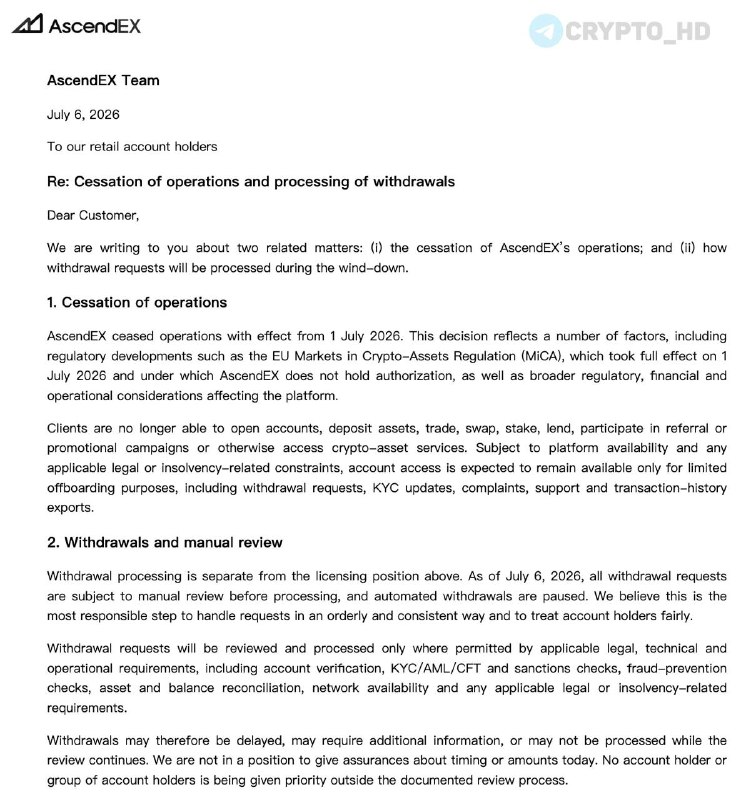
The warning signs showed up before the shutdown notice. Users had already reported frozen withdrawals and liquidity concerns. ZachXBT had flagged those complaints, including worries about weak reserves for major assets. AscendEX has since confirmed that all transactions stopped on July 1. Accounts remain open only for withdrawals, KYC, support, and transaction history downloads. Automatic withdrawals are off. Each request now needs manual review. AscendEX says delays may happen and gives no processing timeline. That part matters. If I still had money there, that would be the detail keeping me up.
AscendEX blamed EU regulatory pressure, especially MiCA, its lack of EU authorization, and its own financial and operational problems. Most shutdown writeups frame this as a compliance issue. That’s only half right. This is also a balance-sheet problem, or at least AscendEX has invited that reading by mentioning the risk of an “insolvency-procedure.” In practice, that sounds uncomfortably close to bankruptcy. If it happens, user claims may go through lawyers and administrators instead of normal withdrawals. Crypto users have seen that story before. It drags. Larger exchanges have felt similar pressure too: according to Bloomberg, Binance.US trading volume fell by more than 90% in 2023 as SEC and CFTC scrutiny increased. MiCA in Europe and US enforcement are different regimes, yes. But for exchanges that cannot meet the rules, the destination can look similar: fewer services, frozen assets, closure, or some ugly blend of all three.
The AscendEX closure is mainly a custody lesson, not a price story. Bitcoin can rise during geopolitical stress or market fear. It gained 8% during the January 2020 Soleimani strike, for example. Exchange failure is different. Why does this matter? Because BTC acting like a safe haven does not help much if your coins are trapped in a manual withdrawal queue. I’ll be honest: this is where the “just watch the chart” crowd loses me. BTC can trade above $61.4K and still be useless to someone who cannot move it. AscendEX’s manual reviews, suspended automatic withdrawals, and missing timeline are not admin clutter. They are custody risk in plain view.
What this means
The AscendEX closure suggests the easy years for loosely regulated crypto exchanges are ending. Regulators are giving exchanges less room to operate without licenses, controls, and visible financial discipline. Counter to the usual advice, this is not solved by glancing at a homepage badge or a vague “regulated” claim. Users need to check where an exchange is authorized, what it publishes about reserves, and how withdrawals behave before stress hits. Funds on an exchange are convenient. They are not the same as funds in your own wallet. If more users decide that tradeoff is not worth it, money may keep moving away from smaller exchanges and toward larger venues with cleaner compliance records. Smaller altcoins could feel it first because many rely on thin exchange listings for liquidity.
Over the next few months, investors should watch MiCA implementation, US enforcement actions, and exchange reserve disclosures. Proof of reserves reports can help when they exist, but they are not magic. Yes, this slightly cuts against the previous paragraph’s push for transparency; bear with me. They do not always show liabilities clearly, and they do not prove a platform can survive a rush of withdrawals. Is this overkill for users who only trade occasionally? For a small balance, maybe. For anyone leaving meaningful assets on a centralized exchange, no. More closure notices or insolvency warnings could hurt confidence in centralized exchanges and trigger short term selling in assets such as Ethereum. For Bitcoin, $60,000 is the obvious level many traders will watch. A clean break below it could feed the view that confidence is slipping. The July 31 FOMC meeting matters too. If the Fed sounds hawkish, risk assets could come under more pressure, and exchange failures may hit harder than they would in a calmer market.
FAQ: AscendEX exchange closure and insolvency risk
Q1: What is the main reason for AscendEX’s closure?
A1: AscendEX blamed EU regulatory pressure tied to MiCA, its lack of authorization in the European Union, and financial and operational problems.
Q2: Can users still access their funds on AscendEX?
A2: Users can still access accounts for withdrawals, KYC, support, and transaction history downloads. Automatic withdrawals are suspended, and each request needs manual review. AscendEX has not guaranteed processing times. We tried to read that generously; it still reads like a warning.
Q3: What does “insolvency-procedure” mean for AscendEX users?
A3: It means user claims could be handled through a legal process instead of normal exchange withdrawals. In plain English, it signals serious financial distress.
Q4: How does this closure fit into crypto regulation?
A4: It fits the wider regulatory push to force exchanges into stricter compliance. MiCA in the EU and enforcement by the SEC and CFTC in the US have made it harder for platforms to operate without proper authorization.
Q5: What should investors do now?
A5: Investors should check an exchange’s regulatory status, withdrawal history, and financial transparency before leaving assets there. Self custody can reduce exchange insolvency risk, though it also puts more responsibility on the user. My stance: that tradeoff should be explicit, not discovered during a withdrawal freeze.
Q6: Will this affect Bitcoin (BTC) or Ethereum (ETH) prices?
A6: The direct price impact may be limited, but closures like this can still dent confidence. If investors start reducing risk, ETH could dip and BTC could test watched levels such as $60,000.
Q7: What is MiCA?
A7: MiCA, short for Markets in Crypto-Assets Regulation, is the European Union’s rulebook for crypto assets and related services. It sets requirements for firms operating in the EU.
Q8: What are proof of reserves audits?
A8: Proof of reserves audits are checks meant to show that an exchange holds the assets it says it holds for users. They can improve transparency, but they are not a full guarantee of solvency.