















































TON Network Fees Reduced Six-Fold as Telegram Prepares Validator Takeover
TON network fees just dropped six-fold to near-zero, and Telegram is moving to become the chain’s largest validator within 2-3 weeks. Pavel Durov calls this step three of seven in the “Make TON Great Again” roadmap. The validator switch is the bigger deal — it’s the most structural change in TON’s governance since launch. For Toncoin holders who watched TON drift sideways through 2025 while Solana and Base ate the high-throughput L1 story, this is the loudest adoption signal the project has produced since the original Telegram-TON pairing went live.
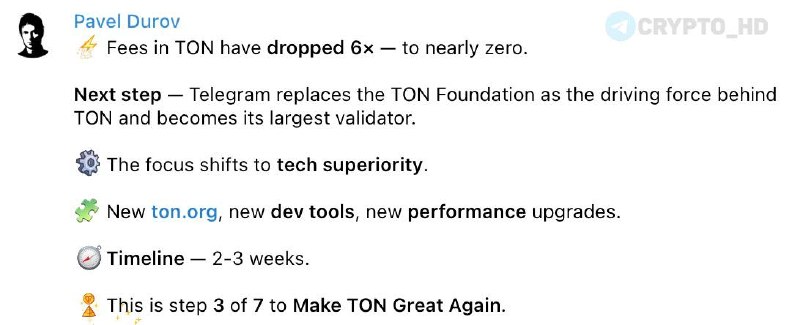
Step one was speed. Step three kills transaction cost. Step four — landing in 2-3 weeks — is the structural one: a relaunched ton.org, new developer tooling, and Telegram itself stepping in as the dominant validator on a chain that already routes payments for almost a billion messenger users. Durov’s own framing makes the shift explicit: the emphasis moves to technical superiority, and the TON Foundation is no longer the engine driving the network.
That last point matters more than the fee number. Telegram becoming TON’s largest validator is a centralization-of-execution decision, not a marketing tweak. Durov is saying the messenger company will run the rails its 950M+ users transact on. No surprise the announcement skipped the usual “decentralized future” boilerplate. What’s being staged here looks closer to a vertically integrated payments stack than a community L1 — think WeChat Pay built on top of a public ledger, not Ethereum with Telegram bolted on.
The adoption-signal read for traders is simple: Toncoin works as a leveraged bet on Telegram’s willingness to push wallet, payment, and mini-app rails into the messenger surface itself. Every prior step in that direction — Telegram Wallet rollout, Stars conversion to TON, ad revenue payouts to channel owners — showed up as a TON spot bid inside a 24-72 hour window. A six-fold gas cut paired with Telegram-as-validator is not subtle. It removes the two friction points that kept TON mini-apps from competing with Tron USDT remittance corridors and Solana retail flow: cost and operator trust. A Filipino worker sending $50 home through a Telegram chat — same UX as forwarding a sticker, fees barely visible — is the use case that suddenly stops being a pitch deck and starts being live infrastructure.
Regulatory implications are non-trivial. A messenger company becoming the dominant validator on a public chain is the kind of structure US and EU regulators tend to notice. The SEC’s posture has softened against Solana post-spot-ETH-ETF, and TON has stayed off the formal enforcement radar mostly because the Foundation, not Telegram, has been the operating entity. Durov dissolving that distinction tightens the link between the messenger and the token. Worth noting: the EU’s MiCA framework treats issuer-controlled networks differently from genuinely permissionless ones, and Telegram is incorporated in the UAE — friendlier than most jurisdictions, but not invisible. Any custody, exchange, or ETF conversation around Toncoin now has to account for that.
The macro setup is clean. Near-zero TON gas in 2026 lands at the exact moment cheap L1 throughput is the hottest narrative outside of BTC dominance. Solana DEX volume has been printing record weeks. Base is pulling stablecoin float that used to live on Tron. The chains winning are the ones with sub-cent transactions and a captive distribution surface. TON has the second part — Telegram — and just fixed the first. That’s the trade setup, however you want to express it: Toncoin fees collapsing while distribution stays intact is a classic adoption catalyst, the kind that shows up in TON/USDT order books before it shows up in headlines.
The validator handover is the part that needs scrutiny. A single corporate validator dominating block production is the opposite of the L1 trust assumption most institutional allocators underwrite. If Telegram executes what Durov described, TON becomes a permissioned-feeling chain dressed in permissionless clothes. That can be fine for retail throughput. It is much harder to sell to a treasury desk evaluating Toncoin for reserves, and harder still to pitch to a US ETF issuer the next time the spot-ETF conversation widens beyond BTC and ETH. Picture a Coinbase or BlackRock filing where the prospectus has to describe what happens to user funds if a single Dubai-incorporated company decides to halt blocks. That conversation gets uncomfortable fast.
What this means
The signal is unambiguous. Telegram is no longer arms-length from TON. The messenger is taking the validator seat, the fee economics, and the developer surface under direct control. For Toncoin, the immediate read is bullish on adoption — cheaper transactions plus tighter Telegram integration is the same playbook that drove TON from sub-$2 to its 2024 highs above $7. The slower read is that TON is repositioning as Telegram’s payment rail rather than a neutral L1, and that distinction will matter the moment regulators or ETF issuers start asking who actually runs the chain.
Watch next: the new ton.org launch and developer tooling drop, scheduled for the next 2-3 weeks per Durov’s own timeline. That release is the first real test — TON spot reaction in the 48 hours after launch, mini-app deployment count in the first month, and any move by Telegram to publish validator share data. If Telegram-controlled validators cross 30-40% of stake, expect the centralization conversation to start dominating the price action faster than the fee cut can offset it. Steps four through seven of Durov’s roadmap are still unannounced. Whatever comes next will decide whether this is a genuine throughput-and-adoption rerate or a slow walk toward a chain that only makes sense inside the Telegram app.