
















































Binance EU License Rejection in Greece Points to More Regulatory Pressure
Binance has another Europe problem. Reuters says its license application in Greece is likely to be rejected. If that happens, Binance could lose the right to serve clients across the EU. That is the part traders should care about. Not the paperwork. The reach. A local decision in Greece could spill across the bloc, and the next question becomes blunt: where can Binance still operate without disruption?
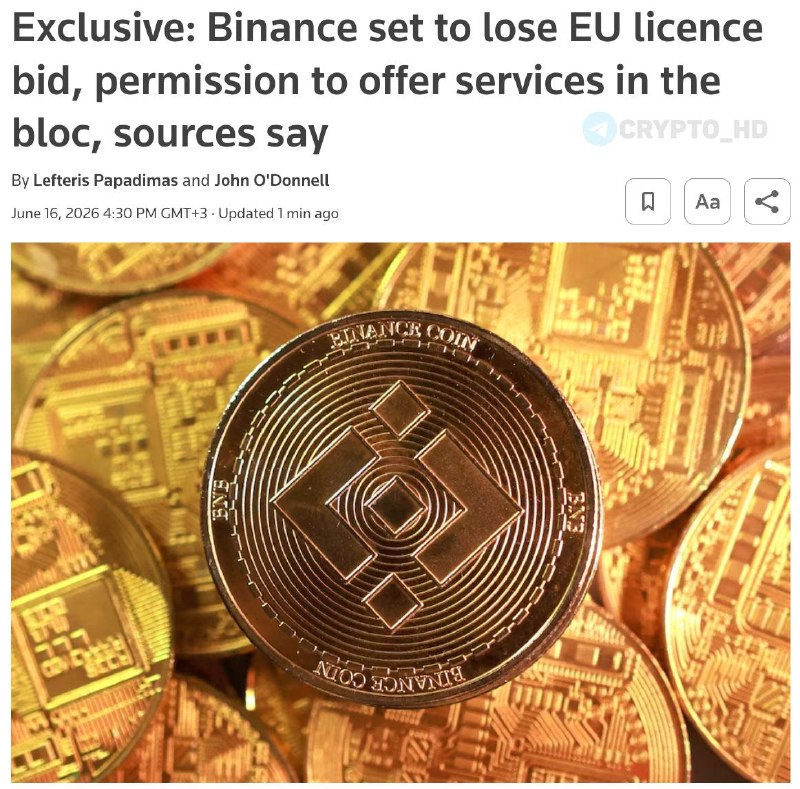
The report comes from a Reuters wire and says Greek authorities are preparing to deny the application. The wire did not give the exact reasons. I’ll be honest: that missing detail matters, but it does not erase the risk. Under the EU’s licensing system, one member state’s decision can affect access well beyond that country. Greece is not a huge crypto market on its own. Greece is not the point. The point is whether Binance can still treat Europe as one connected market.
This fits the regulation pressure story that has followed crypto since 2023. In the US, the SEC went after staking programs and exchanges. It also put pressure on stablecoin linked businesses. Europe has sounded quieter at times. Most guides frame that as Europe being more predictable. That is only half right. Quiet does not mean soft, and a Binance rejection in Greece would make that harder to ignore.
Markets notice this kind of thing. When regulatory uncertainty hit specific platforms in Q3 2023, BTC trading volume on those exchanges fell for a while, in some cases by about 10-15% week over week, as traders moved to venues that looked less exposed. My take: the same behavior could show up here, and maybe faster if EU users think Binance access is at risk. Where does the flow go? Some goes to regulated local exchanges. Some goes on chain. Neither route is smooth.
The story also matters for macro flow. Big funds do not like messy operating risk. If Binance, still one of the largest crypto exchanges in the world, runs into licensing trouble in Europe, traditional finance will treat that as another reason to slow down. BTC and ETH have ignored exchange specific bad news before. BTC was up more than 50% year to date by mid March 2024, even with plenty of regulatory noise in the background. But repeated blocks against large exchanges are different. At some point, this stops looking like Binance’s problem. It starts looking like market access risk.
We saw a version of this in the US when the crackdown on unregistered securities cooled some institutional interest in altcoins. Some funds shifted back toward BTC and ETH. Others went defensive for a while. That was not a permanent freeze. Still, it changed behavior. Counter to the usual advice, the first impact may not be a dramatic price collapse; it may be thinner liquidity, slower allocations, and fewer aggressive altcoin bets in Europe.
What this means
A possible Binance rejection in Greece would suggest European regulators are moving from warnings to action. National authorities look more willing to push back on big global exchanges, even when the result affects users outside their own borders. Is that overreading one report? Maybe. But in crypto regulation, one formal rejection can become the example everyone else studies.
For traders, BNB is the first thing to watch. If the rejection is confirmed and users start leaving Binance in Europe, BNB could come under pressure. Liquidity may also shift between platforms, which can widen spreads and make short term price moves sharper. Annoying, but very possible. I would not fade that risk too casually.
The broader picture is a more divided crypto market. Exchanges may need separate approvals and local staff. They may also need stricter compliance setups in each jurisdiction. That costs money. Users usually feel those costs later through higher fees and slower launches. Fewer products can follow too.
Next, watch for official statements from Binance and Greek regulators. A confirmed rejection would probably trigger a faster market reaction than the Reuters report alone. After that, the question is whether other EU member states take the same line. Yes, this sounds like it contradicts the idea that Greece is not a huge crypto market. Bear with me: the market size is small, but the regulatory signal is not. If other EU member states follow, more users could move toward fully regulated local platforms, even if those venues have thinner liquidity and fewer pairs.
I would also watch comments from European financial authorities over the next few weeks. One rejection is a problem. Several would be a pattern. For Binance, this could become a fight over access to one of the world’s largest economic blocs. For crypto traders, it is another reminder that regulation can move prices even when nothing has changed on chain.