
















































Zcash Orchard vulnerability and verification: a privacy problem for crypto investors
A serious bug in Zcash’s Orchard shielded pool could, at least in theory, have let fake ZEC pass as real. Privacy coin investors do not want to read that sentence. I’ll be honest: this is exactly the kind of boring-sounding implementation issue that can become a price problem before it becomes a legal or technical one. Shielded Labs disclosed the issue, and it hits the awkward bargain at the center of Zcash: users want privacy, but investors still need confidence that the money supply has not been quietly distorted.
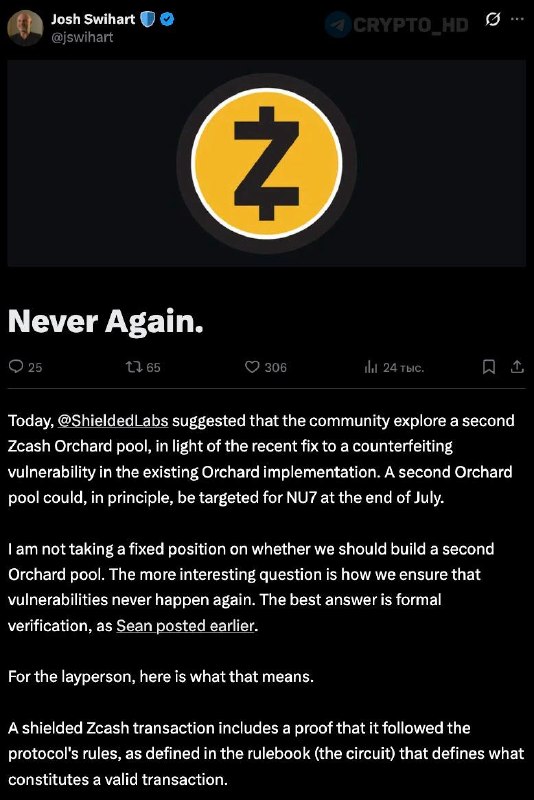
The bug was not a broken proof system or a total cryptographic failure. It was simpler, which almost makes it more irritating: one Orchard rule was too loose, so bad data could pass as valid. Most security writeups make that sound less dramatic than a cracked cryptographic primitive. That’s only half right. Josh Swihart, founder of ZODL, has said Zcash needs either a second Orchard pool or formal verification of the current one. The hard part is that shielded transactions do not give anyone the comfort of a transparent ledger, where balances can be scanned and odd activity sticks out. Why does this matter? Because Swihart’s point is direct: the guarantee has to come from math proving that every transaction follows the rules.
Orchard is complicated. Very complicated. It has plenty of edge cases, it was built for speed, and several expert audits still missed the problem. That should make investors pause. Not panic, necessarily. Pause. My take: the market is usually bad at pricing “maybe impossible, maybe catastrophic” risks until somebody gives it a clean number. This is bigger than ZEC. Privacy protocols ask users to trust machinery they cannot fully inspect from the outside. Markets punish that kind of uncertainty quickly. ZEC has not cratered, but trust is the asset underneath the asset. When the Wormhole bridge exploit hit in February 2022 and more than $320 million was lost, Solana (SOL) fell more than 10% soon after. Different project. Different bug. Same lesson: protocol failures can hit token prices before most people have finished reading the postmortem.
The proposed fix is formal verification: a mathematical check that the rules are written correctly and block fraudulent transactions, instead of relying on humans to catch every mistake by hand. Tachyon, a future version of Zcash, is being designed with formal verification and a simpler structure. Several teams are also working on verifying Orchard as it exists today. If that works, a second Orchard pool could act as a bridge until Tachyon is ready, possibly by NU7 at the end of July. I would not treat that timing as background noise. In crypto, delays around security work can become market events. Counter to the usual advice, “wait for the audit” is not enough here, because several expert audits already missed the issue. This may also push privacy projects toward stricter engineering habits. Institutional buyers are not going to love “trust us, the math is probably fine.” DeFi already taught that lesson the expensive way. Weak audits and exploited contracts have triggered ugly capital flight, with some related tokens dropping 20% to 30% within days.
The episode also brings Arthur Hayes’s earlier ZEC sale back into the conversation, although the source does not connect his timing or reasoning to this Orchard bug. Still, it shows how jumpy privacy coin markets can get when people sense weakness. Traders often talk about safe haven assets during chaos, but privacy coins are not Bitcoin. BTC can benefit from the store of value story during geopolitical stress, as it did when it gained 8% around the January 2020 Soleimani strike. ZEC rests on a narrower promise: private transactions that still obey the supply rules. Is that distinction too neat? Maybe, but investors trade on neat distinctions all the time. If that promise looks shaky, even only on paper, confidence can drain faster than the chain itself reveals.
What this means
The Orchard bug puts a harsher spotlight on verifiable security in privacy crypto. Formal verification is no longer a nice technical badge for Zcash. It is becoming part of the investment case. Yes, this sounds like it contradicts the old crypto instinct that decentralization plus audits should be enough. Bear with me. Projects that can prove their systems behave correctly should have an easier time winning serious capital than projects that lean on audits, reputation, public confidence, and hope. For investors, the takeaway is dull but useful: read past the privacy pitch and look at how the protocol proves integrity. ZEC has held up so far, but privacy coins have a structural problem that transparent chains do not. They hide transaction details by design, so they need stronger mathematical assurances to make up for what the public cannot see.
Next, watch the formal verification work on the current Orchard pool and whether a second Orchard pool appears by NU7 at the end of July. Official updates from the Zcash Foundation and Shielded Labs matter here. I would also watch rival privacy projects. Some may start formal verification work before investors force the issue. Others may wait until a bug makes the decision for them, which is usually the expensive path. We have seen this pattern enough in crypto: security work feels optional until the market reprices it in one ugly afternoon. If Zcash runs into delays or more complications, ZEC could come under pressure. If the verification work lands cleanly, Zcash gets a better answer to the uncomfortable question this bug raised: how do you verify a system built to keep secrets?