
















































Trump criticizes New York data center ban as crypto infrastructure fight heats up
Donald Trump criticized New York Governor Kathy Hochul over a pause on data center development, pulling a state permitting fight into the larger debate over crypto infrastructure, jobs, and power use. My take: this is less about one governor and more about where the next wave of compute actually gets built. If New York keeps big projects stalled, mining companies and other crypto firms that need heavy compute will look elsewhere. Billions in construction spending and thousands of jobs could shift to states where approvals are faster, cheaper, or just less hostile.
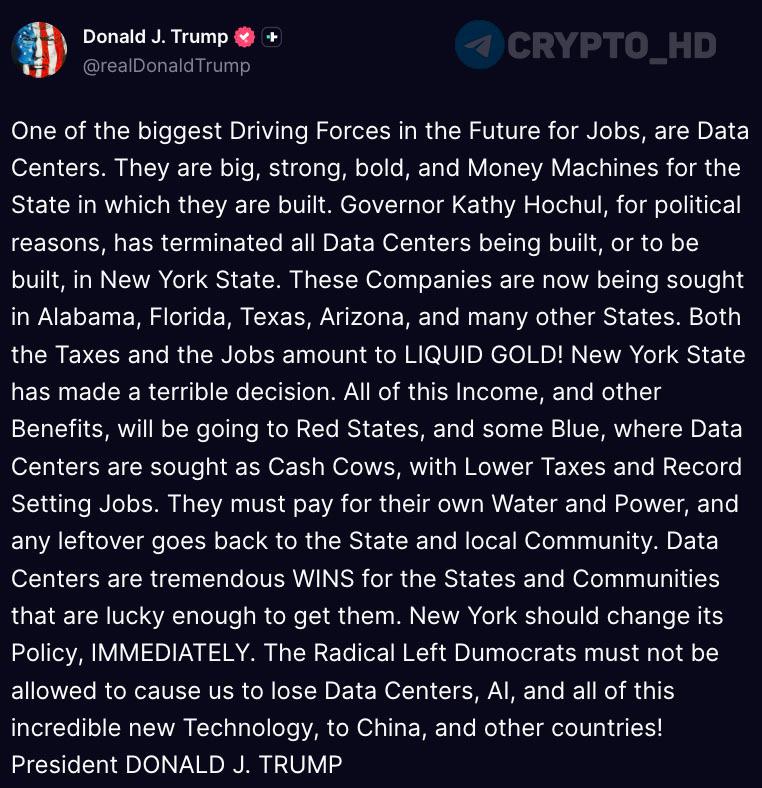
Trump said Hochul stopped data center construction in New York for “political reasons.” In his statement, he attacked the governor for freezing projects already underway, plus projects still sitting on the drawing board. He called data centers “large, powerful, and bold projects” and “money-making machines” for the states that host them. Not subtle. But the point is easy to read: he sees these sites as tax engines, job factories, and political trophies.
Trump went further and called data centers “LIQUID GOLD” for state and local governments. He said Alabama, Florida, Texas, Arizona, and “many other states” are chasing these companies because they want the tax revenue and jobs attached to them. Here is the sharper version: in Trump’s view, New York made a “terrible decision” and handed the upside to Republican-led states, along with some Democratic ones still willing to fight for the projects.
For crypto mining, this fight matters because data centers are where proof-of-work networks get their muscle. Why does this matter? Because Bitcoin mining is not some abstract thing floating in the cloud. It needs land, power, cooling, grid access, permits, utility agreements, and a state government that will not turn every expansion into a procedural war.
New York has energy resources and deep financial ties, so a colder stance there creates an opening for other states. We have seen the louder version before: China cracked down on Bitcoin mining in 2021, hash rate fell, and miners scattered across the globe. The United States picked up a major share of that activity. This New York fight is smaller and slower. Same pattern, though. Miners go where the numbers work and the rules are clear enough to plan around.
That does not automatically make the U.S. mining sector stronger. Most pro-crypto takes stop there. That is only half right. More geographic spread can help, but it can also make the industry more dependent on a handful of states competing on cheap power and loose policy. I would watch the public miners here, especially Marathon Digital Holdings (MARA) and Riot Platforms (RIOT). Their expansion plans depend on state-level decisions like this. If a company has a major buildout planned in a state that suddenly turns against the sector, delays can hit projected hash rate, margins, and eventually the stock.
Trump also argued that data center companies pay their own water and electricity costs while bringing revenue and jobs into local communities. He called data centers a “huge WIN” and urged New York to “IMMEDIATELY change its policy.” He also warned that “radical left ‘dumbocrats'” could push data centers, AI, and “all these incredible new technologies” toward “China and other countries!”
The wording is pure campaign-stage Trump. I’ll be honest: strip out the insults and the infrastructure signal still matters. When national political figures start talking about data centers as strategic infrastructure, not just buildings full of servers, the conversation changes. Crypto companies need that infrastructure. AI companies need it. Cloud providers, trading firms, and high-frequency compute shops need it too.
This is not an SEC case or a token rulemaking fight, but it still affects the crypto market. Counter to the usual advice, watching Washington is not enough here. A state that blocks or discourages data centers is probably not where miners, protocol teams, or infrastructure startups will scale. Talent follows opportunity. Capital follows faster. New York may still be a financial center, but the physical layer of the digital economy does not have to stay there.
What this means
The New York data center dispute shows how far apart states are getting on digital infrastructure. Trump calls data centers “liquid gold,” which is theatrical, but compute power really is becoming an economic prize. It supports AI, Bitcoin mining, cloud services, trading infrastructure, and plenty of boring back-end systems that still consume huge amounts of electricity.
For crypto investors, the practical read is simple: mining and compute-heavy operations will keep drifting toward friendlier states. Is this overkill for one New York policy fight? No, because infrastructure decisions compound. Texas, Florida, Arizona, and Alabama are worth watching because Trump named them directly, and because they fit the pattern of states trying to attract infrastructure projects with cheaper power, quicker approvals, tax breaks, or friendlier utility politics.
Investors should track state policy, not just coin prices. A mining company can look strong on paper and still get slowed by permits, grid limits, or a sudden political backlash. Yes, this contradicts the cleaner crypto-market story people prefer: price is not the whole game. Incentives, construction freezes, utility pricing, and new data center rules can change the economics quickly.
FAQ: Trump on New York data centers and crypto
Q: Why did Donald Trump criticize New York’s data center policy?
A: Trump said Governor Hochul halted data center construction for “political reasons.” He argued that New York is giving up jobs, tax revenue, and infrastructure investment.
Q: How does New York’s data center policy affect the crypto market?
A: It can make New York less attractive to Bitcoin miners and other crypto infrastructure companies. Those firms may move projects to states with cheaper power, clearer rules, or stronger political support.
Q: Which states are attracting data center investment, according to Trump?
A: Trump named Alabama, Florida, Texas, and Arizona as states chasing data center companies.
Q: What does Trump mean by calling data centers “LIQUID GOLD”?
A: He means they can bring tax revenue, construction spending, utility demand, and jobs to the states that host them.
Q: Why do Trump’s comments matter for crypto?
A: His comments connect data centers with AI, crypto, and national competition. That matters because crypto mining depends on large-scale compute infrastructure, and political support can decide where that infrastructure gets built.