
















































Cardano insider selling allegations return, and governance questions come with them
Allegations about Cardano insider selling are back in the feed. An on-chain analyst says wallets tied to early distribution may have moved up to 1.1 billion ADA, worth about $3 billion at the time, during the 2021 bull market. I’ll be honest: that number is large enough to make even a calm market twitch. It does not prove selling. It does not prove wrongdoing either. But it hits one of crypto’s rawest nerves: early token allocations are messy to trace, and one big wallet movement can turn a quiet chart into a rumor machine.
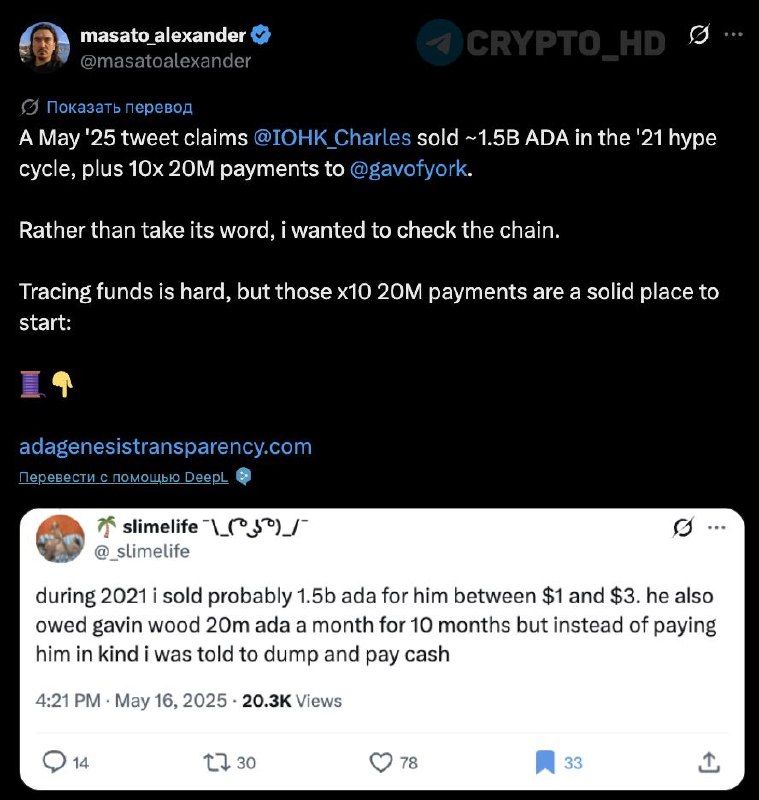
The latest claims come from a report mapping several large ADA transfers. According to the analysis, about 185 million ADA moved between April and November 2021 through nine transfers of roughly 20.2 million ADA each. Before that, between February and March 2021, another 33 transactions moved about 925 million ADA. The report says the funds trace back to the genesis distribution of IOG, Cardano’s development company. Here is the important caveat, and it is not a footnote: the analyst says they found no evidence linking Charles Hoskinson or any named person to the transactions. Versions of this story have been around for more than a year. This report adds wallet-level detail. It still does not show that ADA was sold into the market.
Most guides treat large wallet movements as a near-automatic red flag. That’s only half right. A transfer can mean selling, custody changes, internal restructuring, exchange routing, or something less dramatic than the timeline suggests. Still, large unexplained transfers from early project wallets make people uneasy. Fair enough. Crypto traders watch this stuff closely, and regulators do too. Why does this matter? Because the SEC has spent years going after token projects over whether their coins were sold as unregistered securities, with early sales and team control often getting extra attention. This report does not say Cardano broke any rules. But 1.1 billion ADA moving during a bull market is exactly the kind of pattern regulators may study when comparing similar projects. Ripple is the obvious comparison. The SEC’s XRP case dragged on for years and weighed on XRP while Bitcoin and Ethereum pulled in more capital, even as BTC moved past $69,000 in November 2021.
The market impact can matter even if the allegation never gets proven. Traders do not wait for courtroom-grade certainty. If they believe early investors or insiders are unloading, every rally starts to look suspicious. Price stalls. Buyers wait. Sellers lean in. My take: the damage usually comes less from the transfer itself than from the silence around it. If 1.1 billion ADA, or even a smaller part of it, were believed to be entering the market now, retail traders would step back and some funds probably would too. That does not mean the coins were sold. It means uncertainty has a price. In weak markets, that uncertainty can push money out of ADA and other altcoins into Bitcoin. We saw a version of that in May 2022 after Terra collapsed, when many altcoins dropped by double digits and BTC, though down as well, still looked less fragile by comparison.
What this means
Whether the claims hold up or fade again, they point to a real governance problem in crypto: investors still do not get clear enough information about early token allocations. Yes, this contradicts the instinct to say “on-chain data is transparent” and move on. Bear with me. The chain may show movement, but it often does not explain intent, ownership, agreements, or whether a transfer was operational rather than market-facing. Large early wallets can move markets. Or just scare them. Either way, it matters. For Cardano, the story may keep dragging on sentiment if IOG or Hoskinson leave the details unanswered. It could cap ADA rallies or make selloffs sharper when the broader market turns ugly.
Next, watch for a direct response from IOG or Charles Hoskinson. A clear explanation of the wallets, dates, and purpose of the transfers would do more than a broad denial. Is that overkill? Not when the claim involves 1.1 billion ADA and a 2021 transfer trail. Traders will also be watching ADA around $0.25 support and $0.30 resistance. A break below $0.25 on heavy volume would look bad. A move above $0.30 with strong buying would suggest the market is less worried. Counter to the usual advice, the chart alone is not enough here. SEC activity matters too, especially any new enforcement action or guidance around early token distributions that could hit the wider altcoin market, including ADA.