
















































Binance adds tokens monitoring tag as delisting risk returns
A “monitoring tag” on Binance means an asset is getting extra review and could be delisted. Binance added 9 tokens to the monitoring tag, which puts them under tighter listing checks. My take: the market read is blunt. For anyone searching “binance adds tokens monitoring tag,” this is not just a label change. When Binance flags a token, liquidity risk can move faster than the fundamentals.
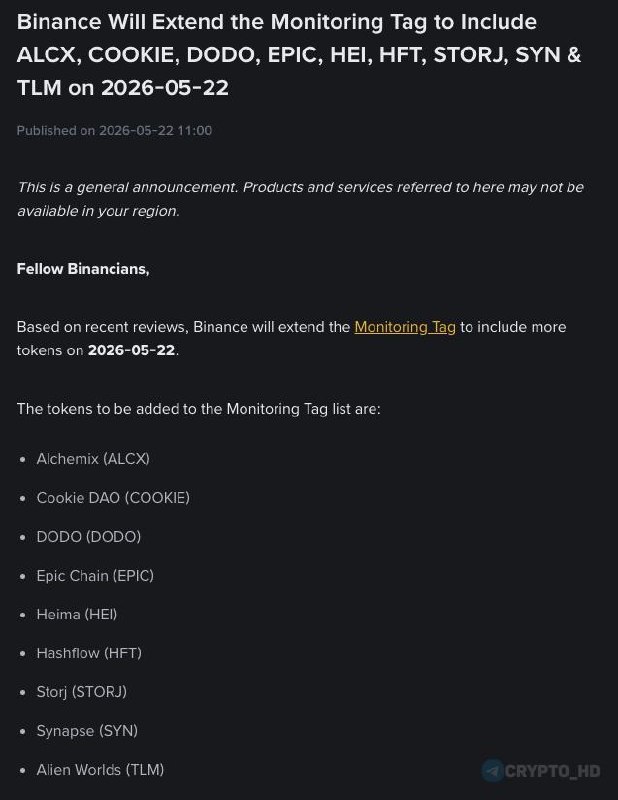
Binance added 9 tokens to the monitoring tag, according to an official announcement and screenshot. The source says Binance added 9 tokens to the monitoring tag. It does not name the tokens, provide tickers, show volume data, or give a date, so those details should stay out for now. Simple rule: do not fill blanks. The tag means Binance is checking whether the tokens still meet its listing standards. Delisting is possible. It has not happened yet.
A Binance monitoring tag can change how traders handle smaller listed assets because Binance is a major liquidity venue. This is more than an admin label. For smaller assets, Binance may be where most real trading happens. Why does this matter? Because once a token goes on watch, traders may sell before Binance makes a final decision. The FTX collapse in November 2022 was a different situation, and I would not overfit the comparison, but it shows how fast venue risk can spread. BTC fell from about $21,000 to under $16,000 that month. ETH also sold off hard as traders reduced exchange and counterparty exposure.
Regulatory pressure has pushed exchanges to tighten asset reviews, especially for smaller altcoins. Regulation is part of the backdrop here. To be precise, this post is about Binance’s own listing standards, not a direct regulator order. Still, exchanges became more careful in 2023, 2024, 2025, and 2026 about legal checks and compliance. Market integrity, too. Most guides frame this as a legal story. That’s only half right. BTC and ETH usually feel that pressure at a distance; long-tail altcoins feel it much faster because access, spreads, and confidence can break down quickly.
The missing tickers matter because tokens under exchange review often see thinner books and weaker market-maker support. The source gives no tickers. That matters. Traders cannot price the actual 9-token list from this text alone, but they can price the category of risk. Tokens under exchange review often face thinner order books and faster exits. They can also lose market-maker support. If any of the 9 tokens rely heavily on Binance spot volume, the monitoring tag may become the main story until Binance clears them or moves closer to delisting.
In risk-off markets, exchange warnings often turn into exits, especially for smaller tokens. Macro flow is the other piece. In risk-on markets, traders sometimes wave off listing risk because liquidity covers a lot of mistakes. Counter to the usual advice, watching BTC alone is not enough here. In risk-off markets, an exchange warning can be enough to push people out. BTC and ETH usually take the first wave of macro selling, then capital rotates back into altcoins if volatility cools. During the March 2020 liquidity shock, BTC dropped more than 30% in one day before recovering as risk appetite returned. Smaller tokens do not always get that kind of clean bounce.
A Binance monitoring label can move a token from “speculative hold” to “event-risk trade.” The tag changes trader psychology. I’ll be honest: this is where the label does real damage. It tells the market Binance is checking the token against its listing standards, and that alone can change the trade. A token that looked like a speculative hold yesterday can become an event-risk position today. The post says delisting is probable, not confirmed. That difference matters. Binance can remove a monitoring tag later. Markets often reprice first.
For active traders, monitoring tags are a reason to watch altcoin liquidity, not only BTC dominance. The immediate issue is liquidity discipline. If BTC holds major levels while monitoring-tag assets weaken, the market is probably treating this as exchange-specific risk. If BTC, ETH, and Binance-linked flows all weaken together, the read gets wider and starts to look like a risk appetite problem. Is that overcomplicating it? No. The source only confirms that 9 tokens were added. The rest is positioning analysis.
Binance moved 9 tokens into a higher-scrutiny category, leaving them exposed to delisting uncertainty. There is no quote in the source, so none should be invented. My read is narrow: Binance moved 9 tokens into a tougher review category. Until Binance gives another official update, those assets carry delisting uncertainty.
What this means
Binance is still policing listing quality, and smaller altcoins are more exposed. Binance is still reviewing listing quality closely. That matters more for smaller altcoins than for BTC or ETH. The affected assets are the 9 unnamed tokens with the monitoring tag. Yes, this repeats the point above, but it is the core of the trade. The pressure point is exchange access. If Binance removes a token, liquidity can shrink. Market depth can shrink. Investor confidence can shrink at the same time.
Traders should watch Binance’s next official update for names, tickers, and any delisting schedule. The next thing to watch is Binance’s official update naming the tokens, giving tickers, or setting any delisting timetable. For broader market context, track BTC around major psychological levels such as $60,000 and watch ETH liquidity into the next weekly close. If large-cap crypto holds up while the tagged assets sell off, this still looks like a token-specific Binance risk event. That is the clean read for now.