
















































CZ on AI company failures tests crypto’s risk appetite
CZ’s warning about AI company failures is not really an AI take. It is a capital cycle take. The hype matters, obviously, but the funding cycle is doing the heavier lifting here. Changpeng Zhao said most AI companies will go bankrupt while AI itself keeps growing quickly. My take: crypto investors should care because AI tokens, BTC, ETH, and exchange linked stocks like COIN still get dragged into the same risk on liquidity trade when money gets loose.
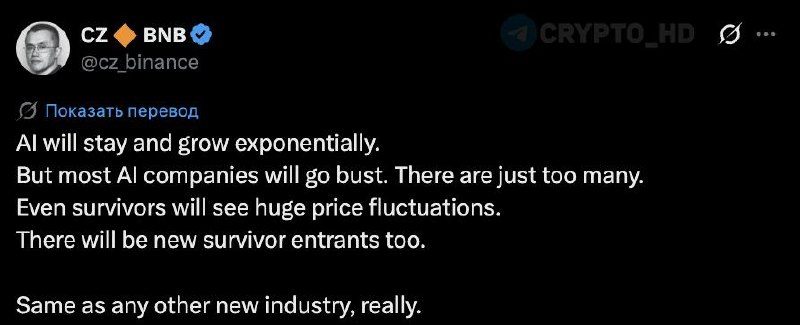
Zhao’s point was blunt: there are too many AI companies. That sounds simple. It is. He said even the survivors could face rough valuation swings, while new players keep showing up and replacing some of today’s favorites. Most guides would frame this as a tech forecast. That’s only half right. This was not a clean call on one company or one token. It was a cycle call, and that part gets missed. He also treated the churn as normal for a young industry, much like the old claim that “crypto” would vanish.
That history is the crypto link. In 2021, capital chased metaverse tokens, layer 1 chains, NFTs, DeFi names, exchange stocks, and almost anything with a convincing enough growth story while BTC climbed to nearly $69,000 in November 2021. By November 2022, BTC had traded below $16,000 after leverage came out of the system. Why does this matter? Because AI linked crypto assets can run into the same boom bust math when traders buy the theme first and worry about cash flows later. Context, not source fact: that is the pattern I would watch before I watched the branding.
The macro flow matters more than the label on the trade. When U.S. rates rose hard in 2022, long duration risk assets got hit, and crypto did not get special treatment. BTC fell from its November 2021 peak near $69,000 to below $16,000 roughly one year later. That is the backdrop for CZ’s AI warning. If liquidity tightens again after the June 17, 2026 FOMC meeting, traders may not spend long separating an AI startup from an AI token, ETH beta, or COIN exposure. They may just sell duration.
“Too many companies” sounds painfully familiar to anyone who lived through crypto cycles. The 2017 ICO wave produced thousands of projects. Most went nowhere. BTC survived. ETH survived. A smaller group of infrastructure names kept gaining usage after the mania cooled. I’ll be honest: this is the most useful part of Zhao’s comment, not the bankruptcy headline. The technology can win while most of the investment wrappers around it lose money. AI may follow that path, and AI themed crypto protocols will need real demand, not just a ticker with the right buzzword.
There is also the safe haven wrinkle. BTC often gets pitched as protection against monetary disorder, but during liquidity shocks it still trades like a high beta risk asset. Context, not source fact: after the January 2020 Soleimani strike, BTC gained roughly 8% in the following days, while gold also caught bids. Episodes like that keep the safe haven argument alive. Counter to the usual advice, though, this is not the stress test I would use to prove BTC is defensive. CZ’s AI comment points somewhere else. Not war. Not sanctions. A valuation collapse inside an overcrowded growth trade.
For traders, the practical read is simple. If AI equities or AI linked private market valuations start cracking, crypto will probably feel it through positioning before fundamentals. BTC and ETH are the cleanest liquidity gauges. COIN adds another layer because it reflects crypto trading activity and public market appetite for exchange revenue. No mystery there. When crowded themes start shaking, the market usually sells the liquid names first. We have all seen that tape.
Changpeng Zhao said most AI companies will go bankrupt, AI technology will not disappear, and the sector will keep developing exponentially.
His second point matters just as much: even surviving AI companies could see huge valuation swings. Anyone who traded ETH from above $4,800 in November 2021 to below $900 in June 2022 knows the feeling. Is that overkill as a comparison? No, because the lesson is not that AI equals ETH. The lesson is that a surviving network can still punish late buyers. A durable technology does not give you a smooth chart. It definitely does not mean every token tied to the theme deserves a premium.
The market has seen this before in crypto. “Crypto will disappear” became a common line after crashes, hacks, bankruptcies, and regulatory fights. Yet BTC still became an institutional product through U.S. spot Bitcoin ETFs in January 2024, while ETH followed with U.S. spot Ethereum ETFs in 2024. Yes, this contradicts the bearish tone two paragraphs ago. Bear with me. A category can mature after a wipeout. The wipeout still takes weak projects first.
What this means
CZ’s message suggests AI is leaving the easy narrative phase and moving into selection pressure. For crypto, that means AI linked tokens and high beta majors such as ETH may stay exposed if traders start asking how much real usage sits behind the story. BTC is the cleaner benchmark because it shows whether capital is leaving only speculative AI names or pulling back from crypto risk as a whole. A decisive move away from the $69,000 area would say more than another slogan about “AI plus blockchain.” My bias: watch price, not the slogan.
Watch the June 17, 2026 FOMC decision, CME BTC futures positioning, and BTC’s reaction around the $69,000 psychological level. If funding rates rise while AI names weaken, that looks like a crowded long, not conviction. If BTC holds support while AI tokens break down, the market is separating infrastructure from theme chasing. But if BTC and ETH both fall after the next macro catalyst, Zhao’s warning may become a crypto liquidity story before it becomes an AI bankruptcy story.