
















































Emirates Crypto Payments in UAE Point to Wider Adoption
Emirates Airlines now accepts cryptocurrency payments for flights in the UAE. That gives digital assets a practical job: buying a plane ticket. I’ll be honest: this matters more than another token sitting untouched in an investment account.
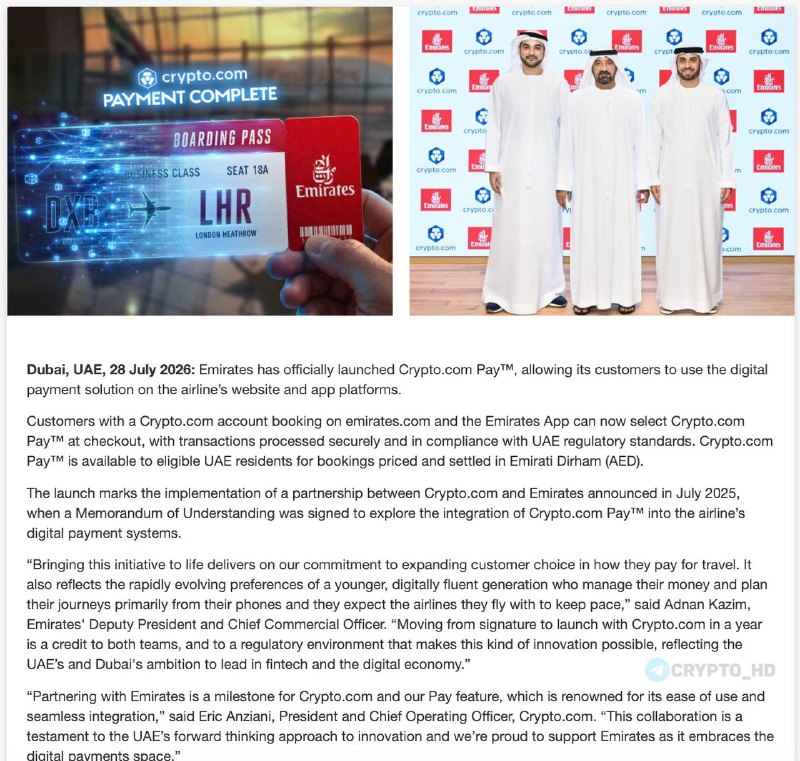
UAE residents with Crypto.com accounts can buy tickets through the exchange’s payment service. The limits are obvious. The arrangement covers one country and requires one provider. Most adoption stories treat availability as proof of demand. That is only half right. Customers can use crypto at checkout, but whether they return and use it again is the real test.
Emirates announced that UAE customers could pay for flights through Crypto.com. Sounds mundane, doesn’t it? That is precisely the point. A familiar purchase makes the technology easier to understand than exchange charts or abstract claims about adoption. My take: one working airline checkout says more than another breathless headline. It shows digital assets being used for something other than exchange trading.
This is an adoption signal for consumer payments. Emirates is a global flag carrier, so some travelers who see the option may be paying with crypto for the first time. Tesla prompted a far bigger market reaction when it briefly accepted BTC in early 2021, as Bitcoin moved above $50,000. Emirates is a different case. The service currently applies only in the UAE and only to customers who use Crypto.com. Why does that matter? Because other large companies can now watch a contained, real-world payment trial instead of debating crypto in theory. If enough travelers choose it, businesses in markets with high ownership rates may test systems of their own. Those purchases could create demand without depending entirely on interest rate news. Regulatory rumors would no longer be the only catalyst, either.
The announcement also belongs in the macro flow of money into risk assets, but one airline deal should not carry too much weight. Inflation and interest rates have pushed some investors toward crypto as an alternative asset class; volatility in traditional markets has contributed too. Corporate payment support adds evidence that these assets can be used, not merely held. MicroStrategy began buying Bitcoin in August 2020, when BTC traded below $12,000. Those purchases influenced institutional interest as the price later reached new highs. Emirates is taking another route. It is not adding Bitcoin to its balance sheet. It is letting customers spend crypto on flights. Counter to the usual adoption narrative, that may have only a small price effect—even if more spending eventually supports demand for BTC, ETH, and payment tokens.
What this means
The partnership adds one more ordinary use for cryptocurrency. That counts. Still, it does not turn crypto into a common payment method overnight. In my view, treating one launch as mass adoption would be a stretch.
It does show that a large company is willing to include digital assets in its sales process, at least within the UAE. Crypto.com may gain transaction volume if travelers use the option regularly. Will they? That is the part worth watching. A press release proves the payment system works; repeat purchases demonstrate actual customer demand. Heavy use could also direct attention toward payment tokens. The same goes for crypto assets that institutions already hold.
Investors should watch for comparable decisions by other airlines and online retailers. Luxury brands belong on that list too. Crypto.com’s reported payment volume will reveal more than the launch announcement: purchases need to rise, and customers need to return. I would put those figures ahead of social-media excitement. BTC and ETH price movements after future corporate announcements may offer another clue, although correlation is easy to mistake for cause. A sustained Bitcoin move above $65,000 might signal stronger confidence, but this partnership alone would not explain it. Yes, that sounds cautious after calling the deal an adoption signal. Both can be true. Regulation matters as well. If the UAE service runs without serious consumer protection or compliance issues, officials in other countries may become more comfortable with comparable rules.