
















































EbUSD Stablecoin Shuts Down as Ebisu Finance Calls It Quits
The ebUSD stablecoin is finished. Full stop. Ebisu Finance is closing the project because it could not attract enough liquidity or consistent demand. Cheap borrowing sounds compelling, but only until you ask the obvious question: who actually wants to use the currency? Apparently, not enough people. My take: anyone considering a smaller stablecoin should remember that distinction.
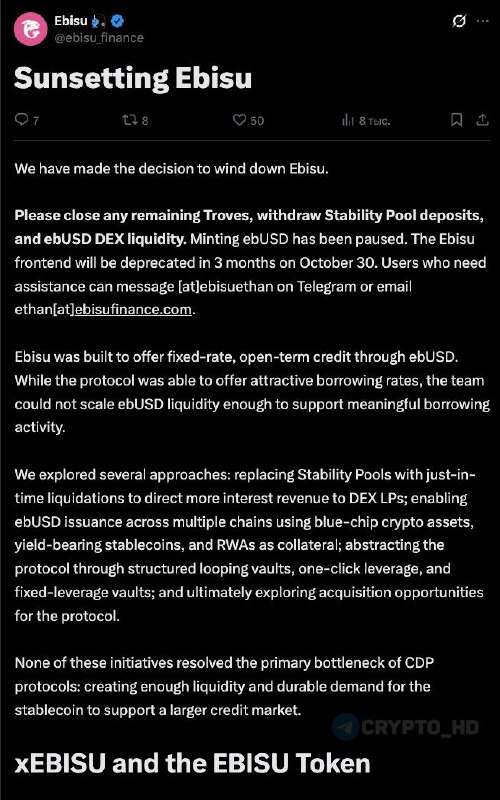
Ebisu Finance said it will permanently discontinue ebUSD despite offering what its team described as “attractive borrowing rates.” The planned EBISU token has been cancelled too. xEBISU and BOLD holders will not receive an airdrop. Anyone still using the protocol now has 3 jobs: close any remaining Troves, withdraw funds from its pools, then remove ebUSD liquidity from decentralized exchanges (DEXs).
Ebisu was a small project, yet its failure exposes a familiar weakness in young DeFi protocols. Creating an algorithmic or collateralized stablecoin is relatively easy; sustaining organic currency demand and adequate market depth is not. Most explanations stop at weak incentives. That is only half right. Ebisu did offer tempting rates, but those incentives produced yield-seeking activity rather than steady demand. People arrived for the yield. When that stopped working, there was no strong secondary use case to keep them around.
Regulation has made launching a stablecoin more difficult. Since the Terra/Luna collapse, the SEC has paid closer attention to issuers, reserves, and the way these products work. Why does that matter? Because a new project must now persuade skeptical users while the rules are still being worked out. Without institutional backing or a clear use case, that is a tough sell. Even Coinbase (COIN) shares have swung sharply after news of SEC action, showing how one regulatory dispute can quickly spill into the wider market.
The economy probably did not help Ebisu either. Federal Reserve interest rates remain high, while inflation continues to worry investors. Safer investments paying better returns raise the bar for speculative projects. Experimental DeFi tokens often get cut first. I’ll be honest: an attractive percentage on a crypto dashboard looks far less exciting when lower-risk alternatives are paying meaningful returns.
A more severe version of that shift appeared in late 2021. Bitcoin (BTC) began sliding from its record highs as the Fed took a more hawkish position. Ebisu was tiny compared with Bitcoin, but both faced the same basic pressure: expensive borrowing makes investors more selective about crypto projects advertising attractive percentages. Counter to the usual advice, lowering rates alone would not have saved ebUSD. It needed 2 things it never secured in sufficient amounts—regular users and deeper markets.
What this means
EbUSD’s closure suggests there is little room for stablecoins that depend mostly on incentives. Promotional rates can draw attention. They cannot manufacture a durable reason for a currency to exist after the promotion ends. Is liquidity merely a technical detail? No. Without enough of it, routine buying and selling can move the price badly. Ebisu never reached the point where that problem disappeared.
I would take this as a warning about small, lightly traded stablecoins. A high yield may look impressive on a dashboard, but it does not reveal who is borrowing, why anyone wants the currency, or what happens when withdrawals arrive together. Yes, that is less exciting than comparing headline rates. It is also more useful. The real test is whether users can get their money out when everyone heads for the door at once.
The market could now become even more concentrated around established stablecoins and larger crypto assets. Investors may favor protocols with longer operating histories. Others may move money into Bitcoin (BTC) or Ethereum (ETH), 2 assets with more users and deeper markets. Neither asset is safe. That distinction matters. Their risks are simply easier to assess than those of a thinly traded stablecoin struggling to find regular users.
Investors should keep an eye on guidance from 2 US authorities: the SEC and Treasury. USDT and USDC are also worth watching because trouble involving either currency could spread far beyond one protocol. Most guides say to start with yield. I disagree. Start with liquidity and real usage, then examine the source of the yield. If demand vanishes as soon as incentives shrink, there may not be much of a business underneath.
Total crypto market capitalization offers another useful measure. A sustained rise above $2 trillion could indicate that investors are becoming more willing to take risks again. Until then, small DeFi projects remain difficult bets. But here is the correction: a stronger market would not rescue every stablecoin. Plenty of weak ones would still fail.
FAQ: ebUSD stablecoin and the Ebisu Finance closure
What is ebUSD?
EbUSD was a stablecoin created by Ebisu Finance. Its intended job was straightforward: maintain a steady value, usually by staying pegged to a fiat currency.
Why did Ebisu Finance close ebUSD?
Ebisu Finance said ebUSD failed to attract enough liquidity or consistent demand. The team therefore chose to shut the project down permanently. In my view, that second problem—demand—was the harder one to solve.
Will the EBISU token be launched?
No. The launch is off. Ebisu Finance has cancelled the EBISU token, and holders of both xEBISU and BOLD will not receive an airdrop.
What should ebUSD users do now?
Users need to complete 3 actions: close any remaining Troves, withdraw their pool deposits, then remove ebUSD liquidity from decentralized exchanges (DEXs).
What does this mean for the broader stablecoin market?
The closure shows how difficult it is for a small stablecoin to survive without regular users and deep liquidity. Attractive borrowing rates may bring people in temporarily. Rates alone cannot keep a project alive. That is the uncomfortable bit.
How does regulatory scrutiny affect stablecoins?
Closer SEC scrutiny pressures stablecoin issuers to provide clearer information about their reserves and business models. At the same time, unsettled rules can make investors less willing to back new projects. My take: disclosure may help credible issuers eventually, even if the transition is painful.
What role do macroeconomic factors play in DeFi project failures?
Higher interest rates make speculative assets less appealing because investors can earn better returns elsewhere. Inflation compounds the pressure. Tighter financial conditions also leave less money available for small DeFi projects.
What should investors consider when evaluating stablecoin projects?
Check real usage first. Then examine whether the stablecoin can be traded easily, where its yield comes from, and how regulatory changes could affect it. One final question matters: what keeps users interested after the temporary incentives disappear? If the answer is nothing, the yield is beside the point.