
















































Iran US Tensions Crypto Market Tests Bitcoin Safe-Haven Bid
Iran US tensions crypto market risk is not one clean trade. It is the Washington-Tehran standoff colliding with Bitcoin, Brent-style oil risk, inflation expectations, dollar liquidity, and the old BTC pitch: when the world gets uglier, buyers show up.
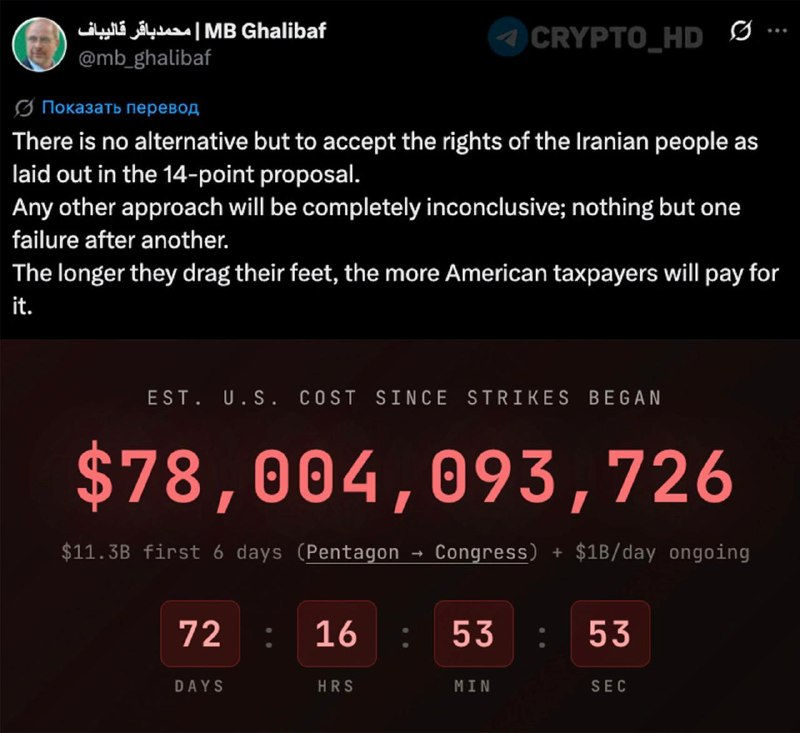
Iran’s parliament speaker said there is “no alternative” but to accept the Iranian people’s rights in a 14-point proposal. The post also says Donald Trump rejected Iran’s offer earlier. My read: crypto traders do not need a diplomacy degree here. A longer Middle East standoff can hit oil, inflation expectations, and the BTC safe-haven trade in the same tape.
The source post frames the dispute as a waiting game, with the US bill getting larger. It says any other approach will be “completely fruitless,” and says the Middle East conflict has already cost the US $78,000,000,000, citing the Iran War Cost Tracker. Why does that number matter? Because traders are not just pricing missiles. They are pricing energy risk, fiscal strain, election-year patience in Washington, and how long a bad headline cycle can keep bleeding into markets.
Context, not a new source fact: during the Jan-2020 Soleimani strike window, BTC rose about 8% as traders tested the “digital gold” story. That move still hangs over this setup. I’ll be honest: I would not treat a BTC bounce as proof by itself. If Iran US conflict Bitcoin price action starts separating from Nasdaq risk appetite, then I would watch whether BTC holds a crisis bid better than ETH or COIN.
The macro setup is awkward. Very awkward. Geopolitical risk can help Bitcoin for a few sessions, then damage the broader liquidity backdrop crypto needs. Higher Middle East risk can lift oil and inflation expectations, which can push rate-cut hopes further out and weigh on risk assets. BTC and ETH still depend heavily on dollar liquidity, whatever the purists say. Counter to the usual advice, the first move may be right and still become the wrong trade later. A war-risk bid can help BTC in the first 72 hours, but sticky inflation can punish the same position after that.
The Iran sanctions cryptocurrency angle is still there. The source does not state new sanctions, and it does not mention exchanges, stablecoins, mining, ETFs, SEC, or CFTC. Still, the market knows this script. When Iran, the US, and sanctions appear in one sentence, compliance desks start looking at exchange exposure, payment rails, stablecoin flows, and counterparties before the policy text lands.
In the source’s version, the speaker pushes pressure back onto Washington by tying delay to American taxpayers. That is politics. Markets translate it into time risk. My take: the longer this standoff lasts, the less useful the headline itself becomes. Traders then move to oil volatility, Treasury auctions, gold strength, and whether BTC is acting like a hedge or just another high-beta asset with cleaner branding.
“Нет альтернативы, кроме как принять права иранского народа, изложенные в 14-пунктном предложении.”
That quote is the center of the Iran parliament speaker crypto news angle. Iran is presenting its 14-point proposal as the only workable path, while the post says Donald Trump rejected it earlier. For crypto traders, the first question is not whether the diplomacy sounds persuasive. It is sharper than that: does the stress bring fresh demand into BTC, drain liquidity from altcoins, or do both one after the other?
What this means
Iran-US tension is more than a diplomatic headline for crypto. It tests liquidity, oil, inflation, and Bitcoin’s safe-haven claim. Is that overkill for one political post? No, because BTC trades the second-order effects, not the speech itself.
This points to a harder diplomatic line, not a cooler one. For BTC, watch whether geopolitical buying can outrun the macro pressure from oil-linked inflation fears. Over the next 72 hours, compare BTC with gold and Nasdaq. If BTC holds above a recent support level while ETH lags, the safe-haven argument looks stronger. If it cannot, skip the heroic narrative.
For crypto macro trading, the next FOMC date, the next CME futures positioning update, and BTC’s nearest major technical level matter more than treating the $78,000,000,000 figure as background noise. Yes, this partly contradicts the crisis-bid idea above. Bear with me. BTC may catch the hedge bid while ETH follows liquidity and COIN takes the regulatory-pressure hit. Those are three different trades, not one Iran-US trade wearing different tickers.