
















































FSB Seeks Pavel Durov Arrest, Telegram Standoff Rattles Crypto Exchange Flows
“Russia’s FSB has placed Telegram founder Pavel Durov on its international wanted list for allegedly assisting terrorism.” The case could squeeze crypto exchanges and test how much protection digital assets actually provide during geopolitical crises. Telegram refused to remove channels the FSB claims were used by Ukrainian special services; now, a dispute over online speech has spilled into crypto markets. Why does that matter? Because Bitcoin cannot operate beyond state control if governments can choke the platforms and exchanges surrounding it. That is the uncomfortable part.
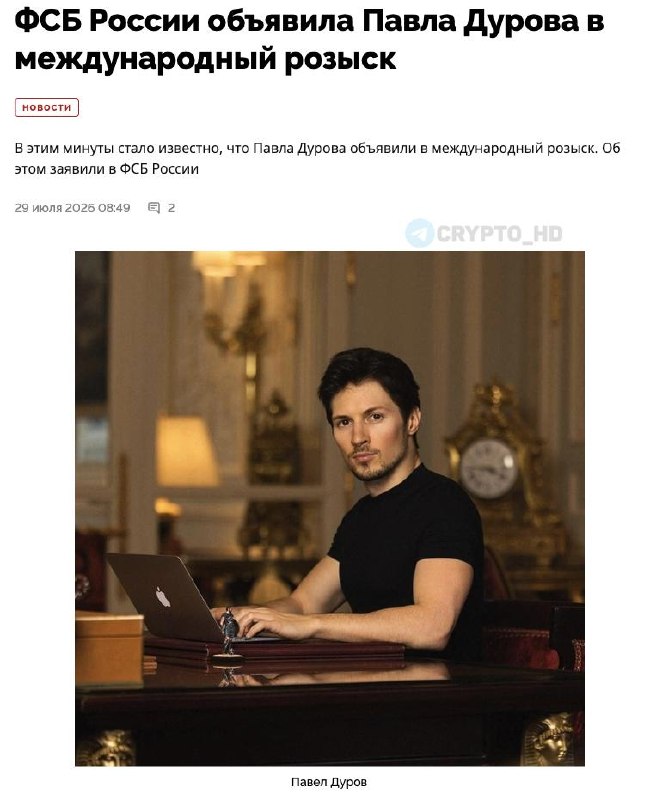
“Durov faces charges under Part 1.1 of Article 205.1 of the Russian Criminal Code, which covers assistance with terrorist activity.” The FSB says Telegram administrators refused to delete channels and chats, as well as bots allegedly used to plan attacks and sabotage in Russia. Its most specific example is the “Daivinchik” dating bot, also called Leonardo Da Vinci or Leo. According to the agency, Ukrainian operatives posed as women and contacted young Russians through the bot before people described as “law enforcement officers” entered the conversation. The allegations say those targets were threatened and pressured to start fires or attack security personnel. Some were allegedly told to send money through crypto exchanges. Russian lawyer Zherebenkov told TASS that Durov could receive a life sentence if convicted. Authorities may first seek a заочный arrest, or arrest in absentia, and then pursue extradition. I’ll be honest: that sequence matters more than the dramatic wanted-list headline.
“The allegations follow a criminal case first reported by Russian state media on February 24, 2026.” The FSB claims Telegram has been involved in more than 153,000 crimes since 2022, including about 33,000 cases it classifies as terrorism or sabotage. Those are enormous figures. They are also figures supplied by the agency bringing the case, so caution is warranted. Most coverage will repeat the totals first and add that caveat later. I would reverse the order. The FSB further says that, since July 2025, authorities in several Russian regions have detained 46 people aged 12 to 22. They are accused of attacking security forces and setting infrastructure on fire, with some allegedly transferring money through crypto exchanges. Criminal cases have been opened against them.
That exchange reference is easy to skim past. Don’t. Once the FSB publicly identifies crypto exchanges as a payment route in alleged terrorism or sabotage cases, compliance departments have a concrete reason to review transaction monitoring. Platforms serving Russian customers will likely feel the pressure first; so will exchanges still doing business in the region. My take: the 46 detentions and the age range of 12 to 22 will attract more regulatory attention than another abstract warning about illicit finance.
“Crypto investors may face tighter oversight of large exchanges, including Coinbase (COIN), if authorities decide current compliance checks are not enough.” In practice, alleged illicit transfers tend to produce demands for stricter know-your-customer checks, followed by tougher anti-money-laundering screening. The response may not stay inside Russia. EU or US regulators could point to the case when arguing for new reporting requirements and account limits. Transaction screening could tighten too. Counter to the usual advice, more compliance does not automatically calm markets; uncertainty about how new rules will be enforced can be worse than the rules themselves.
Something similar happened after sanctions were imposed on Russia. Bitcoin (BTC) briefly attracted buyers looking for another store of value, then slipped when traders turned to enforcement risk. BTC has not moved dramatically on this news by itself. Still, the familiar “crypto equals illicit finance” argument is back, and markets rarely enjoy that conversation. I don’t think the headline alone is the threat. Restrictions that reduce exchange access or drain liquidity could hurt sentiment much faster. Past bursts of regulatory scrutiny have often coincided with corrections or months of flat trading in BTC and Ethereum (ETH), as investors cut risk and waited for the actual rules.
“The case gives Bitcoin’s safe-haven reputation another uncomfortable test.” Bitcoin has behaved inconsistently during wars and political shocks. When Russia first invaded Ukraine, BTC rose briefly before surrendering those gains as sanctions and possible regulatory action took over the discussion. Could that pattern repeat? Yes, especially if the Durov case develops into broader action against exchanges rather than remaining a Russian prosecution.
The market has two plausible reactions. Traders may rotate from smaller altcoins into BTC, which many investors regard as the least risky crypto asset. Or they may leave crypto and return to traditional havens such as gold. Both make sense. Yes, that sounds contradictory. Markets are contradictory. Institutional investors are especially sensitive to compliance trouble, and the FSB’s references to exchanges give them a specific reason to hesitate. I would watch whether traders treat this as a one-off Russian case or the opening move in a wider crackdown. Exchange outflows should offer an early clue. Changes in stablecoin market share should offer another.
What this means
“Governments want more control over communication platforms partly because those platforms can function as informal payment networks.” Durov is the immediate target, but Telegram is not the whole story. Services supporting private or pseudonymous activity may face the same questions when users can discuss transactions and fund them with limited oversight. Crypto sits directly in the middle. Regulators may scrutinize privacy coins and decentralized applications more aggressively. Exchanges with large Russian customer bases could face local restrictions; platforms with weak KYC and AML checks may be ordered to remove certain assets. Some may block access before a regulator formally tells them to do so.
The case may also strengthen government arguments for central bank digital currencies. CBDCs provide authorities with much more visibility and control than cash or Telegram transfers. They also offer more control than public cryptocurrencies. Most crypto commentary treats that outcome as politically impossible. That’s only half right. Crypto purists will hate the idea, but policymakers may view the same features as the selling point. I suspect that divide will become harder to ignore if this case expands.
“Investors should pay close attention to what regulators in the EU and US do next.” Either jurisdiction could move prices far more than the original FSB announcement. Restrictions targeting exchanges or privacy technology could weigh on Bitcoin (BTC) and Ethereum (ETH). Traders are also likely to focus on BTC’s $61.4K level. Is monitoring all of this overkill? Not when one EU or US response could turn a Russian criminal case into a cross-market compliance event.
Statements from large exchanges matter, particularly if they change transaction monitoring or their treatment of Russian users. Trading volume may reveal the reaction before an official statement lands. Sudden exchange outflows could signal fear, while larger stablecoin balances may indicate that investors are waiting rather than abandoning crypto altogether. Further charges against Durov would raise the stakes. So would additional measures against Telegram or coordinated action by several governments. CME futures data deserves separate attention: if institutional activity declines as the case unfolds, professional investors may be stepping aside because the regulatory risk has become too difficult to price. My read is simple. Watch behavior, not speeches.