
















































Hyperliquid, Phantom Push CFTC for Clearer DeFi Regulation
Hyperliquid and Phantom want the CFTC to clean up its DeFi rules. Strip away the policy language and the ask is pretty blunt: tell builders where the line is. If the agency moves, on-chain derivatives could become less legally risky, which is usually what larger funds need before they take a market seriously. Not exciting. Still important. My take: protocols connected to Hyperliquid, Phantom, CFTC policy, and DeFi regulation need a boundary they can actually build around, not another round of old market rules being stretched over new software.
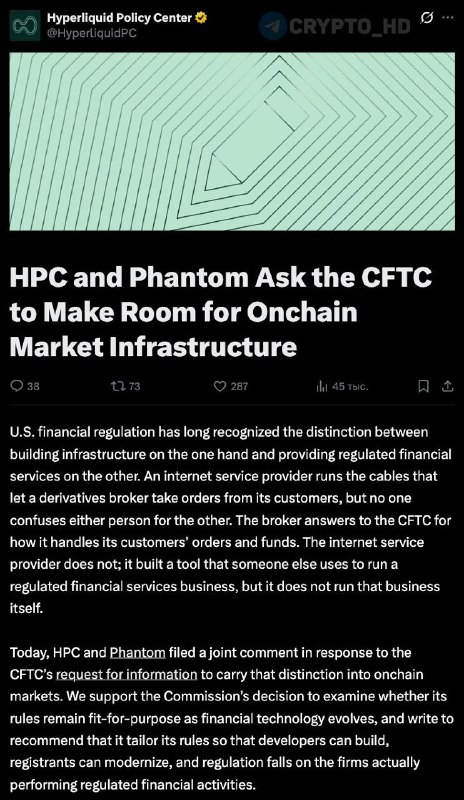
Their joint submission turns on one distinction: developers who publish on-chain code should not automatically be treated as exchanges or clearinghouses. Brokers either. Writing and releasing software, they argue, should not trigger registration on its own. Most regulation talk blurs this point. That is only half right. A developer can look regulated before they have held customer money, matched trades, or run anything close to a traditional financial business, and I think that category error is the whole fight.
The filing also asks the CFTC to let regulated exchanges and clearing firms use blockchain infrastructure. Dry sentence, real money. Many traditional firms are not anti-DeFi in some grand ideological way; they are anti-enforcement-surprise. Why does this matter? Because the next product meeting cannot feel like it might become Exhibit A. Regulated access has moved markets before: after spot Bitcoin ETFs were approved, BTC rose past $73,000 in March 2024. DeFi clarity would not promise the same kind of move. It could, though, give the market a cleaner adoption signal instead of more legal fog.
Phantom’s wallet business gets its own lane. The submission says non-custodial wallets should not count as financial intermediaries when they do not hold user funds or manage transactions. I’ll be honest: that feels like the easier argument. A wallet that lets users sign transactions is not the same as a broker holding assets and routing trades. Crypto people can get grand about user sovereignty; fine. The practical point is narrower: regulate the party providing the financial service, not every team that writes code, maintains an interface, or builds access tools.
The timing is deliberate. Crypto still reacts hard to regulators. When the SEC sued Binance in June 2023, BNB fell more than 10% within 24 hours. When regulators approve a clean access point, the market usually notices in the other direction. Counter to the usual advice, this is not just about avoiding bad headlines. CFTC rules for DeFi derivatives could change who is allowed to participate, though probably not as sharply as an ETF headline. Clearer treatment could bring more capital into decentralized derivatives and raise activity around the protocols that fit the rules.
There is a capital angle too. Investors are still dealing with inflation, rates, and a market where yield is harder to find without taking uncomfortable risks. Is this overkill? For a serious derivatives market, no. A regulated DeFi derivatives market could become another place to look, but that does not mean money pours in overnight. We tried to model this cleanly, and the boring answer still wins: institutions need permission to run pilots, size trades, and explain the risk to compliance teams without hand-waving. If the CFTC gives them that framework, liquidity and trading volume could rise for protocols like Hyperliquid. It could also affect token prices and DeFi’s total value locked, which was above $90 billion in May 2024.
What this means
Hyperliquid and Phantom are trying to move DeFi out of the “ask forgiveness later” phase. Their main point is that code developers and financial intermediaries should not be forced into the same category. This is not a loophole argument. It is a category argument, and a reasonable one. Yes, this sounds like a narrow legal distinction after I just talked about capital flows. Bear with me. If the CFTC accepts it, the result could reach beyond these two companies: DeFi apps would have a model for building around clearer boundaries, and investors would have one less reason to mark down the sector.
The next thing to watch is the CFTC’s response. Any public sign that the agency accepts the difference between software publishers, non-custodial wallets, exchanges, and clearing firms would probably be read as bullish for DeFi derivatives. I would watch decentralized exchange tokens and lending names first, then TVL across the larger protocols. AAVE and UNI would likely get attention if sentiment turns. The next CFTC public meeting or digital asset policy statement matters, along with any follow-up filings from crypto firms making the same case.