
















































Chainlink Leads Best Privacy Coins 2026 by Developer Activity as Monero Slides to No. 9
Chainlink ranks first among privacy-focused crypto projects by 30-day developer activity in 2026, per Santiment’s GitHub commit data, ahead of Monero, Zcash, and Dash. I’ll be honest: an oracle project topping a privacy leaderboard looks off at first glance. But it isn’t a typo. Chainlink has not suddenly become an anonymity coin. Santiment’s list is really showing where confidential computing work is happening now, and that build map has moved hard since the last two cycles. XMR and ZEC used to define this corner of crypto almost by default. Not anymore.
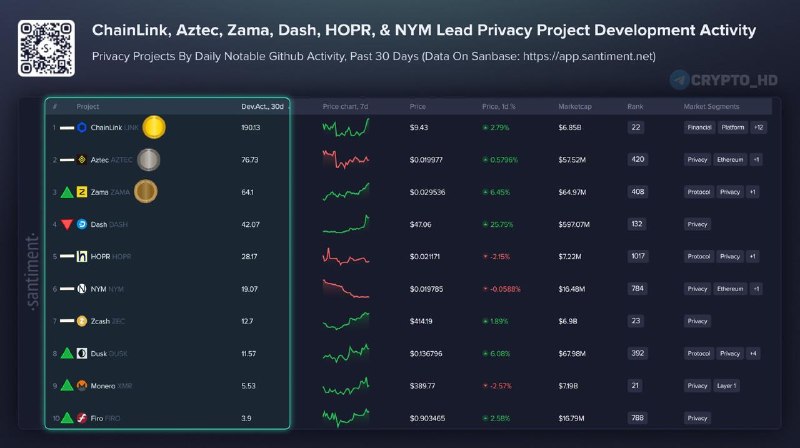
Santiment’s 30-day GitHub ranking goes: Chainlink (1), Aztec (2), Zama (3), Dash (4), HOPR (5), NYM (6), Zcash (7), Dusk (8), Monero (9), Firo (10). Look at the middle of that table, not just the headline slot. Aztec is a zk-rollup. Zama ships a fully homomorphic encryption stack. Both sit above Monero. That is the second story, and maybe the better one. Privacy stopped being one coin bucket. It’s infrastructure now.
Developer activity is one of the rare on-chain metrics that can front-run price instead of narrating it afterward. My take: the 10-name Santiment board shows engineering attention moving away from native privacy L1s and into privacy primitives attached to smart-contract infrastructure. Chainlink’s CCIP and confidential compute work. Aztec’s zk-rollup mainnet push. Zama’s FHE library. Those are not three versions of the same trade; they are three different ways to make privacy a developer feature without launching a separate coin around it. Why does this matter? Because the next demand wave may reward the rails, not only the old privacy tickers.
You can’t write this story without the regulators. Most guides say privacy coins are under pressure because exchanges dislike anonymity. That’s only half right. The pressure is more specific: per public delisting notices, Binance, Kraken’s EU arm, OKX, and Bittrex have at various points delisted or restricted Monero, Zcash, and Dash to comply with FATF travel-rule guidance. That helps explain why builders appear to be moving work toward privacy layers that sit on top of compliant chains, instead of pure anonymity coins. Aztec on Ethereum and Chainlink-secured confidential rollups do not carry the same listing risk XMR does. The ranking lines up almost too neatly with that compliance reality.
Monero at No. 9 and Firo at No. 10 does not mean those projects are dying. Slow down there. Their codebases are mature and stable, and fewer commits is not the same thing as lower utility. Same caveat for Zcash at No. 7. The bottom-half surprise is Dash at No. 4, where the renewed Evolution roadmap appears to be pulling real engineering hours despite flat price action. One thing worth flagging: per Santiment’s methodology, commits get counted regardless of size, so a documentation push can sit beside a consensus rewrite. Treat the list as directional. Not absolute.
For traders, the read is mostly in the top six. LINK has held the $14 to $18 zone through 2026’s chop and trades against a cap that already prices in oracle dominance, but a confidential-compute narrative could still re-rate the token if CCIP’s private channels see real institutional pickup. Aztec’s points program and eventual token are the cleanest bet on the zk-privacy thesis. Zama is pre-token, which makes it harder to trade directly, but it is worth tracking on testnets. Its FHE library has been integrated into early-stage DeFi privacy modules, and the eventual launch will catch beta hunters who missed last cycle’s L1 rotation. NYM and HOPR are further out on the risk curve as mix-network plays. Still, landing at No. 5 and No. 6 says the metadata-privacy thesis has builders behind it.
What this means
Privacy as a vertical is splitting in two. On one side: native anonymity coins. On the other: privacy infrastructure layers. Yes, this contradicts the old Monero-first framing of the sector. Bear with me. The native side, Monero, Zcash, Dash, Firo, keeps operating as cash-like instruments for users who want untraceable settlement, and dev activity has plateaued because the protocols largely work. The growth area is now privacy infrastructure: zk-rollups, FHE compute, mix networks like NYM and HOPR. Is this overkill as a read on a 30-day GitHub table? Maybe for price timing, no for sector direction. Santiment’s ranking is only a snapshot, but this is the kind of snapshot that can look obvious twelve months later, once the products behind the commits actually ship.
Watch the next 90 days for two signals. First, any Aztec mainnet token launch timeline. A concrete date pulls speculative flows into the zk-privacy thesis and lifts ZEC and XMR by association as legacy proxies. Second, regulatory wording on FHE and zk-proofs in the upcoming MiCA Phase 2 consultations and the FATF travel-rule update expected mid-2026. Counter to the usual advice, the key may not be whether regulators “like privacy coins.” It may be whether they separate cryptographic privacy primitives from coin-level anonymity. A clean carve-out would validate the rotation Santiment’s list is showing and put a tailwind under LINK, Aztec, and the FHE basket. A hostile reading does the opposite. Then Monero rallies on the censorship trade, and flows run back to the original cypherpunk ticker.