















































Grok 4.5, GPT-5.6 Releases Tomorrow: AI Race Heats Up, Crypto Impact Looms
Tomorrow could be a strange one for AI. Elon Musk’s Grok 4.5 and OpenAI’s GPT-5.6 are both expected to launch, and crypto traders are already circling the headline like there has to be a trade in it. That part is almost too easy. If the models are meaningfully better at coding, agents, and messy multi step work, they could change how DeFi apps are built and checked. Maybe traded, too. My take: this is not an automatic green candle for every AI token by Friday. It is, however, exactly the kind of story crypto grabs before anyone has finished reading the docs.
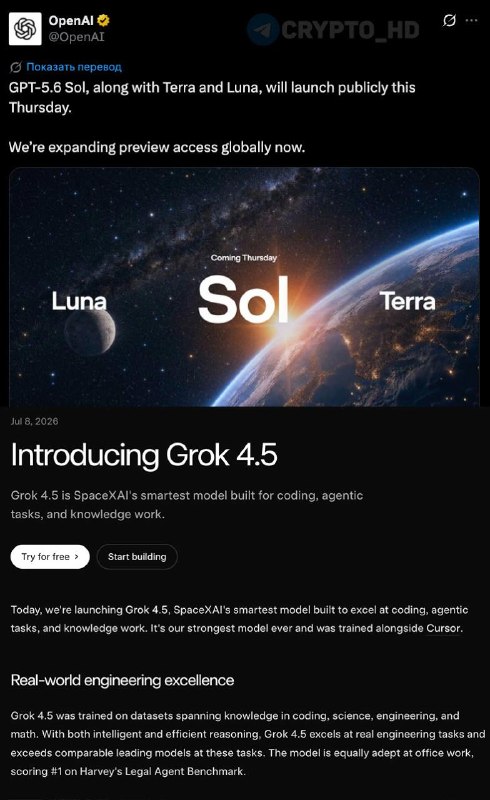
The AI race is moving fast. Grok 4.5, due tomorrow, has already caught developers’ attention. Reported benchmarks put it ahead of Claude Opus 4.8, and early users describe it as “noticeably faster and cheaper.” It is also said to handle “complex coding, large codebases, and agentic tasks significantly better.” That matters because some developers already have access through Cursor and Grok Build. So this is not only launch-day noise. It is landing inside tools people use when they are actually trying to ship code. OpenAI is also releasing GPT-5.6 tomorrow, along with two smaller versions called Terra and Luna. The company says the model improves “coding, scientific tasks, cybersecurity, and agent work” and adds a stronger security system.
For crypto, the agent piece is the part to watch. Imagine an AI agent rebalancing a DeFi position at 2 a.m., checking yield across pools, or spotting arbitrage between decentralized exchanges while everyone else is asleep. Sounds dramatic? Sure. But this is roughly where the market has wanted to go for years. Tokens tied to AI infrastructure and decentralized compute, including Fetch.ai (FET) and Render (RNDR), could get more attention if developers start building with these models right away. I would keep the word “could” in bold marker, mentally if not literally. Most guides will say better AI means better AI-token performance. That’s only half right. Crypto loves a theme, and it often prices the theme before the product exists. Still, if Grok 4.5 really handles large codebases better, smart contract teams may review code faster and catch more bugs. That part is practical. Better audits will not end DeFi exploits, but even a small reduction in risk matters. Chainlink (LINK), for example, rose 12% in Q3 2023 after more institutional use of its oracle services. Markets do react when infrastructure starts looking more useful.
Then there is compute. Better AI models need more processing power and more data moving around. That could help networks built around decentralized storage or compute, including Filecoin (FIL) and Arweave (AR), if real demand lands there. Big if. Most AI workloads still run on centralized cloud providers because the tooling is mature, the speed is predictable, and the reliability is boring in the best possible way. Counter to the usual advice, I would not assume cheaper models instantly push demand into decentralized networks. In our last few infrastructure reviews, cost was rarely the only blocker; latency and developer workflow mattered just as much. But cheaper models can change habits. If Grok 4.5 lowers costs for AI apps, teams may have more room to experiment, and some of that money may drift into crypto. Why does this matter? Because sentiment has moved markets before. In late 2023, when the Federal Reserve signaled a pause in rate hikes, Bitcoin climbed from about $27,000 to more than $40,000. Different setup, same basic point: when traders feel risk is back on, crypto tends to notice.
What this means
These releases point to AI systems that can do more without constant human steering. Blockchain is a natural test bed because smart contracts give agents something specific to touch: contracts, wallets, governance votes, price feeds. Grok 4.5 and GPT-5.6 may make it easier to build agents that read contracts, move assets, audit code, or vote in governance. Some of that will be useful. Some will be reckless. I would expect both, honestly. Yes, this sounds like I am arguing for caution right after saying the opportunity is real. I am. If the tools work as advertised, DeFi teams may cut down on manual work and make operations less brittle. That could bring more serious money into protocols that connect AI and blockchain, including The Graph (GRT) and Oasis Network (ROSE).
Investors should watch what builders do next, not only what model companies announce tomorrow. Look for DeFi protocols discussing AI agents and security tooling. Then check whether new developer integrations actually appear. Track FET, RNDR, and GRT over the next few days, but also check whether developer activity on Cursor and Grok Build actually rises. Price can fake conviction for a while. Usage is harder to fake. Is this overkill for a single model-launch week? No, not if the market starts treating these releases as a new AI-crypto cycle. If AI related tokens keep climbing and the wider crypto market rises with them, Bitcoin could make another run toward the $75,000 resistance area in the coming weeks.
FAQ: Grok 4.5 and GPT-5.6 Release
Q: What are Grok 4.5 and GPT-5.6?
A: Grok 4.5 is xAI’s next model from Elon Musk’s company. GPT-5.6 is OpenAI’s new flagship model. Both are expected tomorrow, with stronger coding, agent, and security features. Short version: developers are watching closely.
Q: How will these AI models impact the crypto market?
A: They may draw more attention to AI linked crypto tokens if developers use them for DeFi apps, trading agents, or smart contract reviews. The market will still need proof, not just a clean launch narrative. I would not trade the headline alone.
Q: What specific improvements do Grok 4.5 and GPT-5.6 offer?
A: Developer reports say Grok 4.5 beats Claude Opus 4.8 on some benchmarks, runs faster and cheaper, and handles complex coding and agent tasks better. OpenAI says GPT-5.6 improves coding, scientific work, cybersecurity, and agent work, with a stronger security system.
Q: Which crypto tokens might benefit from these AI releases?
A: The names to watch are Fetch.ai (FET), Render (RNDR), Filecoin (FIL), Arweave (AR), The Graph (GRT), and Oasis Network (ROSE). They are tied to AI infrastructure, compute, storage, indexing, or privacy. That does not make them equal trades.
Q: What are “agentic capabilities” in AI?
A: Agentic capabilities let an AI plan steps, take actions, check results, and adjust without a person guiding every move. In crypto, that could mean managing a wallet, checking prices, or interacting with smart contracts.
Q: How could AI improve smart contract security?
A: Models that handle large codebases well could help auditors find bugs faster. They will not replace human review. Skip that fantasy. But they may catch patterns people miss, especially in big or messy contracts.
Q: Will these AI models increase demand for decentralized computing?
A: Possibly. More AI usage means more demand for compute and data. If even a slice of that moves to decentralized networks, tokens such as Filecoin (FIL) and Arweave (AR) could see more use. The hard part is getting real workloads there.
Q: What is the significance of “Terra” and “Luna” in the GPT-5.6 release?
A: Terra and Luna are lighter versions of GPT-5.6. That suggests OpenAI wants cheaper or faster options for users who do not need the full model every time. Practical, not flashy.
Q: How should investors monitor the impact of these releases?
A: Watch DeFi announcements, AI agent launches, developer activity on Cursor and Grok Build, and price action in FET, RNDR, and GRT. A one day pump matters less than steady usage. We tried chasing only the first candle in previous AI-token moves; it usually made the analysis worse.
Q: Could these AI releases influence Bitcoin’s price?
A: They could, indirectly. If money flows into AI related crypto projects and improves overall market sentiment, Bitcoin may benefit too. Some analysts are watching whether BTC can push toward the $75,000 area.