
















































US strikes Iran commercial vessels: Bitcoin’s safe-haven story gets tested
US Central Command says it hit Iranian targets after what it described as Iran’s “unprovoked, dangerous aggression” against three commercial vessels in the Strait of Hormuz. Markets cannot shrug that off. My take: this is exactly the kind of headline that makes Bitcoin’s safe-haven pitch stop being theory and start being marked to market. BTC tends to move quickly when Middle East risk hits the tape.
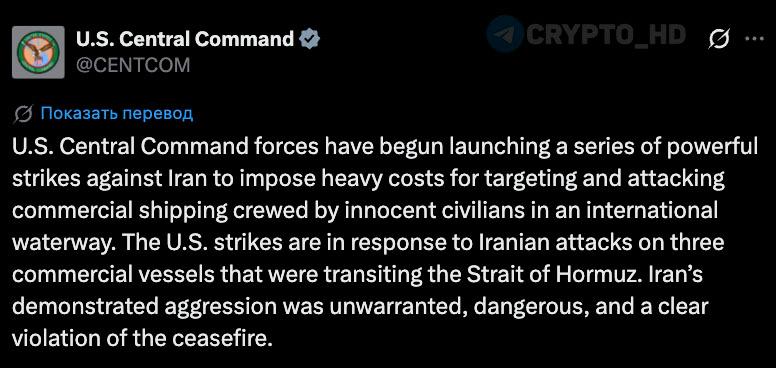
The strikes came after the US accused Iran of attacking three commercial vessels moving through the Strait of Hormuz, one of the world’s most important oil shipping routes. Washington also called the incident a “clear violation of the ceasefire regime.” Why does this matter? Because that waterway is not a background detail; it is where oil risk, military risk, and inflation risk meet. Oil reacts. Gold reacts. Stocks react. Crypto does its own messier version.
Bitcoin has been here before, or close enough for traders to force the comparison. After the January 2020 Soleimani strike, BTC rose about 8% in 72 hours and beat gold over that short stretch. That number will get dragged back into every trader chat now, whether it deserves to or not. The setup looks similar at first glance: US-Iran tension, shipping risk, fast headlines. But Bitcoin in 2026 is not Bitcoin in 2020. More institutions own it now. Most guides call that bullish for the digital-gold story. That’s only half right. Institutional ownership can help the store-of-value case, but it can also make BTC trade like a risk asset when liquidity gets thin. I would watch $61.4K first. A clean break above that level would matter. A quick pop that fades would matter more. That is the tell.
The macro picture is messier. Middle East instability can push oil higher, and higher oil can bring inflation worries back into the room. If inflation expectations rise, the Federal Reserve has less room to sound relaxed on rates. That matters for crypto. A hawkish Fed usually pulls liquidity out of the market, and Bitcoin does not handle that well. Still, if traders read this as a short shock instead of the start of a wider conflict, BTC could catch a bid as a hedge. Yes, that contradicts the risk-asset point a bit. Bear with me. For a few hours, both stories can be true.
What this means
Geopolitical risk has jumped after these strikes. Put simply, a political shock now has a better chance of spilling into markets. I’ll be honest: the first move is often noisy enough to fool people.
For crypto, Bitcoin is back in its old argument with itself. Is it digital gold, or a high-beta risk trade with better branding? The next 24 to 72 hours should give a cleaner read. I would compare BTC with gold and major stock indexes instead of staring at the BTC chart alone. If Bitcoin holds above $61.4K while stocks weaken and gold rises, the safe-haven case looks stronger. If it falls with tech stocks, that case takes another hit. Simple test. Hard market.
Watch the first 24 hours, then the 72-hour follow-through. The levels are clear enough: $61.4K resistance and support near $58K. Also watch statements from Washington and Tehran. A calmer line from either side could cool the move fast. A sharper one could do the opposite. Is this overkill for one headline? No, because the headline touches oil, rates, and liquidity at the same time. Oil prices matter too. If crude spikes and stock indexes sell off, crypto will probably feel that pressure even if Bitcoin gets an early fear bid.
FAQ: US strikes Iran commercial vessels and Bitcoin’s response
Q1: What prompted the US strikes against Iran?
A1: US Central Command said the strikes followed Iran’s “unprovoked, dangerous aggression” against three commercial vessels in the Strait of Hormuz.
Q2: How has Bitcoin historically reacted to geopolitical instability?
A2: Bitcoin has sometimes risen during geopolitical shocks. After the January 2020 Soleimani strike, BTC gained about 8% within 72 hours.
Q3: What is the “safe-haven narrative” for Bitcoin?
A3: The safe-haven narrative says Bitcoin can act as a store of value during economic or geopolitical stress, somewhat like gold. My read: the word “can” is doing a lot of work there.
Q4: What technical levels should traders monitor for Bitcoin?
A4: The near-term levels are $61.4K for resistance and roughly $58K for support.
Q5: How might this event impact broader macro flows?
A5: More tension in the Middle East can lift oil prices. That can bring back inflation fears and shift expectations for Federal Reserve rate policy.
Q6: What is the Strait of Hormuz and why is it important?
A6: The Strait of Hormuz is a major oil shipping route. A large share of global oil supply moves through it, so markets react when trouble starts there.
Q7: Has Bitcoin’s institutional adoption changed its safe-haven potential?
A7: Bitcoin has more institutional ownership than it did in 2020. Counter to the usual advice, that is not automatically stabilizing. It may help its store-of-value case, but it can also make BTC more sensitive to broad market liquidity.
Q8: What other market indicators should be watched?
A8: Watch oil and gold first. Then check stock indexes and the US dollar. Together, they will show whether traders are buying safety or cutting risk across the board.
Q9: Could a hawkish Fed stance impact cryptocurrencies?
A9: Yes. If the Fed sounds more hawkish, liquidity usually tightens. That tends to hurt risk assets, including crypto.
Q10: What does “unprovoked aggression” mean in this context?
A10: In the US account, it means Iran acted against commercial vessels without a prior hostile move from the US or its allies.