
















































21Shares files Canton ETF, and the SEC is about to tell us which chain gets the next wrapper
The 21Shares Canton Network ETF is a proposed U.S. exchange-traded fund that would give retail investors regulated exposure to Canton, a privacy-enabled blockchain built for tokenized real-world assets. 21Shares filed for it in the U.S., which pulls one of crypto’s most institution-heavy chains into the same regulatory funnel that produced the spot Bitcoin and Ether ETFs. I’ll be honest: the filing matters more than the asset itself. Another niche layer-1 is now fighting for Wall Street wrapper capital. The SEC’s response will not just affect Canton; it will sketch the next approval map for chain-level ETF products.
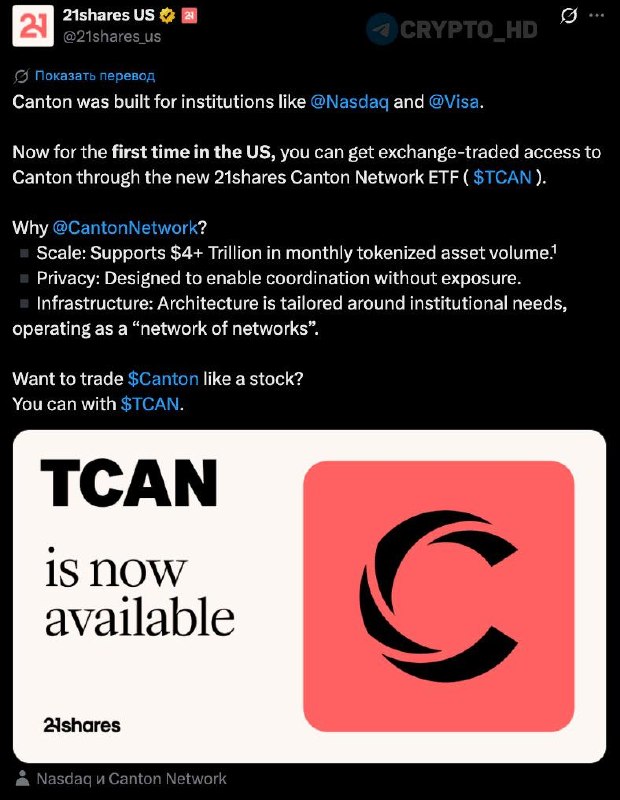
Per the filing announcement, the Swiss issuer pushed the product through its U.S. arm. 21Shares already runs one of Europe’s biggest crypto ETP shelves and co-sponsored the U.S. spot Bitcoin ETF, so this is not a first meeting with regulators. Canton was built by Digital Asset and is backed by Goldman Sachs, BNP Paribas, and Deloitte. That mix matters. We are not talking about a meme chain with a Discord army; Canton was designed for tokenized bonds, funds, repo, and the trillion-dollar back-office plumbing people pretend is dull until fees appear. A U.S. ETF tied to its native asset would be the first retail-grade American exchange wrapper for a permissioned, institution-first chain. Not a footnote.
The regulatory angle is the actual test here. The SEC spent two years gating spot crypto ETFs behind surveillance-sharing agreements and CME futures markets. Canton has neither a deep U.S. spot market nor a futures product. Most guides say the ETF fight is about “institutional adoption.” That’s only half right. The real gate is market structure: float, custody, pricing, surveillance, redemption mechanics. So 21Shares is testing a different door. If the filing clears under the streamlined generic listing standards the SEC rolled out for digital-asset ETPs in late 2025, tokenization-focused chains get a template. Avalanche gets one. Provenance gets one. Chainlink-anchored products get one too. If it stalls, the message is blunt: “institutional” branding does not fast-track approval.
The adoption signal cuts deeper into the RWA story. Canton’s pitch is tokenized assets, the same thesis that pushed BlackRock’s BUIDL fund past $2 billion and made real-world assets the loudest non-meme narrative of the cycle. Why does this matter? Because an ETF wrapper can route passive flow into the thesis without investors holding the underlying token directly. That is the same structural shift that turned Bitcoin into a portfolio allocation instead of just a trade. Per public validator data, Canton’s float is small and clustered among institutional validators, so even modest ETF inflows could move the asset much harder than they would BTC or ETH. My take: that float detail is the whole trade. Small float plus regulated bid has punished shorts before.
The macro read favors regulated wrappers over offshore venues. The 21Shares filing lands in a market where COIN is the default “crypto infrastructure” equity, and every new ETF approval has compressed the premium between regulated wrappers and spot tokens. Counter to the usual advice, this is not just bullish for “crypto beta.” It is bullish for the legitimacy trade and less friendly to exchanges that built moats on jurisdictional arbitrage. Simple split. Regulated wrappers gain credibility. Offshore liquidity venues lose some narrative power.
No timeline was disclosed in the announcement, and 21Shares has not said publicly which custodian or index provider will back the product. Per SEC procedural rules, the agency has 240 days to act on a 19b-4 once the filing is formally docketed, with the first decision window usually landing around day 45. Is that slow? For traders, yes. For ETF plumbing, no.
What this means
This is a regulatory probe wearing a product launch costume. 21Shares is asking the SEC whether a privacy-permissioned, institution-backed chain qualifies for the same ETF treatment as Bitcoin and Ether. Yes, this slightly contradicts the easy “Canton is institutional, so approval should be easier” argument. Bear with me. If approved, the RWA narrative gets a public-market vehicle, and Canton’s native asset moves from validator-only liquidity to ETF-flow liquidity. That is a structural re-rating, not a vibe shift. If denied, the market learns that “institutional adoption” is not yet a regulatory shortcut, and the RWA premium baked into ONDO, AVAX, and LINK comes under pressure quickly.
Three things actually matter for traders tracking this filing. First, watch the SEC docket for the formal 19b-4 publication. That starts the official review clock. Then track Canton’s on-chain validator activity, plus any disclosed AUM figures from 21Shares Europe, as leading demand signals. On the equity side, COIN and Galaxy Digital tend to front-run ETF news by 5 to 10% on the announcement window. We have seen that pattern enough times that I would not ignore it. The next real data point is the first SEC response, expected within the standard 45-day initial review.