
















































Russia’s stablecoin proposals: a regulatory tightrope for crypto
Russia’s Central Bank, the CBR, wants feedback on ruble-backed stablecoins by September 1. Big headline, smaller move. The bank is not preparing to turn stablecoins into everyday payment money inside Russia. It is asking a narrower question: do ruble-linked tokens need cleaner rules for international settlement?
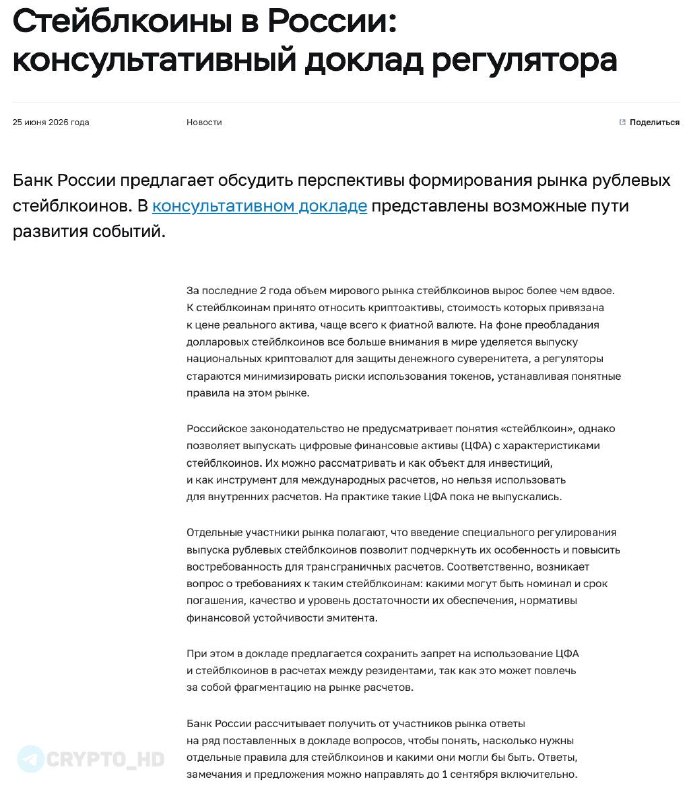
That distinction matters. Russia still has no separate legal definition for “stablecoin.” It does, however, already regulate digital financial assets, or DFAs, which can look similar once they are actually used. DFAs can be used for investments and some international payments, but not for domestic goods and services. So the CBR is not starting from zero. My take: this is less a crypto opening than a filing-cabinet problem with geopolitical consequences.
The choices are fairly limited. The CBR could leave the DFA framework alone and keep using it. It could give Russian stablecoins a separate legal status, maybe as a specific type of DFA. The bank says that would make them easier to identify and could make market participants more willing to use them. Or it could test the rules through an experimental legal regime. Most guides would frame this as “regulate or ban.” That’s only half right. Russia is already in the middle lane, deciding how much labeling and control to add.
Here is the part crypto investors should care about. The CBR is considering a model where only banks and special purpose vehicles, or SPVs, could issue Russian stablecoins. SPVs would probably face tougher rules, including separate backing assets, possible overcollateralization, and outside oversight. Banks would have more room to maneuver because their tokens could be backed by the bank’s own assets. This is not a free market version of stablecoins. It is permissioned and bank centered, with the state keeping a hand near the switch. That’s the point.
The CBR is still firm on domestic payments. It says lifting the ban on using DFAs and stablecoins for payments between Russian residents is “unjustified.” Why does this matter? Because the CBR is drawing a hard line between trade settlement and money used by households. I would not read that as temporary caution. It sounds like the CBR wants stablecoins for trade plumbing, not for Russians buying coffee, paying rent, or shopping for groceries. Market participants have until September 1 to submit proposals. After that, the regulator will decide whether stablecoins need their own rules or whether the DFA regime can keep doing the job.
For the crypto market, this is not an adoption breakthrough. It is a regulatory temperature check. Russia is a large economy, and its central bank has the same fear many central banks have: digital assets may be useful, but only if they stay inside a controlled box. Counter to the usual crypto read, tighter stablecoin rules are not automatically bullish. This is not the same fight as the SEC cases against Coinbase or Binance. Still, the mood is familiar. Regulators want tokenized money to move faster. They do not want to give up control over payments, bank rails, or capital flows.
The CBR’s model could appeal to governments that want stablecoins for international trade without allowing open crypto payments at home. The United States is still working through stablecoin legislation. Russia, meanwhile, seems to be sketching a more centralized version, with banks and approved vehicles in the middle. Emerging economies may watch closely, especially those that want alternatives to traditional financial rails but do not want retail crypto spreading through the domestic economy. I’ll be honest: this should cool the lazy idea that every stablecoin law means wider crypto adoption. Some laws open doors. Others build fences.
The cross border angle matters too. Countries have been looking for ways around SWIFT based settlement, especially since sanctions and geopolitical tensions made payment rails feel less neutral. A regulated ruble stablecoin could give Russia another tool for trade with willing partners. Is it a Bitcoin style safe haven asset? No. It would still carry ruble risk. But for invoices and settlement timing, a tokenized ruble might be easier than older banking channels in some cases. Trade accounting matters here too, even if it sounds dull.
Take India and Russia. If they settled a meaningful share of trade with a ruble stablecoin, that would not overturn the dollar system overnight. But it could move a small slice of financial flow away from the usual fiat channels. Enough small moves like that, across enough countries, would make global payments more fragmented. Banks and regulators would hate the mess. Yes, this sounds like it contradicts the “not bullish” point above. Bear with me. Fragmentation can create openings for networks like Ethereum, which are built around programmable settlement and alternative financial rails, even when governments prefer closed systems for national currency.
What this means
The CBR is not embracing crypto. It is trying to domesticate one narrow piece of it. Banks and SPVs would issue the tokens. Domestic payments would stay off limits. Cross border settlement would be the main use case. That says a lot about where this is heading: digital assets may enter national financial systems, but under tight rules and with familiar institutions in charge.
For traders, the risk is that other major economies copy the restrictive parts. If stablecoin regulation becomes mostly bank led, permissioned, and limited to approved uses, the market may need to rethink what “adoption” means. That could weigh on sentiment for BTC, ETH, and other large crypto assets if investors expected broader payment use. I would watch the details more than the headline: who can issue, who can hold, where the token can move, and whether public blockchains are involved at all. Small wording changes will matter.
The next date is September 1, when market feedback is due. The responses should show whether Russian banks, issuers, and trade firms actually want this product under the CBR’s conditions. Strong pushback could force revisions. Quiet acceptance would suggest the market is willing to work inside a tightly managed structure. We will learn more from the objections than from the press release.
After that, watch the CBR’s timeline. A quick decision would give the market clarity. A long review would probably drain interest. The ruble matters too. A ruble-backed stablecoin is only as useful as the currency behind it. If the ruble is unstable against major currencies, the token may work only as a settlement tool for specific corridors. If the ruble holds steady, the case for using it in cross border trade gets easier to make.