
















































Russian economy central bank criticism: Elvira Nabiullina under fire, crypto implications
Russia’s central bank chief, Elvira Nabiullina, is getting blamed for an economy that seems to be irritating everyone at once. That matters for crypto because messy macro stories can bleed into risk markets. Businesses want lower rates. Households want prices to stop rising and wages to catch up. The government wants inflation under control without people getting openly angry. Good luck making all of that work at the same time. My take: this is exactly the kind of macro noise crypto traders pretend to ignore until liquidity starts drying up. One unnamed source called the situation “total failure on all fronts.” If the pressure keeps building, investors may cut exposure to emerging markets. That can dent the risk appetite that often helps Bitcoin and other crypto assets climb.
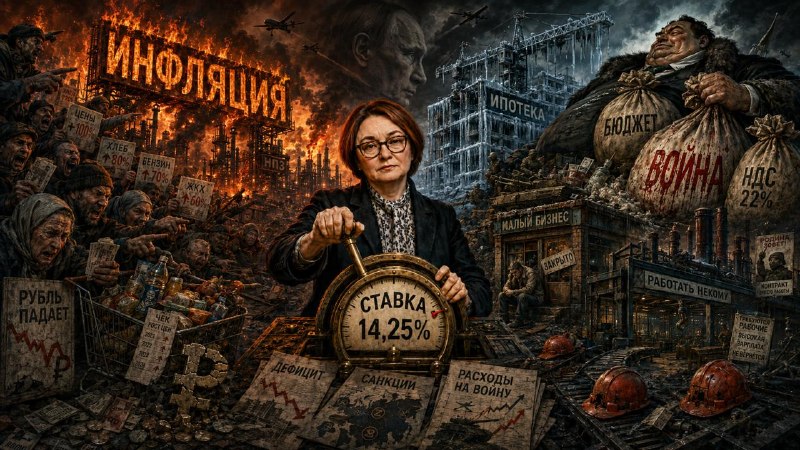
Nabiullina has become the easiest target for Russia’s economic frustration. The source called her the “scapegoat” for problems that go well beyond one central banker. That part matters. Businesses want “low rates and cheap loans” because borrowing costs are high and growth is under pressure. People want “low prices and rising wages” because household budgets feel tighter. The government wants “low inflation” without an angry public. Most central-bank commentary frames this as a clean policy tradeoff. That’s only half right. This is also a political pressure cooker, and those goals do not fit together cleanly. According to the report, the result is “total failure on all fronts.” Harsh? Yes. But it captures the mood.
Russia’s economic stress gives crypto investors one more macro risk to watch. Russia does not need to be the center of the global economy to cause problems. If its central bank keeps policy tight to fight inflation, it adds to the sense that liquidity is harder to find. Risk assets usually do not like that. Bitcoin (BTC) and Ethereum (ETH) tend to react when traders stop chasing upside and start thinking about cash or dollars. Why does this matter? Because crypto still trades like a high-beta risk asset during stress, no matter how often people call it independent money. The cleaner version came in 2022, when Federal Reserve rate hikes helped push BTC from about $48,000 in March to below $17,000 by year-end, according to CoinMarketCap data. Russia is not the Fed. Still, instability there adds another problem to a market that already has enough of them.
The pressure on Nabiullina could also give Bitcoin’s hedge argument a bit more room. I’ll be honest: I would not overstate this. When people see a national financial system attacked from inside its own political structure, some start looking for assets outside that system. That does not mean everyone rushes into BTC overnight. Markets are messier than that. But Russia has dealt with ruble volatility before, and the phrase “total failure” is the sort of thing investors notice. In February 2022, during the first days of the Ukraine war, BTC rose roughly 4% to 7% within 72 hours, according to Reuters analysis, as some investors looked beyond traditional currencies and banks. Counter to the usual advice, the hedge story does not need mass adoption to move price. It only needs a small group of nervous buyers at the wrong moment. If this domestic blame game gets louder, Bitcoin may draw fresh interest as a hedge against local economic stress, even if the price reaction is uneven.
What this means
The criticism of Russia’s central bank points to real economic strain. Crypto traders should read it as another risk-off signal, not a stand-alone price trigger. This probably does not move BTC on its own. Skip the drama trade. But it adds to the same pile: inflation worries and tight money. Political stress sits beside that. So does weaker demand for volatile assets. For crypto, the question is whether capital gets more cautious. Is this overkill for one Russia story? No, because BTC and ETH can feel it quickly if investors pull back from emerging markets or riskier trades.
Watch the Russian central bank’s next moves, especially on rates, capital controls, and inflation language. I would focus less on the public blame and more on what policy actually does next. Sudden policy changes could spill into emerging markets and then into crypto sentiment. The ruble matters too. A sharp drop against the dollar or euro would suggest the stress is getting worse. For BTC, the $61.4K support area is worth watching. A clear break below it would point to weaker sentiment, while a rebound would show buyers are still willing to step in despite the noise. Yes, this slightly contradicts the idea that Russia is not a stand-alone price trigger. Bear with me: single headlines rarely move crypto for long, but support breaks can turn background stress into a real trade. Russia’s next inflation and GDP releases should show whether this is mostly political pressure or the start of a more serious economic crack.