
















































Russia crypto regulation bill update: what changes for digital assets
“Russia’s State Duma Committee on Financial Markets has approved a crypto regulation bill for its second reading. If it passes, crypto investors and traders would get court protection for digital assets and clearer market rules.”
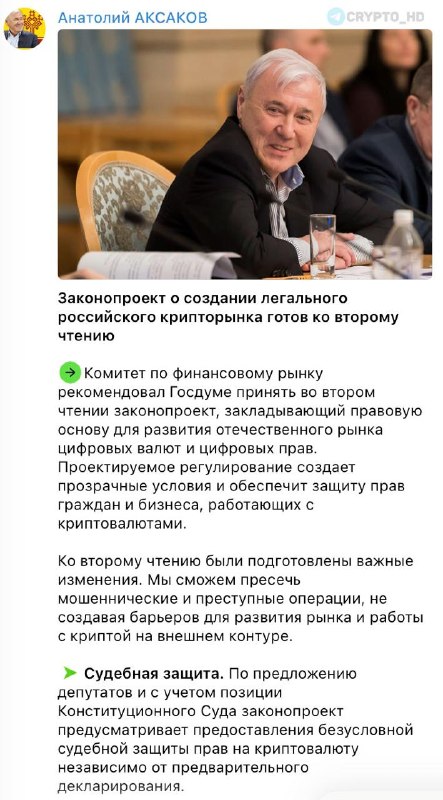
The bill, backed by Anatoly Aksakov, does a few specific things, not just the usual “regulatory clarity” blur. Crypto rights would be protected in court even if the owner had not declared the assets before. That is the headline. For Russian holders, crypto moves from awkward legal gray zone toward something a judge can actually deal with. Owners of foreign wallets would not have to disclose wallet addresses; they would report balances and turnover instead. My take: that is a compromise between surveillance and operational sanity. Exchanges would also be allowed to send purchased crypto only to the buyer’s own account, which points at one obvious target: suspicious transfers and account abuse.
Digital depositories would be allowed to freeze large transfers abroad or to third parties for up to 48 hours if they suspect fraud. Short window. Big consequence. Why does this matter? Because in crypto, 48 hours can be the difference between tracing funds and writing them off. Non-qualified investors would still be able to buy the most liquid cryptocurrencies, but only up to 300,000 rubles per year through each intermediary. Qualified investors would be able to buy any crypto assets, as long as both groups pass a special test. Most guides will frame that as simple investor protection. That is only half right. The interesting part is that a person could qualify based on past crypto trading experience, although the test will decide whether that is genuinely practical or just nice wording.
Russian brokers and asset managers may later be allowed to work with foreign crypto exchanges and platforms. That could help liquidity, if the final wording does not make the access too narrow. Crypto would also be allowed for payments in securities transactions and Russian digital rights, pulling digital assets closer to ordinary market infrastructure. For foreign economic activity (FEA), the rules stay loose in a very deliberate way. Settlements could use Russian or foreign intermediaries. Any wallets. Any cryptocurrencies or stablecoins. According to the State Duma Committee on Financial Markets, the bill is expected to pass by July 20, with its main provisions taking effect on September 1, 2026.
Russia’s move fits a larger pattern: governments are no longer treating crypto as a thing floating outside finance. I’ll be honest: that framing sounds boring, but it is where the market structure story is. It matters around macro flow, because rules from a large economy get noticed by desks that otherwise ignore crypto politics. They may still hate the risk. Fair enough. But unclear rules are often worse than strict ones. The US has proved that repeatedly, with SEC actions, ETF headlines, and enforcement news jolting sentiment around assets like ETH. This Russian bill will not suddenly reprice BTC in New York. It does add another piece to global crypto regulation, though, and over time that can make the market feel less improvised to traditional finance.
The FEA language is the part that sticks with me. It connects directly to the safe haven narrative. If cross border settlements can use any crypto or stablecoin, Russia is leaving room for a payment channel outside the usual banking rails. Counter to the usual advice, the important asset here may not be BTC first. Stablecoins may matter more in actual invoices. BTC has moved sharply during geopolitical stress before, including in the early stages of the Ukraine conflict, when some investors treated it like digital gold and others treated it like a high beta risk asset. The price showed both instincts. Messy, but real.
The immediate BTC impact may be limited. I would not trade the headline alone. Still, the bill adds weight to crypto’s role as a trade and settlement tool, especially for countries trying to reduce reliance on dollar based systems or work around sanctions. Is this overkill as a market signal? For a single bill, yes. For the broader direction of policy, no. Stablecoins may be the cleaner fit because nobody wants a shipment priced in an asset that can move 6% before breakfast. BTC could still benefit in specific corridors if traders use it as a settlement layer or reserve asset. The permission to use crypto in securities transactions also narrows the gap between conventional finance and digital finance. I would not call that revolutionary. I would call it another piece of the wall going up.
What this means
“Russia’s bill shows crypto being pulled into the financial system instead of left outside it.” Court protection for crypto rights and separate rules for qualified and non-qualified investors point to a more formal market. That can make participation less risky for ordinary investors, though “less risky” is carrying a lot of weight. Crypto is still crypto. For institutions, clarity is the bigger issue. A fund or broker can work with rules it understands. Vague enforcement risk is harder to price.
The bill may not cause a sudden move in BTC or ETH. Markets rarely reward legal plumbing right away. Yes, this slightly contradicts the excitement around regulation headlines. Bear with me. The longer term effect is more likely to show up through confidence and lower operational risk, then possibly deeper liquidity. The rule allowing crypto payments in securities transactions is worth watching because it treats digital assets more like financial instruments than casino chips. That difference matters, although the final impact still depends on implementation.
Investors should watch whether the bill passes by July 20 and whether the September 1, 2026 start date holds for the main provisions. The broker and asset manager rules will matter. So will the practical rollout of the FEA provisions. If companies start using crypto for cross border settlements, demand for certain stablecoins could rise, and BTC may get another use case as a settlement asset. In my view, the first real signal will not be a speech; it will be follow-up guidance from the Russian Central Bank or Ministry of Finance. Track the plain data points: qualified investor approvals, broker access to foreign platforms, volume of crypto based securities transactions, and whether securities payments actually happen outside pilot cases.
FAQ: Russian crypto regulation bill
- What is the main goal of the new Russian crypto regulation bill?
- The bill would give digital assets court protection and set operating rules for Russia’s crypto market.
- When is the bill expected to pass and when will its main provisions take effect?
- According to the State Duma Committee on Financial Markets, the bill is expected to pass by July 20. Its main provisions are expected to take effect on September 1, 2026.
- Will foreign wallet owners need to disclose their addresses?
- No. Foreign wallet owners would report balances and turnover, but not wallet addresses.
- What is the limit for non-qualified investors?
- Non-qualified investors would be limited to 300,000 rubles per year through each intermediary for the most liquid cryptocurrencies.
- Can cryptocurrency be used for payments in Russia under this bill?
- Yes. Crypto would be allowed for payments in securities transactions and Russian digital rights.
- How will foreign economic activity (FEA) be regulated?
- FEA would stay mostly unrestricted. Settlements could use Russian or foreign intermediaries, any wallets, and any cryptocurrencies or stablecoins.
- What role will digital depositories have?
- Digital depositories would be able to freeze large transfers abroad or to third parties for up to 48 hours if needed to protect clients from fraud.
- How can someone become a qualified investor?
- A person could qualify through prior crypto trading experience and by passing a special test.
- Will Russian brokers be able to work with foreign crypto exchanges?
- Yes. Russian brokers and asset managers may be allowed to work with foreign crypto exchanges and platforms later.
- Why does court protection for crypto rights matter?
- It gives crypto holders a legal route to defend their assets in court, even if they had not declared the assets before.