
















































Hantavirus Outbreak on MV Hondius Cruise Ship Tests Crypto’s Pandemic Memory
The MV Hondius hantavirus outbreak is a contained maritime health incident involving the Andes virus strain. Every passenger and crew member sits under a 42-day WHO quarantine as high-risk contacts. A hantavirus outbreak on the MV Hondius cruise ship has every passenger and crew member flagged as high-risk contacts, and the WHO just ordered a 42-day quarantine. I’ll be honest: that wording lands badly if you traded through early 2020. The setup has the same uncomfortable cruise-ship texture as the headlines that ran just before Bitcoin’s worst liquidation week on record. The UN Secretary-General says epidemic risk stays low. I have heard that exact phrasing before. February 2020. Days before BTC lost half its value in a week.
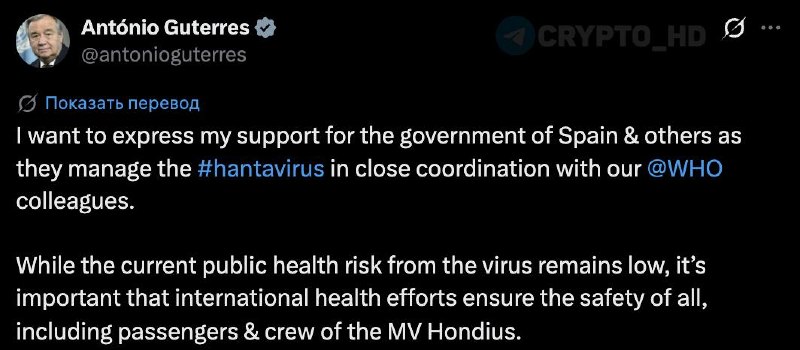
Crypto desks should focus on three things, not the whole noise cloud. The strain is Andes virus, the one hantavirus known to transmit person-to-person. Fatal cases are confirmed. And 30 passengers already disembarked at Saint Helena on April 24, before the outbreak was officially declared. That last detail is the red flag. Not dramatic. Just operationally ugly.
The bulletin establishes four concrete facts. Per the WHO statement: (1) all passengers and crew on the MV Hondius are now classified as high-risk contacts, (2) a 42-day quarantine covers the entire manifest, (3) evacuations are running on dedicated flights, with some passengers transferred to isolation under medical supervision, (4) confirmed and suspected infections include deaths, though the statement gives no specific count. Authorities in several countries are tracing people who came into contact with passengers after disembarkation. That includes the Saint Helena group from April 24. It also includes additional passengers who got off at Tristan da Cunha.
The WHO and European regulators say this is not a global epidemic threat. Most market notes will stop there. That is only half right. The statement matters, but so does the market’s memory of January and February 2020, when officials used similarly contained language before the tape decided to care. My take: this is not a forecast. It is a scar traders still price.
Safe-haven angle: BTC’s pandemic playbook is not what people think. Bitcoin historically behaves as a high-beta risk asset during the panic phase of a health crisis. Not a safe haven. The popular narrative says Bitcoin is digital gold and rallies on crisis. The March 2020 tape disagreed violently. When COVID-19 went from “low risk” to global pandemic between February 20 and March 12, 2020, BTC collapsed from roughly $10,400 to under $4,000. A 60% drawdown in three weeks. The asset traded as the highest-beta risk position in the book, not a hedge. Only after the Fed’s emergency liquidity flood did Bitcoin decouple and start its run to $69K. Why does this matter? Because the virus did not create the bull case. The monetary response did.
Andes virus is not COVID. Case fatality is high but transmissibility is far lower, and a cruise-ship containment is structurally different from an airborne respiratory pathogen with months of unmonitored spread. Yes, this cuts against the scary headline. Bear with me. That distinction matters for the base case, but it may not matter during the first 48 hours of headlines, when positioning desks and algos are scanning for pandemic-coded language rather than parsing virology. If the WHO or a major health ministry hits the wires with escalated language, expect a knee-jerk risk-off bid in DXY and Treasuries. BTC and the high-beta alt complex would likely take the other side. SOL, AVAX, and the AI-adjacent token basket tend to lead drawdowns by 1.5x to 2x BTC’s move.
Macro flow angle: this lands on a Fed already on a knife edge. The real driver of crypto pricing in a health-scare scenario is the repricing of the Fed rate path. Not the virus. A health scare that pulls forward expectations of growth softening reprices the rate path. In 2020, futures markets went from pricing zero 2020 cuts to pricing 100+ basis points of easing inside ten trading days. That repricing, not the virus, eventually drove BTC, ETH, and the entire risk-asset complex to new highs. I would watch the front end before I watch the case dashboard. If 2Y yields start sliding 10 to 15 bps on health-scare headlines without a corresponding equity crash, that is the early signal that the market is pricing a Powell pivot. Historically, that is a green light for BTC. It is also supportive for long-duration crypto trades like ETH staking yield plays, L2 tokens, DeFi blue chips, and basis-heavy positioning.
The contact-tracing complication is the wild card. Per disembarkation records, 30 passengers left the ship at Saint Helena on April 24 before the outbreak was declared, and others got off at Tristan da Cunha. National authorities are now hunting down everyone those people met after leaving. Is this overkill? For a cruise-ship outbreak with an Andes virus strain, no. Counter to the usual advice, the headline case count may be less important than the travel map. That is the exact pattern, undetected community spread preceding official acknowledgment, that turned a “contained” Wuhan story into a global market event in 2020. No comparison is one-to-one. But traders who watched the COVID arc will recognize the shape.
What this means
This is a headline-risk event. Not yet a thesis-changing event for crypto markets. The immediate signal is straightforward. Bitcoin’s reaction function during health scares is well-mapped by now: sell first with equities, then diverge higher only if the central bank response is large. The most important variable is not the Andes virus case count. It is whether contact tracing turns up confirmed cases in major financial centers like London, Frankfurt, or New York over the next 7 to 14 days. That is the threshold where positioning desks start treating this as a 2020 analog instead of a contained outbreak. Watch BTC’s reaction to the next WHO situation report. A downgrade in language from “low risk” to “moderate” is the level where the market historically front-runs the policy response.
Specifically, what to watch next. The 42-day WHO quarantine clock runs into mid-June, putting the resolution window squarely against the next FOMC meeting. If any of the Saint Helena passengers test positive in a European or North American jurisdiction before then, expect a fast repricing in front-end rates and a BTC move that follows equity beta down before any safe-haven bid emerges. The technical levels matter. BTC’s reaction to the $61.4K support zone on any health-scare flush will tell you whether 2020 muscle memory or 2024 ETF-flow demand wins the tape. ETH/BTC is the cleaner risk gauge. A break below 0.045 on health-scare headlines is the signal that the high-beta complex is leading risk-off, and that is the moment to size down alt exposure and watch CME Bitcoin futures basis for forced unwinds. We tried to make this cleaner. It is not. Until contact tracing produces a confirmed case outside the original passenger pool, the base case stays the same. Trade the headlines. Do not rewrite the thesis.