
















































Visa Canton Network stablecoin payments point to institutional adoption
Visa is testing private stablecoin settlements on the Canton Network. My take: the goal is not to make crypto exciting. It is to make institutional crypto payments feel less risky, less chaotic, and easier to fit into ordinary finance.
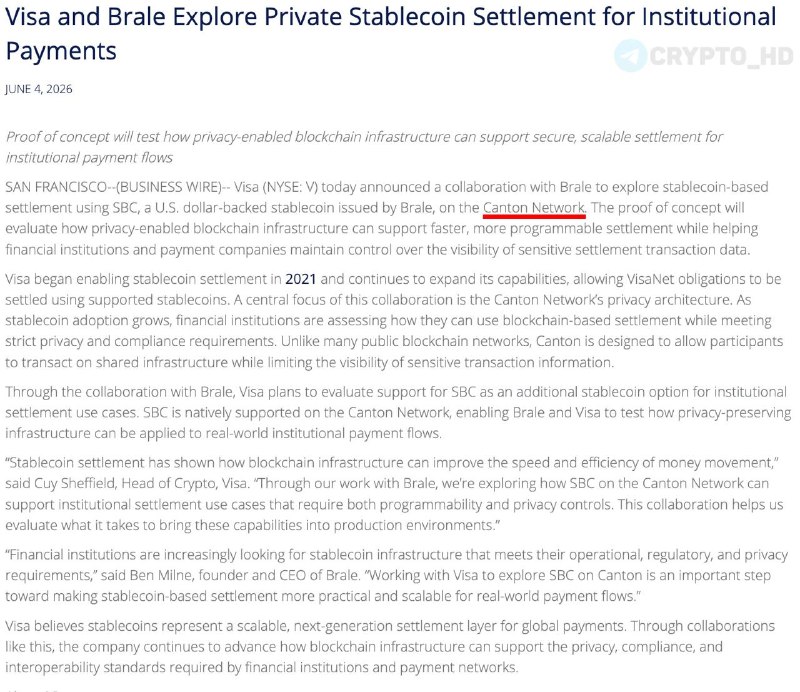
This is not Visa rolling out a flashy consumer crypto app. It is checking whether private stablecoin settlement can handle real institutional payment flows on Canton. Dull? Yes. Useful? Also yes. That sounds boring, but it is exactly the kind of boring banks pay attention to. Large banks and payment companies rarely move onto crypto rails unless they can get comfortable with privacy and compliance. Settlement risk is the third rail here, and it does not go away because a blockchain is involved.
The announcement focuses on Visa’s work with Brale, using Brale’s dollar pegged stablecoin, SBC, on Canton. It is still exploratory. There is no full product yet. The test asks whether private stablecoin transactions can support institutional payments at scale, especially when privacy and permissioning matter. That is the hard part. Institutions already know blockchains can move value. Why does this matter? Because the real question is whether the system can do it without making the compliance team miserable.
This is an adoption signal for stablecoins, but I would not stretch it too far. Visa testing SBC does not mean bank treasury desks will rush into crypto next week. Most crypto commentary treats any Visa stablecoin test as a broad market green light. That is only half right. Still, when a global payments company tests stablecoin settlement for institutional use, the category gets harder to dismiss. We have seen this kind of early signal before, although in a much noisier market. CoinDesk archives show MicroStrategy began buying BTC in August 2020, when Bitcoin traded around $11,000, and BTC later broke $20,000 before the end of that year. This Visa test probably will not spark an instant BTC rally. Different asset, different setup. But it does make stablecoins look more like payment infrastructure and less like crypto back-office plumbing. If these trials keep going, the effect may show up in stablecoin market caps and settlement volume. Crypto liquidity more broadly may feel it later.
The test also points to regulation pressure. Private, permissioned networks like Canton are easier to explain to regulators than fully open systems. They can include controls for transparency and AML/KYC. Counterparty access can be limited too. That is not cypherpunk. It is very Visa. I’ll be honest: this is probably the version of stablecoin infrastructure institutions were always going to prefer. Counter to the usual advice, openness is not always the selling point. The bet seems to be that institutions will use stablecoins if the rails look familiar enough to legal, risk, and compliance teams. The SEC has kept stablecoins under scrutiny, including actions involving some issuers, so demand for cleaner settlement models is not surprising. If this proof of concept works, other firms may borrow the same structure: private network, compliant issuer, limited counterparties, clear audit trail.
What this means
The Visa-Brale test on Canton shows traditional finance moving closer to crypto, but not on crypto’s preferred terms. The model is controlled networks and known participants. Fewer surprises. That is the pitch.
Visa and Brale are not leaning into the open, permissionless version of crypto here. They are taking the parts institutions actually want: faster settlement and programmable money. Operational efficiency sits in the same bucket, but it is less glamorous and probably more important. Then they are putting those pieces behind privacy and controls. Is this overkill? For a serious institutional payment flow, no. That could lift demand for enterprise blockchain networks and compliant stablecoins. It may also bring more institutional liquidity into crypto over time, though probably slowly. These firms move through quarters, committees, risk reviews, and legal signoff. Not Discord hype cycles.
Next, watch whether Visa and Brale move the Canton test beyond proof of concept. A successful trial would matter more if it comes with a path to wider deployment. Yes, this contradicts the excitement around the announcement a little, but bear with me: the press release matters less than whether the workflow survives internal review. Also watch the Federal Reserve and Treasury for digital dollar or stablecoin guidance, since public policy could either help private stablecoins like SBC or make them harder to scale. For the market, USDC and USDT volumes are still useful tells. If institutional stablecoin settlement is really catching on, it should eventually show up in volume and counterparties. Use cases too. Not just press releases.