
















































US Court Blocks Trump’s 10% Global Tariffs in Ruling That Could Reshape Bitcoin’s Macro Setup
The US Court of International Trade ruled on May 7, 2026 that President Trump’s 10% global baseline tariffs are unlawful. That removes a key inflation driver and could weaken the dollar, a setup that has historically helped Bitcoin and risk assets. My take: this is not just another trade-law headline. With the dollar’s tariff-driven strength suddenly in doubt, the ruling lands right on top of Bitcoin’s macro thesis. Every tariff escalation this cycle shoved risk assets in one direction. Every legal reversal snapped them back. Traders watching DXY and BTC correlation just got a live catalyst, not a footnote.
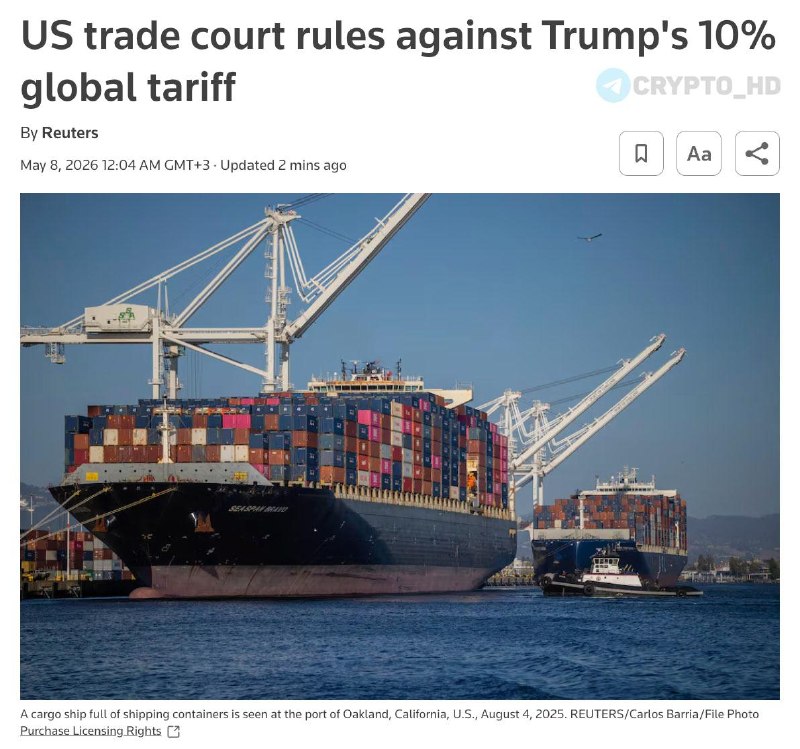
According to Reuters, the trade court blocked the White House’s latest attempt to keep a baseline import tariff alive after the Supreme Court had already gutted the previous tariff scheme. This time the administration leaned on a different legal hook: Section 122 of the Trade Act of 1974, a provision that permits temporary duties when the US faces serious balance-of-payments problems. The judges weren’t buying it. They ruled that sweeping global tariffs “on everything” couldn’t be justified under a statute written for narrow, emergency-style fixes, not a permanent rewrite of US trade policy. Fairly terse ruling signal. Big market consequence.
This is the second judicial defeat for the same policy in a short window. The Supreme Court already knocked down the original tariff framework. The administration tried to swap the legal foundation, keep the tariff rate, and quietly continue collecting the duty. The trade court said no. Most macro notes will frame this as a tariff story. That’s only half right. For markets, the cleaner read is legal compression: the runway for blanket tariffs is shrinking fast, and any importer paying that 10% baseline now has a reason to ask whether refunds, exemptions, or pauses are next.
The macro angle for crypto is what I keep coming back to. Tariffs operated as a stealth tax on US consumption that fed straight into CPI inflation and tied the Federal Reserve’s hands on rate cuts. They pushed import prices up. CPI felt it. The Fed got another reason to stay cautious. Strip the tariffs out and one of the structural inflation drivers gets weaker. Why does this matter? Because Bitcoin’s strongest legs up since 2023 came alongside cooling CPI prints and dovish Fed pivots, not during inflation scares. Look at Bitcoin’s price action since 2023 and the pattern is hard to ignore: a softer inflation path is the single most reliable tailwind BTC has had this cycle. If the legal demolition of these tariffs filters into a softer inflation read over the next two CPI cycles, the rate-cut math gets easier. Cheaper money starts looking for risk again.
The dollar piece tightens the link further. Tariffs had been a quiet bid under the dollar index, partly because they reduced the dollar value of imports and partly because they signaled a more confrontational US stance that pushed safe-haven flows toward the greenback. Take that bid away and DXY can soften. Two-year correlation data shows Bitcoin holding a consistent inverse relationship with the dollar index, which makes it one of the cleaner macro relationships of the past two years. Counter to the usual advice, this is not only about the Fed. A weakening DXY into Q3, driven by lost tariff revenue, a Fed that no longer needs to lean hawkish, and a more uncertain trade policy, is the kind of setup that tends to sit underneath BTC rallies. Not on top of them.
The political read matters for crypto positioning. Two consecutive judicial defeats weaken the Trump administration’s broader room to maneuver on executive economic policy, and that includes future pro-crypto executive action. I’ll be blunt: this is where the bullish crypto read gets messier. The same Trump administration that pushed these tariffs is the one that delivered the most pro-crypto stance Washington has shown in years. Spot ETF approvals normalized. SEC posture loosened. The strategic Bitcoin reserve conversation moved from fringe to live policy. Two consecutive judicial defeats on a flagship economic policy, however, weaken the administration’s broader room to maneuver. A White House losing in court loses leverage everywhere. That includes appointments and executive orders. It also touches the regulatory tailwind that has supported COIN, MSTR, and the broader crypto-equity complex through 2025 and into 2026. Important context: this isn’t a crypto ruling, but it tells you something about how much running room the executive branch still has to act unilaterally on economic policy. That ceiling matters for any future pro-crypto executive action.
The fiscal angle is underpriced. Tariff revenue had quietly become a Treasury cushion, and removing it forces more debt issuance, pressures the long end of the yield curve, and supports hard-asset hedges like gold and Bitcoin. Strip a 10% global baseline tariff out of the revenue projection and the budget arithmetic gets uglier. More issuance. Longer duration. More pressure on the long end of the curve. Historically that setup pulls capital toward hard-asset hedges. Gold has already been making the move. Bitcoin’s “digital gold” narrative tends to pick up the second leg of those rotations, usually with a lag of a few weeks rather than days. Is this overkill for crypto traders? No. Treasury auction demand and 10-year yields are now charts the crypto desk should be watching, not just the equities desk.
The administration will almost certainly appeal. That’s the base case for any ruling of this size, and previous tariff fights have moved through multiple appellate stages before settling. Until then, the 10% baseline tariff is legally on ice. Any importer has to factor that in. So does any economist modeling CPI. So does any trader pricing the September Fed meeting. Yes, this complicates the clean bullish read from two paragraphs ago. Bear with me: the legal team will hunt for a third statutory hook, and markets will have to decide whether one even exists.
What this means
The ruling structurally favors Bitcoin by reducing the inflation impulse from US trade policy, which supports a more dovish Fed path, a softer dollar, and the macro mix that has historically driven BTC higher. The signal cutting through the legal weeds is that the inflation impulse from US trade policy is fading, not building. For Bitcoin, that’s structurally bullish. A softer CPI path means a more dovish Fed and a softer dollar. It also revives the macro mix that lifted BTC from the low $40Ks through prior cycle highs. Coinbase (COIN) and MicroStrategy (MSTR) typically amplify those moves on the equity side, with COIN tracking volume sensitivity and MSTR running as a leveraged BTC proxy. If DXY rolls over in the coming weeks while yields stabilize, the path of least resistance for BTC is up, not sideways. I would not ignore ETH here either. The setup also takes pressure off ETH and the broader L1 complex, which has lagged precisely because the dollar and rates backdrop has been hostile to longer-duration risk.
Three catalysts to monitor over the next two weeks: the next US CPI print, the DXY level around 104, and the tariff appeal timeline. Start with CPI and any revisions. If tariffs come out of the inflation pipeline, economists will start trimming forward CPI estimates, and that’s the catalyst the rate-cut trade has been waiting for. Then watch the DXY level around 104: a clean break below opens room for BTC to retest its prior cycle high zone, while a hold there keeps the chop alive. Last, track the appeal timeline and any sign that the administration tries a third legal hook for the tariffs. A clean defeat in the appellate phase would lock in the macro shift. A successful workaround would put the inflation bid back under the dollar and slow the BTC tape. The September FOMC meeting is still the gravitational center. Every data point between now and then gets read through one question: does the Fed have more room to cut, or less? Today’s ruling, quietly, just gave them more.