
















































Bitcoin long-term holder accumulation hits 30-month high
Bitcoin long-term holder accumulation has reached a 30-month high. That matters. Not because it guarantees the next leg up, but because it shows a real shift in how coins are being held. My take: this is less about hype and more about patience. More experienced holders appear to be sitting on their BTC instead of reacting to every sharp move, and that gives Bitcoin a firmer base than it had a few months ago.
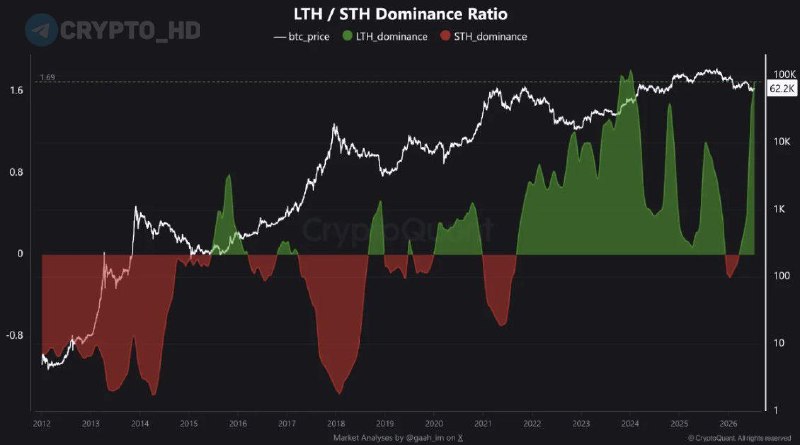
Long-term holder accumulation means more Bitcoin is being held by investors who are less likely to sell quickly. CryptoQuant data shows the LTH/STH Dominance Ratio is now at its highest level in 30 months. The ratio compares Bitcoin held by long-term holders, or LTHs, with Bitcoin held by short-term holders, or STHs. When it rises, more BTC is sitting in wallets that usually ride out volatility instead of chasing the next candle. Why does this matter? Because fewer coins sitting with quick sellers can change the supply picture fast, especially on exchanges. One metric is never a crystal ball. Still, this one is not noise.
This Bitcoin long-term holder accumulation is happening while macro conditions are still unsettled. The market is watching the Federal Reserve, interest rates, inflation data, risk assets, and every nervous repricing that comes with them. Bitcoin’s “fiat debasement hedge” narrative is still around, even if people drag it out so often that it starts to sound automatic. I’ll be honest: I think that narrative gets overused, but it is not useless. When investors lose faith in monetary policy or traditional markets look fragile, some capital still moves toward assets seen as stores of value. This LTH move suggests a decent part of the market still sees BTC that way. BlackRock’s IBIT ETF, launched in January, has also brought steady demand for regulated Bitcoin exposure, which tends to attract investors with longer time frames.
The accumulation trend also suggests Bitcoin ownership is stretching beyond short-term retail trading. A 30-month high in the LTH/STH ratio is not usually built by small traders alone. Larger holders may be adding. Or, just as important, they may simply be refusing to sell. Most guides frame accumulation as aggressive buying. That is only half right. Sometimes the signal is quieter: coins stop moving, exchange supply tightens, and short-term traders lose influence. There are also ongoing discussions about corporate treasuries and sovereign wealth funds looking at Bitcoin as a reserve asset, although the source does not name a specific country or bank. Spot ETFs have made Bitcoin easier for traditional investors to access, and that changes how coins are held. This is not weekend pump-chasing. Some holders are treating BTC as a longer-term allocation before the market turns euphoric. That is the part I would not ignore.
What this means
Sustained long-term holder accumulation gives the market a stronger base. More Bitcoin appears to be sitting with holders who are less likely to sell during normal volatility. That can reduce selling pressure and leave fewer coins available if demand picks up. Is this a guaranteed rally setup? No. Bitcoin does not hand out guarantees. In past cycles, though, similar setups have often appeared before stronger moves higher. The cleaner read is that some larger, patient buyers are comfortable accumulating around current levels.
Traders and investors should watch on-chain data, especially the LTH/STH Dominance Ratio. Exchange balances matter too. A sudden rise in exchange supply can change the short-term picture quickly, even if the long-term holder trend still looks strong. For BTC, $70,000 remains an important level. A clean move above it could point to renewed bullish momentum. FOMC meetings are also worth watching because a more hawkish Fed can pressure risk assets in the short run. Yes, this cuts against the long-term accumulation argument a bit. Bear with me. Long-term holders can keep holding while short-term traders still get shaken out by rate expectations.
FAQ
What is a long-term holder (LTH) in Bitcoin?
A long-term holder, or LTH, is a Bitcoin investor who has held BTC for a longer period, usually more than 155 days. These holders are generally less likely to sell during short-term price swings.
What is the LTH/STH Dominance Ratio?
The LTH/STH Dominance Ratio compares Bitcoin held by long-term holders with Bitcoin held by short-term holders. It gives a rough read on whether the market is leaning more toward holding than fast trading.
Why is a high LTH/STH Dominance Ratio considered bullish?
A high LTH/STH Dominance Ratio is often viewed as bullish because more Bitcoin is sitting with holders who are less likely to sell. That can reduce available supply and ease selling pressure.
How does institutional adoption relate to long-term holding?
Institutional adoption, including spot ETFs, can bring in investors who think in quarters and years rather than days. That usually supports longer holding periods.
What does “supply shock” mean in the context of Bitcoin accumulation?
A “supply shock” happens when long-term holders absorb a large amount of Bitcoin, leaving less available on exchanges. If demand rises while supply is tight, price can move sharply.
What is the significance of the $70,000 mark for BTC?
The $70,000 mark is an important resistance level for BTC. A sustained break above it could show that bullish momentum is returning.
How do FOMC meetings impact Bitcoin’s long-term holder accumulation?
FOMC meetings can move Bitcoin because interest-rate expectations affect risk assets. Long-term holders may still keep accumulating or holding through that volatility.
What data source is cited for the LTH/STH Dominance Ratio?
The article cites CryptoQuant data, which shows the LTH/STH Dominance Ratio at its highest point in 30 months.
What is an example of institutional adoption mentioned in the article?
BlackRock’s IBIT ETF, launched in January, is mentioned as an example of institutional adoption and demand for regulated Bitcoin exposure.
Does long-term holder accumulation imply immediate price increases?
No. Long-term holder accumulation can appear before bull runs, but it does not promise an immediate price increase. It mainly shows that more supply is moving into stronger hands.