















































Bitcoin Pizza Day history: a $7.7 billion lesson in adoption
Bitcoin Pizza Day falls on May 22 each year. It marks the moment Bitcoin stopped living as code, theory, and forum chatter. It bought dinner. That sounds small. It was not.
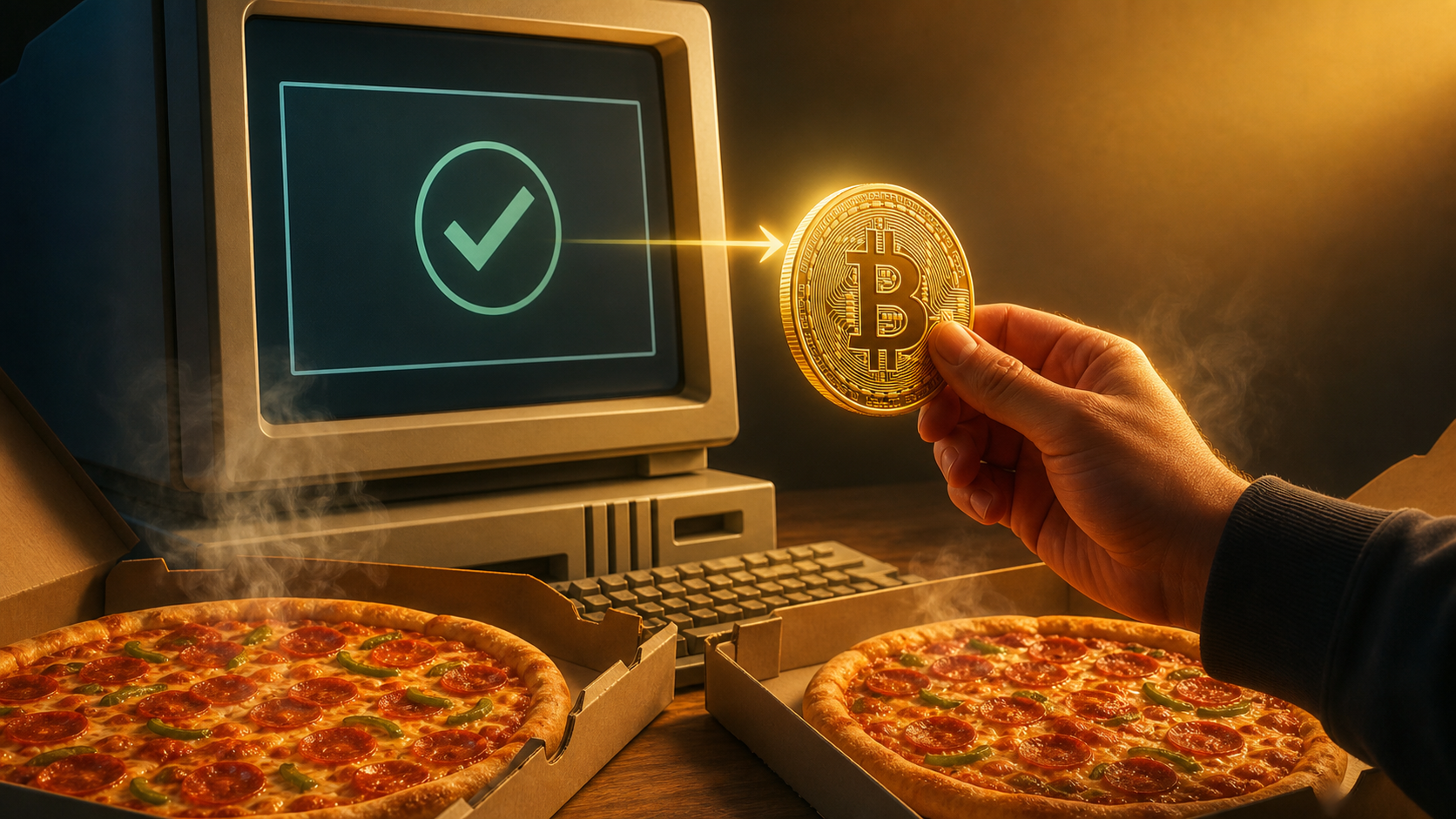
On May 22, 2010, programmer Laszlo Hanyecz paid 10,000 BTC for two Papa John’s pizzas. The price was about $41 then. At today’s quoted value, that same 10,000 BTC would be worth about $772 million. Painful math. And it gets worse. Hanyecz reportedly spent nearly 100,000 BTC on pizza during 2010, which would put the total near $7.7 billion today. I’ll be honest: I do not read that as a joke about a bad trade. Someone had to spend Bitcoin before anyone could honestly say it worked.
Most retellings make this sound like a punchline. That is only half right. The price move is absurd, yes, but the first real purchase mattered because it gave Bitcoin a small, awkward proof point. Why does this matter? Because markets do not adopt abstractions forever; eventually, somebody has to use the thing.
Historical accounts point to Hanyecz’s order as one of the first known purchases of physical goods with Bitcoin. Back then, that was enough. A digital token bought two hot pizzas. Today, companies such as MicroStrategy (MSTR) hold large amounts of BTC on their balance sheets, and El Salvador made BTC legal tender. Put those facts next to each other and the gap almost sounds fake. Bitcoin went from a forum experiment to something people debate in treasury meetings, ETF filings, government policy, and risk models. It also reached new highs above $73,000 in March 2024, which makes the pizza story feel less like trivia and more like an early receipt from a market almost nobody understood. My take: the receipt matters more than the regret.
The Pizza Day story also says something about macro flow and risk rotation. Bitcoin did not stay tucked away in its own corner. It escaped.
In 2010, Bitcoin sat far outside normal financial markets. Most people had never heard of it. Today, BTC often trades like a risk asset, moving with rate expectations, liquidity, inflation worries, balance sheet stress, and market appetite. Counter to the usual advice, Bitcoin is not always a clean hedge against everything bad. When the Federal Reserve sounds hawkish, BTC can get hit with other speculative assets. When inflation fears rise or banks look shaky, some investors treat Bitcoin as an escape hatch, or at least as a trade on mistrust. During the March 2023 banking crisis, BTC rallied more than 30% in a few weeks as investors looked beyond traditional finance. That shift matters. A pizza payment became a macro sensitive asset. Strange, messy, and very Bitcoin.
What this means
The obvious lesson is that early adoption can look silly until it suddenly does not. Simple, but brutal.
For crypto investors, Hanyecz’s pizzas are a reminder that new assets often look useless before the market figures out what to do with them. That does not mean every token deserves patience. Most do not. Yes, this slightly contradicts the romance of early adoption, but it needs saying: survival is the filter. Bitcoin’s story shows what can happen when a network survives long enough, keeps pulling in users, and keeps making skeptics revise their assumptions. The missed fortune is the easy headline. The better point is that Hanyecz helped make Bitcoin usable by using it. ETFs and corporate treasuries came much later. Public market exposure came later too.
From here, traders should watch adoption data, regulatory decisions, macro liquidity, and positioning. Is this overkill? For Bitcoin, no. FOMC meetings still matter because rate expectations can move risk assets fast. CME Bitcoin futures data can also show how larger players are positioned. On the chart, the $60,000 to $62,000 area remains worth watching if BTC retests support. A clean bounce there would suggest buyers are still active. A sustained break below it could mean more consolidation. I would not dress this up as destiny: Bitcoin’s store of value story is stronger than it was in 2010, but the trade is still tied to liquidity, regulation, and the mood of global markets. Not romantic. Just real.