
















































Ekubo Protocol hack puts DeFi contract risk back on traders’ radar
Cyvers Alerts reported a $1,400,000 DeFi exploit involving an Ekubo Protocol v2 contract. No timestamp came with it, and that is not a small omission. I’ll be honest: in crypto, an undated exploit note makes people guess in exactly the wrong direction. Traders tend to reprice smart contract risk fast when liquidity is thin, leverage is crowded, or both.
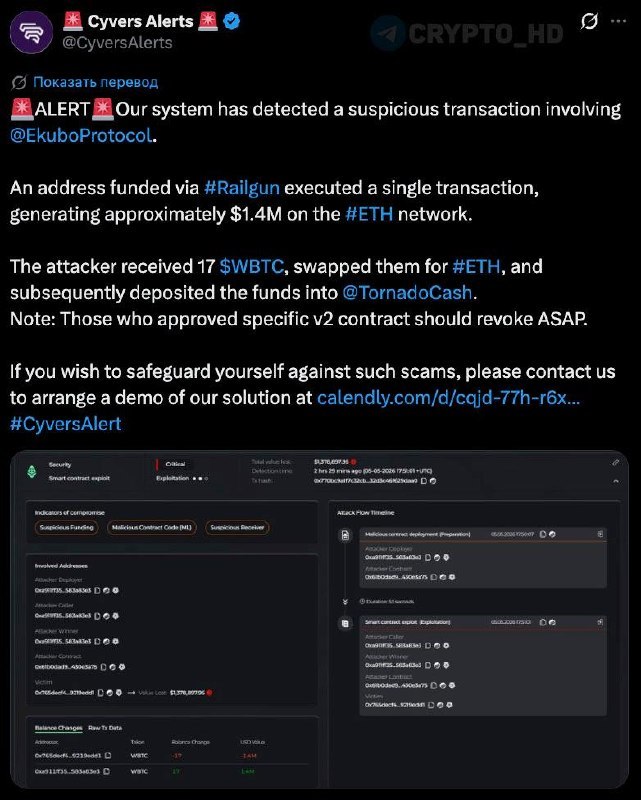
The confirmed details are sparse: Ekubo Protocol, a reported $1,400,000 loss, hackers, and a v2 contract exploit. Cyvers Alerts did not name an attacker. It did not publish a chain trace, describe a recovery plan, say whether users would be reimbursed, or include a quote. Those blanks matter. Why? Because the market immediately asks the same ugly questions. Was this isolated? Can someone repeat it? Is it over? Nobody can responsibly answer those from the source detail alone.
The Ekubo Protocol hack also hands regulators a clean example of operational risk in DeFi. That does not mean the SEC or CFTC has acted on this incident. The source does not say that, and I would not stretch it. Still, BTC, ETH, and COIN traders have seen the pattern: a security failure hits, then the policy conversation snaps back to custody, disclosures, exchange controls, investor protection, and who is supposed to be accountable when code fails. Not complicated.
Most guides treat DeFi hacks as “ETH bad, BTC fine.” That is only half right. DeFi exploit headlines usually hit ETH sentiment more directly than BTC sentiment because ETH is still the market shorthand for smart contract activity, liquidity design, and on-chain application risk, even when the protocol involved is not an ETH-only story. My take: if the Ekubo headline spreads, ETH traders first check DeFi beta. DEX tokens. Lending names. Protocols with messy upgrade paths. BTC can avoid some of that pressure because many investors frame it as clean collateral rather than application infrastructure.
A reported $1,400,000 loss is not systemwide by itself. Still, markets do not always need a giant number to get jumpy. If rates, inflation, and dollar liquidity already have traders on edge, a DeFi security headline can become permission to cut risk instead of rotating inside crypto. Is that rational? Sometimes no. But it happens. BTC and ETH do not need the exploit to be huge; they only need leveraged traders to decide the tape feels weak. Small incidents can suddenly sound larger than they are.
Bitcoin may trade differently from DeFi tokens after hack headlines because BTC does not depend on the same application-layer contract surface. Counter to the usual advice, that distinction does not always show up in the first move. The first reaction is often crude: sell crypto first, sort the labels later. Then investors separate BTC, ETH, DEX tokens, protocol-specific exposure, and anything sitting too close to the blast radius. It works. Just not instantly.
The point is narrow: Cyvers Alerts reported a $1,400,000 Ekubo Protocol exploit tied to a v2 contract, without a reaction quote or detailed incident timeline. There is nothing responsible to quote beyond that. The more useful point is blunt. This landed in the part of crypto where trust is supposed to be code, and code risk reprices faster than any press statement. Yes, that sounds obvious. It is also the part traders forget when markets are calm. The confirmed source details are still only the $1,400,000 figure, Ekubo Protocol, hackers, and a v2 contract exploit.
What this means
The Ekubo Protocol hack means DeFi contract risk is still a trading variable, not just an audit-team footnote. For BTC, the effect is mostly sentiment and risk rotation. For ETH and DeFi-linked tokens, the pressure can be more direct because smart contract confidence sits closer to the investment case. The affected protocol is Ekubo Protocol, and the reported figure from the source is $1,400,000.
The next useful updates would come from Cyvers Alerts, Ekubo Protocol, or on-chain investigators. Traders need dated information on the exploit path, fund movement, containment, and any recovery effort. Skip the guesswork. For market structure, BTC and ETH levels matter too, especially around high-volume support, CME crypto futures positioning, and the next scheduled FOMC decision on May 6, 2026. If risk appetite weakens into that date, the Ekubo Protocol headline can matter more than the $1,400,000 number suggests.