
















































CryptoQuant CEO says bitcoin bear market could last until 2027, adding pressure on BTC
CryptoQuant’s CEO is warning that bitcoin’s bear market could stretch into 2027, and the warning is not built on vibes. It comes from how past on-chain profit cycles have behaved after large profit-taking waves. The logic is blunt: after big rounds of profit-taking, aggregate investor PnL in BTC has usually kept falling for roughly 18 months. If that repeats after the October 2025 trend reversal, bitcoin could stay under pressure longer than traders want to admit. Early 2027 is not a random date. It is about where that 18-month window ends. My take: that is the uncomfortable part.
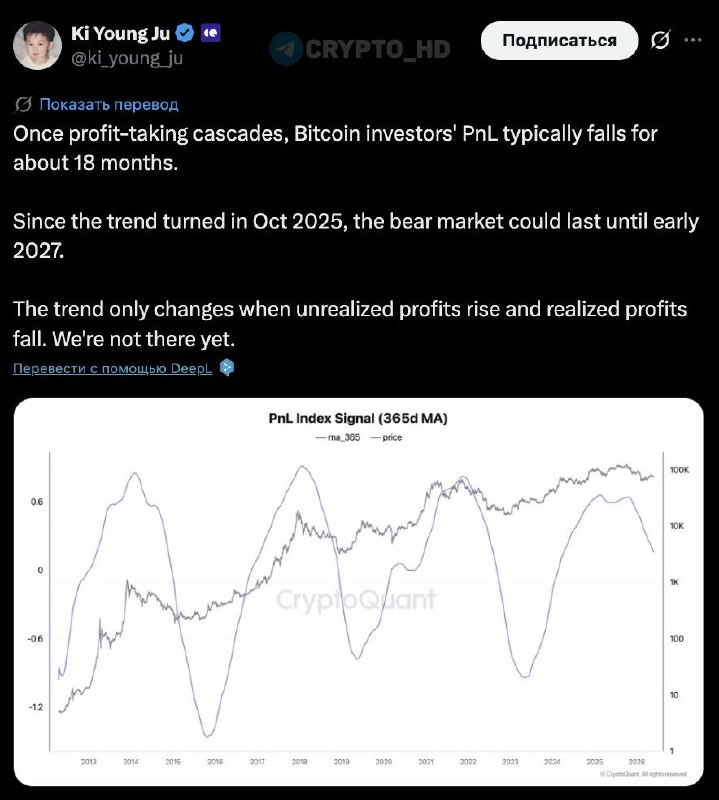
The signal comes from on-chain metrics showing BTC is still working through a post-profit-taking phase. CryptoQuant’s CEO compares the current setup with earlier cycles where profit-taking peaked, then started to unwind. In those cases, pressure tended to last about 18 months. Most cycle commentary says the hard part is spotting the low. That’s only half right. The harder part is surviving the dead space after it, when BTC can bounce just enough to lure people back in. By that timeline, BTC could remain in a bear-market phase into early 2027. Bulls need a clean shift: unrealized investor profit has to rise. Realized profit-taking has to drop. CryptoQuant says those signs are not here yet.
For BTC positioning, the problem sits underneath the chart. Realized profit-taking often means coins are moving from earlier buyers to later buyers. When aggregate PnL keeps sliding after a major profit-taking wave, rallies can become exit windows instead of fresh uptrends. Why does this matter? Because BTC spot traders, perpetuals desks, and funds treating October 2025 as a clean cycle low may be pricing the turn too early. CryptoQuant’s framework points to early 2027 as the bigger calendar risk, not late 2025.
The macro side makes this harder to trade. BTC still behaves like a high-beta liquidity asset when rates, inflation, and dollar liquidity start moving money around. On March 12, 2020, BTC fell more than 35% during a global liquidity shock, then recovered as central banks eased and risk appetite returned. If BTC investor PnL is already weakening after October 2025, the June 16-17, 2026 FOMC meeting is more than another rates date. It tests whether macro liquidity can overpower on-chain distribution pressure. I’ll be honest: I would not treat that as background noise.
The safe-haven story still matters, but usually in bursts. After the January 3, 2020 Soleimani strike, BTC rose about 8% within days as traders briefly reached for non-sovereign assets. That is real. It is also limited. CryptoQuant’s signal points to a different problem for 2025 and 2026: investor profit cycles, not headlines. A safe-haven bid can lift BTC for 72 hours. An 18-month PnL downtrend can cap rallies for quarters. Those are different trades, and confusing them can get expensive.
The lack of a named executive quote puts the weight on the metric, not the person. There is no long quote to parse, and the source post does not identify an executive beyond the CEO of CryptoQuant. That makes the claim simpler, almost annoyingly simple. Unrealized profit needs to rise. Realized profit-taking needs to fall. Until both happen, BTC bulls calling for a durable reversal into 2026 are arguing against the on-chain setup, not just gloomy market sentiment. Skip the personality read.
The read-through for other crypto assets is fairly plain, though not perfectly mechanical. If BTC stays under pressure into early 2027, the rest of crypto probably does not get much room to ignore it. ETH can move on protocol news. COIN can react to trading volumes or regulation. Miners can swing with hashprice and balance sheet stress. High-beta altcoins can still rip for reasons that look brilliant for three days and embarrassing a week later. Still, BTC usually sets the risk budget for crypto portfolios. If BTC bounces while aggregate PnL keeps falling, I would treat that as a trade before treating it as an investment.
The distinction between probability and certainty matters. The easy mistake is reading “may last” as “will last.” CryptoQuant is not saying the bear market definitely runs until early 2027. Counter to the usual advice, the right response is not to slap a single date on the chart and wait. The argument is that past large profit-taking events point to pressure that can last about 18 months after the October 2025 reversal. That is a probability map, not a price target. Is this overkill? For BTC, no. Crypto markets often punish people who want the cycle to move faster than it does.
What this means
CryptoQuant’s analysis ties BTC’s bearish phase to investor profit and loss behavior, not just weak sentiment. BTC is the main ticker. Spillover could hit ETH, COIN, miners, and higher-beta altcoins if Bitcoin keeps anchoring crypto liquidity through 2026. The signal to watch is not one big green candle. It is a sustained rise in unrealized investor profit, along with a drop in realized profit-taking after the October 2025 reversal. I keep coming back to that because it is less exciting than price action, and usually more useful.
The indicators to watch are macro liquidity, derivatives positioning, BTC’s reaction around major technical levels, and whether realized profit-taking actually cools. The June 16-17, 2026 FOMC meeting matters because liquidity can shift quickly around rates. CME BTC futures positioning matters because leverage can make a rally brittle. BTC’s behavior near support and resistance from the October 2025 reversal matters because crowded levels often decide whether traders press or bail. Yes, this slightly contradicts the clean on-chain framing above; bear with me. On-chain pressure can define the backdrop, while macro and leverage decide the timing. If BTC rallies into the FOMC meeting while realized profit-taking stays high, the move may turn into another exit window. If unrealized profit rises and realized profit-taking falls, early 2027 starts to look less like a hard deadline and more like the point where the bear phase finally gives way.