
















































Ethereum Evangelist Sells ETH as Asset Narrative Faces L2 Test
“A prominent Ethereum advocate selling all his ETH raises an awkward question: does ETH still get enough upside from the network it powers?” David Hoffman, co-founder of Bankless and one of Ethereum’s most visible defenders, said he sold all his ETH because the token is no longer his favorite way to bet on Ethereum’s growth. That is not a small shift. I’ll be honest: this is the kind of sale markets remember because it comes from inside the camp, not from a tourist dunking on Ethereum. Hoffman is not saying Ethereum is finished. He is saying Ethereum can keep growing as infrastructure while ETH captures less of the money created by Layer 2s (L2s), stablecoins, Real World Assets (RWA), Decentralized Finance (DeFi), and traditional finance (TradFi).
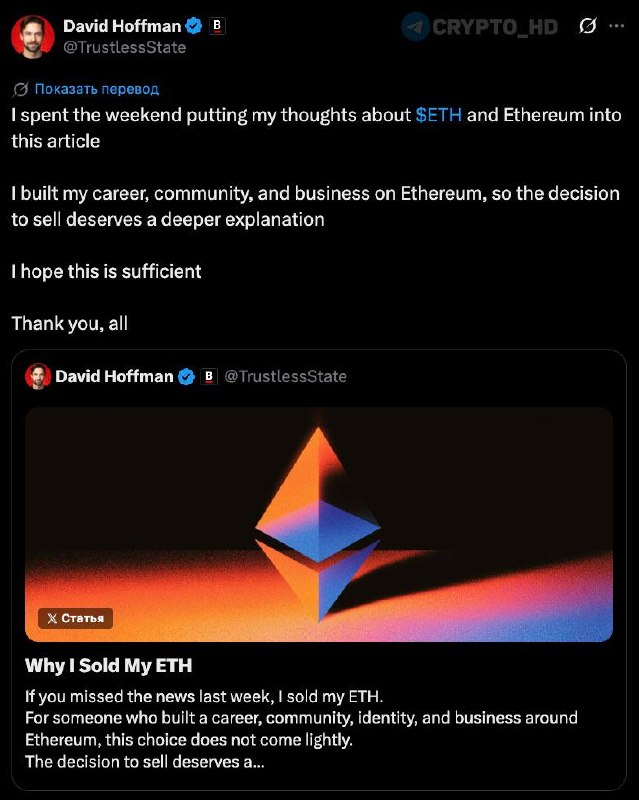
“Hoffman’s sale dents the old ‘ETH is money’ argument, but it does not make him an Ethereum bear.” According to the source post, Hoffman treated this as a portfolio exit, not a break with Ethereum itself. His argument is blunt: the old “ETH is money” thesis has run out of steam. ETH remains a major ecosystem asset, but it has not become global internet money. That distinction matters in 2026 because investors are splitting network usage from token value with less patience than they had last cycle. A chain can be busy while its token lags. Yes, that sounds contradictory at first. It isn’t. It happens when activity and margins move away from Ethereum Layer 1 (L1) fees and toward L2 chains and applications.
“Ethereum adoption is real, but the ETH investment case weakens if other assets collect most of the upside.” Ethereum’s adoption signal is still strong. The source says stablecoins on Ethereum have grown by dozens of times, and RWA, TradFi, DeFi, NFTs, smart contracts, and tokenization have all expanded the network’s role. Fair enough. That part is hard to wave away. My take: the uncomfortable bit is not usage, it is ownership of the economics. If dollars, apps, L2s, and tokenized assets take most of the upside, ETH can remain necessary infrastructure without becoming the main reserve asset. Good for Ethereum usage. Not automatically good for ETH holders.
“Bitcoin and Ethereum tell very different asset stories, and price cares about that.” The Bitcoin comparison makes the market issue easier to see. Bitcoin stripped the story down until the asset itself was the point. BTC sits at the center of its own monetary pitch. Ethereum went the other way. It added DeFi and NFTs, then L2s, smart contracts, and tokenization kept stretching the story. More useful? Yes. Easier to price? No. BTC can trade on scarcity and store of value demand. ETH usually needs several things to work at once: fees, token burn, staking yield, L2 demand, application growth, and collateral demand. That is a tougher sell.
“The shift from Ethereum L1 to L2s cuts into the old ETH value capture model.” Fees are where this trade gets uncomfortable. The source says network fees and revenue still have a strong effect on L1 token prices. When Ethereum dominated fee activity, ETH looked cleaner as an asset. Once activity and margins moved to L2s and apps, some of that value driver moved with them. Most Ethereum scaling arguments say this is fine because the pie gets bigger. That is only half right. Ethereum can sell secure blockspace to L2 chains at very low cost, protect DeFi, and support tokenized global assets, while ETH receives only part of the economic benefit.
“Dencun made L2s cheaper. That helped scaling, but it made the ETH value capture debate harder to ignore.” The Dencun upgrade went live on March 13, 2024. It made L2 data cheaper through blob transactions. We tried to defend this with the old fee-burn framing for a while, but after March 2024 that argument got harder to make cleanly. Why does this matter? Because cheaper L2 execution has to create enough total demand to offset lower L1 fee pressure. Hoffman’s exit suggests he no longer wants that to be his main Ethereum bet.
“In tighter markets, ETH may need more than network growth to keep up.” There is a macro side here too. ETH still trades like a high beta crypto asset when liquidity improves. But Hoffman’s thesis says network success may not be enough when risk appetite narrows. If interest rates, inflation prints, or Federal Reserve messaging push investors toward simpler stories, BTC can attract the “hard money” bid more easily than ETH. Counter to the usual advice, “buy the base asset of the ecosystem” may be too lazy here. In that setup, ETH is also competing with L2 tokens, DeFi governance assets, stablecoin rails, public crypto equities like COIN, and the boring appeal of BTC’s simpler pitch.
“Ethereum can win as a network even if ETH disappoints as an asset.” This is not a call for Ethereum to fail. The source suggests almost the opposite: Ethereum may succeed as a network even if ETH does not win as an asset. That is the piece allocators need to think about. Many people still use ETH as a shortcut for everything happening on Ethereum. In 2026, that shortcut may be too crude if applications and L2s keep more of the value. Stablecoins, RWA issuers, and TradFi integrations can also capture economics that ETH holders expected to see flow back to the base token.
“Stablecoin growth on Ethereum mostly helps the dollar, not ETH.” Stablecoins are the cleanest example. The source says stablecoins on Ethereum have grown by dozens of times, but the main beneficiary is the dollar. Ethereum helps existing money move on-chain. It does not automatically replace that money with ETH. Obvious? Sure. But crypto markets blur this line constantly. Payment network adoption is not the same as monetary premium, and stablecoin growth can be great for Ethereum infrastructure while making ETH’s upside feel less direct.
“Regulation can support ETH demand, but it cannot fix weak token economics by itself.” Regulation sits underneath this debate. In the United States, regulated products, staking rules, and exchange listings can shape demand for ETH even when on-chain fees are low. But regulation cannot repair the asset story on its own. If the market decides ETH is mostly productive collateral rather than internet money, ETF demand or staking access may support flows without bringing back the old “ETH as global money” multiple. Is this enough for institutions? Sometimes, yes. Is it enough to revive the full monetary premium? That is a much bigger ask.
“Hoffman’s sale matters because of who he is, but it is not a vote against Ethereum as a chain.” Hoffman gets attention because Bankless built much of its brand around Ethereum’s financial and cultural case. The source names him as a Bankless co-founder and longtime Ethereum defender, so the sale carries weight. Still, one person’s exit is not a referendum on the whole network. I would read it narrower: a prominent Ethereum bull now sees a gap between Ethereum’s technical success and ETH’s ability to turn that success into price performance. That gap is the story.
“Crypto markets often reprice the story before the fundamentals visibly break.” ETH can keep securing DeFi, settling tokenized assets, and supporting L2 ecosystems while the token underperforms. That is the uncomfortable part. We have seen this pattern before in crypto: usage looks fine, then the market quietly decides the value capture is somewhere else. If investors start doubting the mechanism, utility alone may not save the chart. Hoffman’s risk is basically this: “Ethereum activity is growing” is no longer a complete bull case for ETH. The bull case needs a clear link from activity to ETH demand, fee burn, staking value, or collateral premium.
What this means
“Hoffman’s ETH sale points to a more mature Ethereum debate: adoption alone is not enough anymore.” The affected ticker is ETH, but the pressure runs through the whole Ethereum stack, including L2 protocols, DeFi apps, stablecoins, and RWA platforms. The market now has to answer two questions. Can ETH rebuild a cleaner monetary story against BTC? Can L1 fees recover enough for value capture to show up again? Yes, this contradicts the easy “Ethereum wins, ETH wins” line. Bear with me. If BTC keeps owning the hard money narrative while Ethereum usage spreads across other layers, ETH may trade more like infrastructure beta than internet money.
“The next tells are Fed policy, CME positioning, and whether Ethereum fees recover when L2 activity jumps.” Watch the Federal Reserve decision on June 17, 2026, CME futures positioning for ETH and BTC, and Ethereum fee trends after big L2 activity spikes. For traders, the useful signal is not just a price level. It is the gap between network usage and ETH capture. If stablecoin supply and RWA activity rise while ETH fees and burn stay quiet, Hoffman’s thesis gets stronger. If L2 transactions rise at the same time and still fail to pull value back to L1, that says even more. But if L1 revenue rebounds and ETH beats BTC in the next risk-on move, the market will start testing the other side.