















































Kiyosaki Bitcoin Recommendation Doubles Down as Boomer Retirement Crisis Hits 2026
Robert Kiyosaki’s 2026 retirement framework points at four assets: Bitcoin, Ethereum, gold, silver. He calls them the floor under your wealth when currencies get debased and pensions come up short. The Rich Dad Poor Dad author is not easing into this one. Load up, or end up on the street in retirement. That is his wording, not a paraphrase. My take: the shock value is the distribution strategy, but the asset mix is the real story. He says 2026 is when boomer financial pain stops being a forecast and starts running as a headline. Why does that matter for crypto? Because BTC and ETH are no longer side mentions in his pitch; they sit beside bullion. Boomers control roughly half of US household wealth, per Federal Reserve data. Even a small drift from bonds and cash into hard assets keeps pressure on that rotation.
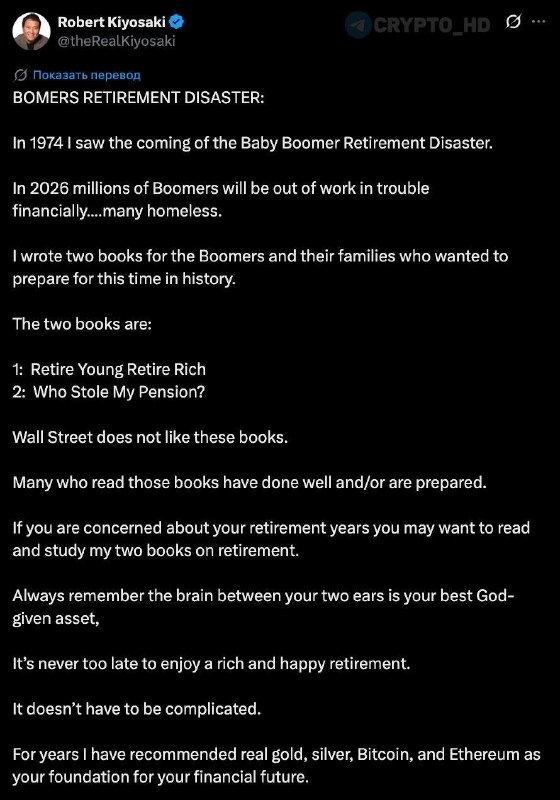
Kiyosaki says he saw the pension mess coming back in 1974. Now he is pointing at 2026 as the trigger year: millions pushed out of work, financial trouble running through the cohort, some ending up homeless. He keeps steering readers toward two books he wrote for boomers and their families, books he says Wall Street hates. The crypto-Twitter line is cleaner and louder: gold, silver, BTC, and ETH are the foundation of a financial future. That’s the pitch. Blunt by design.
None of this is new. He has bundled Bitcoin with bullion since at least 2020. What has changed is the volume: the 2026 label, the retirement-crisis framing, the warning that the global economy gets rough from here. Most guides would treat that as macro commentary. That’s only half right. Kiyosaki is also doing something simpler: telling older investors to sell paper and buy what governments cannot print. He closes with the softer line about the brain between your ears being your best God-given asset and how it is never too late to build a wealthy retirement. Fine. The trade underneath is still hard-edged.
The first crypto angle worth taking seriously is the safe-haven flow. Kiyosaki classifies Bitcoin as digital gold, not as a tech bet or a yield play. He is putting BTC in the same bucket as the metal, and that matters because 2.7 million Twitter followers hear the comparison in plain English. Every time he does it, the BTC-versus-gold correlation argument gets dragged back onto the desk. Bloomberg ETF flow data shows spot Bitcoin ETFs cleared $61 billion in cumulative inflows by early 2026, and IBIT alone is now within striking distance of the largest gold ETFs by assets. The audience is not abstract either: it is the same older cohort advisors are slotting into 1-3% BTC allocations through ETF wrappers. His message is not building the pipe. It is greasing one that already exists.
The macro angle of his thesis rests on one read: he expects fiscal stress, currency debasement, or both. He only gestures at it with the phrase “tough global economy ahead.” Strip the rhetoric and the logic is plain: this is the same trade BTC’s 2024-2025 rally leaned on, with risk assets bidding whenever markets sniff looser policy or higher long-term inflation. ETH is messier. I’ll be honest: Kiyosaki rarely explains why Ethereum specifically rather than, say, a basket of large caps. My read is that he treats ETH as the second crypto pillar, not as a separate macro story. Investors who follow that cue tend to buy both, which has historically reinforced ETH’s beta to BTC during macro-driven rallies instead of letting it decouple.
What is missing from his message is just as telling as what is in it. No price target. No timing beyond the 2026 stamp. No portfolio percentage. That ambiguity is not a bug. Kiyosaki sells books, and books sell better when the prescription stays directional. For a trader, his calls register as sentiment data, not signal. His tweets do not move BTC the way an ETF approval or a Fed pivot does. They move retail attention. That attention can show up in derivatives positioning a week or two later.
The boomer angle is the structural story under the headline. The cohort he addresses is the demographic most resistant to direct crypto ownership, and the spot ETF wrapper is the wedge cracking that open. Americans roughly 62 to 80 in 2026 have historically been the group most allergic to crypto, with surveys through 2023 and 2024 putting boomer Bitcoin ownership in low single digits. But they do not need to learn what a seed phrase is to buy IBIT or FBTC inside a Schwab IRA. Counter to the usual advice, education may not be the main unlock here; packaging is. Kiyosaki has been pushing on exactly that door for three years. If even a sliver of his audience moves from “interesting idea” to “small position,” it shows up as steady ETF inflows, not a vertical candle. Slow money. Sticky money. The kind that can compress volatility on the way up.
His pairing of BTC with silver is a deliberate sentiment tell. Bundling Bitcoin with the laggard metal implies the hard-asset rotation has more room to run. Silver has lagged gold for most of the current cycle, and Kiyosaki has been one of the louder voices arguing the gap closes. The crypto read-through is direct: when commentators pair BTC with the laggard metal, they are implying the rotation is mid-cycle, not late-cycle. Is that a forecast? Not really. It is more useful as a mood marker for the camp expecting BTC to grind higher into 2026 rather than top early.
The biggest gap in his framing is regulatory. His 2026 thesis ignores SEC enforcement, staking classification disputes, and the altcoin status decisions that directly hit ETH exposure. The SEC’s posture on staking, the unresolved status of several altcoin classifications, the ongoing exchange enforcement docket: none of that exists in Kiyosaki’s pitch. Yes, this cuts against the clean hard-asset story above, but it has to. He is selling a 1970s gold-bug worldview transplanted onto a 2026 asset mix. For investors, that is useful on sentiment and weak on risk management. The retirement thesis breaks if a future administration squeezes US-domiciled crypto access. Boomers buying BTC through ETFs are insulated from a lot of that. Boomers buying ETH directly for the staking yield are not.
What this means
Kiyosaki’s 2026 warning works as a sentiment drumbeat, not a price catalyst. Its measurable footprint shows up in spot ETF flow data, not BTC’s hourly chart. The signal is sentiment, not price action. I would watch IBIT, FBTC, and ETHA flows before watching a five-minute BTC chart. The key band is whether spot Bitcoin ETF net inflows hold above the $200-300M daily band that, per Farside Investors flow tracking, has defined the strong-flow regime through Q1 2026. If they do, the boomer-to-ETF pipeline he keeps pushing on is working quietly in the background. If flows soften despite his loudest endorsements, his audience is reading him for entertainment, not allocation.
The harder structural watch is the BTC-gold correlation. His retirement portfolio thesis depends on Bitcoin and gold continuing to trade as paired hard assets. Through late 2025 the two traded together more often than not, and his framing assumes that pairing holds. By standard correlation analysis, the 30-day rolling correlation between BTC and the GLD ETF is the cleanest tracking metric. A sustained drop below 0.3 would be the first sign the retirement-portfolio pitch is breaking down structurally. Near-term calendar items matter more than another viral Kiyosaki post: the next FOMC meeting, the next CPI print, and any movement on the SEC’s pending decisions around ETH staking ETFs. Those set the macro tone and directly affect the second half of his BTC-and-ETH recommendation. Until they move, his message is what it has been for years. Boomer-targeted marketing for hard assets, with crypto now welded firmly to the metals side of the trade.