
















































Michael Saylor’s Bitcoin ideologies: a map of how BTC people think
Michael Saylor, the Bitcoin maximalist and MicroStrategy co-founder, recently described four kinds of BTC holders. I think the split is useful, but too clean. Bitcoin buyers are not one crowd with one motive. Some want hard money. Some want balance-sheet collateral. Others care about rails, custody, or a political boundary they do not want banks and governments to cross. Why does that matter? Because those camps do not react the same way when rates move, ETF flows reverse, or regulators start circling.
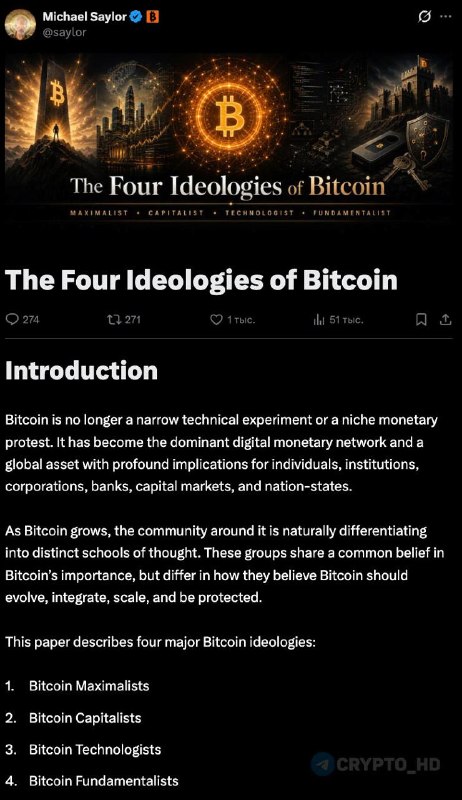
Bitcoin maximalists: the monetary network
According to Michael Saylor, Bitcoin Maximalists see BTC as the final monetary network and a defense against inflation, currency debasement, and financial disorder. That is the safe haven argument. It is also messy. Bitcoin can drop 40% before anyone feels especially sheltered. In March 2020, BTC sold off with almost everything else, then ripped higher when liquidity came back. In late 2021, when inflation fears were everywhere, BTC pushed above $60,000. Maximalists called it proof. Skeptics called it risk appetite. My take: both readings were defensible, which is exactly why the label “safe haven” never quite fits.
Bitcoin capitalists: digital capital for finance
According to Michael Saylor, Bitcoin Capitalists see BTC as digital capital that belongs in banks, funds, corporate balance sheets, credit markets, and capital markets. Saylor’s own company is the obvious example. MicroStrategy held more than 214,400 BTC as of April 2024, enough that Bitcoin stopped being a treasury footnote and became the company story. Then spot Bitcoin ETFs launched in January 2024 and brought in billions, giving institutions a cleaner way in. BTC moved from roughly $45,000 to more than $73,000 within weeks. That does not prove the Capitalist thesis forever. It proves something narrower: when old finance gets an easier on-ramp, price can move fast.
Bitcoin technologists: building the infrastructure
According to Michael Saylor, Bitcoin Technologists focus on the infrastructure under and around Bitcoin: scalability, privacy, security, Layer 2 systems, and protection against future threats. This part gets less attention than ETF flows. That is a mistake. Bitcoin is slow and expensive next to many newer networks when traffic spikes, and the Lightning Network is one answer: faster BTC payments through a Layer 2 setup. Traders may ignore that on a quiet Tuesday. They probably should not. Counter to the usual advice, infrastructure news is not always “long term only.” If Bitcoin cannot become easier to use without breaking the things that make it Bitcoin, rival networks will keep pressing that weakness.
Bitcoin fundamentalists: protecting the rules
According to Michael Saylor, Bitcoin Fundamentalists defend Bitcoin’s core rules: self-custody, personal nodes, decentralization, immutability, and censorship resistance. This group can be stubborn. Good. That stubbornness is part of the job. They push back when exchanges, governments, or financial firms make Bitcoin easier to package but easier to control. The self-custody debate shows the tension clearly: centralized platforms make access simpler, but users hand over trust. Fundamentalists hate that trade. Yes, this partly contradicts the adoption argument above. Bear with me. Clear regulation can help Bitcoin reach more investors, while heavy restrictions could damage the features Fundamentalists care about most. The SEC’s position on crypto assets and services often sparks that argument, and markets sometimes move before anyone has finished reading the fine print.
Saylor’s larger argument is simple: Bitcoin needs all four groups. Maximalists bring conviction. Capitalists bring money and distribution. Technologists keep the system usable. Fundamentalists stop everyone from smoothing away the parts that made Bitcoin interesting in the first place. I’ll be honest: the conservative-base-layer idea sounds boring. But boring may be the point. Saylor wants most experimentation to happen on upper layers or inside financial infrastructure, not inside Bitcoin’s core rules. That may be the only way Bitcoin grows without becoming something its earliest users would barely recognize.
What this means
Saylor’s framework is a cleaner way to think about Bitcoin than the usual “store of value versus speculative asset” argument. Most guides stop there. That is only half right. The ecosystem is messier: ETF buyers, node runners, corporate treasurers, Lightning developers, and people stacking sats because they distrust central banks are not playing the same game. For traders, that split is practical context. Institutional buying can push BTC higher. A fight over custody or protocol rules can trigger nervous selling, or push more users toward self-custody tools. Spot Bitcoin ETF inflows remain one of the clearest Capitalist signals, especially when daily demand is strong enough to move price instead of just make headlines.
Investors should watch all four tracks. Corporate treasury announcements and new institutional products show whether the Capitalist story still has buyers. Inflation data and central bank policy shape the Maximalist case, especially when markets start pricing in rate cuts or tighter money. The FOMC meeting on June 12 is worth watching for any change in interest rate language, because BTC still trades like a risk asset when liquidity expectations shift. Daily net flows into spot Bitcoin ETFs matter too. Is this overkill for one asset? No, because Bitcoin now trades on at least two clocks: crypto-native sentiment and traditional finance liquidity. Sustained inflows above $100 million a day would point to strong institutional demand and could put the $75,000 area back in play. Large outflows would tell a different story and could bring the $60,000 level into focus again.
FAQ: Michael Saylor’s Bitcoin ideologies
- What are Michael Saylor’s four Bitcoin ideologies?
- According to Michael Saylor, the four groups are Maximalists, Capitalists, Technologists, and Fundamentalists. Each one cares about a different piece of Bitcoin’s future.
- How do Maximalists view Bitcoin?
- Maximalists see Bitcoin as the main monetary network and a hedge against inflation, debasement, and financial instability.
- What is the focus of Bitcoin Capitalists?
- Capitalists want Bitcoin inside traditional finance, including banks, funds, credit markets, and corporate balance sheets.
- What role do Technologists play in Bitcoin’s ecosystem?
- Technologists work on Bitcoin’s infrastructure, including scalability, privacy, security, and Layer 2 tools.
- What principles do Bitcoin Fundamentalists uphold?
- Fundamentalists defend self-custody, decentralization, immutability, censorship resistance, and the right to run personal nodes.
- Why does Saylor believe all four ideologies are essential?
- Saylor believes Bitcoin needs conviction, capital, technical work, and people willing to protect the rules. One camp cannot carry the network by itself.
- How can investors use Saylor’s framework?
- Investors can use it to read market moves with more context, especially around ETF flows, regulation, infrastructure news, and macro data.
- What are some examples of Capitalist adoption signals?
- MicroStrategy’s BTC purchases and the January 2024 launch of spot Bitcoin ETFs are two clear examples.
- How do technological advancements impact Bitcoin’s value?
- Tools like the Lightning Network can make Bitcoin more useful. That may not move price right away, but utility matters over time.
- Why does self-custody matter to Fundamentalists?
- For Fundamentalists, self-custody keeps Bitcoin closer to its original design. If someone else controls the keys, they think the user has already given up too much.