















































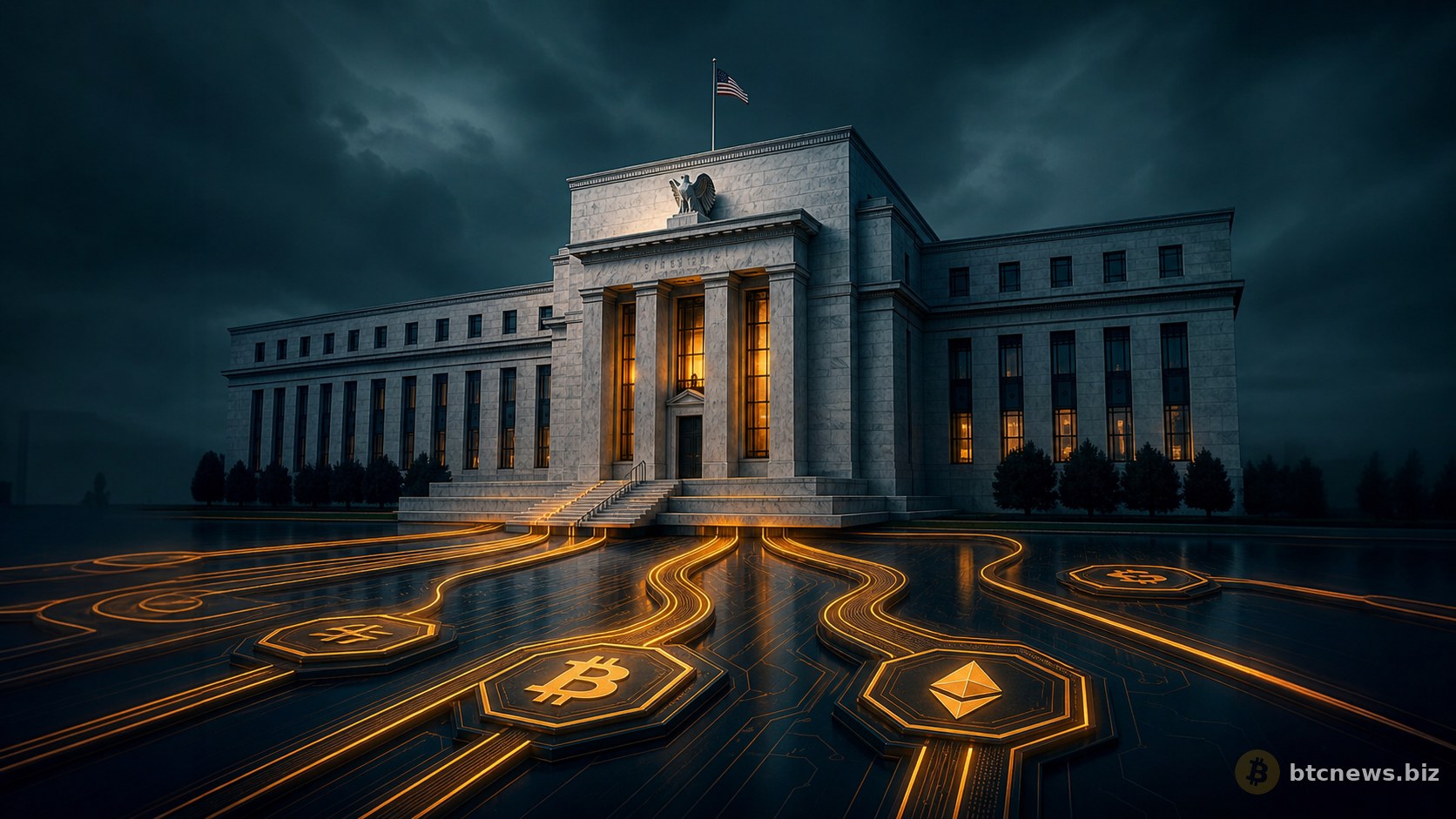
Crypto and the Fed: Crypto Tests Payment Rails
Crypto is being pulled into a practical fight now: who gets access to payment rails, and who gets stuck with tougher oversight. Crypto and the Fed finally has a policy hook traders can price. President Donald Trump signed two executive orders on Tuesday, May 19. The Federal Reserve Board followed on Wednesday, May 20, with an updated proposal for a “skinny” master account. My take: this is not just another Washington headline. Payment rail access could move BTC, ETH and COIN closer to real financial infrastructure. Bank Secrecy Act guidance could tighten the other side of the trade.

The Fed proposal gives fintech and crypto firms a possible way into central bank payment rails without making them become full banks. The Fed’s Wednesday proposal updates a request for information first published in December 2025. It lays out how fintech and crypto firms might reach central bank payment rails without becoming full fledged, Office of the Comptroller of the Currency chartered banks. Trump’s first Tuesday order tells federal regulators to review rules that may block fintech firms from working with regulated entities. His second order tells the Treasury Department and regulators to strengthen Bank Secrecy Act rules. Two orders. Two very different trades.
Markets will treat any route into federal payment rails as real infrastructure progress for crypto. That is the adoption signal. If crypto firms eventually get narrower access to federal payment rails, investors will see it as more than friendly talk from Washington. BTC and ETH do not need another white paper in 2026. They need settlement, custody, payments and bank operational comfort to get boring enough for large institutions to use without flinching. Why does boring matter? Because boring is usually where financial infrastructure starts making money. COIN sits right in the middle of that, because regulated exchange infrastructure usually benefits when Washington gives firms a lane they can actually use.
Congress may still need to decide which firms qualify for Federal Reserve accounts. Here is the catch: the Fed may not be able to finish this alone. According to a source, Congress may need to pass legislation that spells out which entities qualify for an account. That matters for timing. A proposal can lift sentiment around BTC, ETH and COIN, but legislation is what makes the change stick. Traders have seen this movie before. Crypto rallies on access hopes, then stalls when Senate floor time gets eaten by fights that have nothing to do with crypto. I would not underwrite this as done until Congress actually moves.
The Bank Secrecy Act order does not name crypto, but DeFi platforms could still end up in the final guidance. The pressure side cuts the other way. The BSA focused order did not explicitly mention cryptocurrency or decentralized finance trading platforms, but Nicholas Anthony, a research fellow at the Cato Institute, said they could get caught up in any final guidance. Trump’s order points to illicit cross border financial activity, shell companies, payroll tax evasion and unregistered money services businesses. It also points to third party payment processors and peer to peer platforms. That is a wide net. DeFi traders should take it seriously.
Treasury has a lot of room under the Bank Secrecy Act, so the next guidance may matter more than the headline. Anthony’s warning is useful because it gets at Treasury’s discretion. According to Nicholas Anthony, “Right now it’s in the hands of the Treasury, and the Treasury is able to apply it not only however it sees fit, but also to whoever it sees fit, because of the broader power that the Treasury has under the Bank Secrecy Act.” Most crypto-policy reads stop at the executive order. That is only half right. For ETH linked DeFi protocols, the follow up guidance may matter more than the executive order itself.
Payment rail access will not move rates or inflation directly, but it can still change how traders price risk. Macro is the quieter part of this story. Still, it is worth watching. Fed payment access is not a rate cut, and it does not change inflation by itself. Is this a macro catalyst? Not in the clean CPI or fed funds sense. But a central bank proposal that lets crypto firms get closer to payment rails can shift risk appetite a bit. BTC has often traded like a high beta liquidity asset when U.S. policy looks friendlier. ETH and COIN can move even harder on regulatory clarity because their usage and revenue stories depend on access, compliance and institutional participation.
The Senate calendar may be the real problem for crypto legislation like the Clarity Act. Worth noting: the Senate calendar may be the resistance level. The Senate Banking Committee advanced the Clarity Act just over a week ago, and the full Senate was expected to take it up sometime in the next month. That schedule took a hit on Thursday, May 21, when the Senate left town for the Memorial Day recess without voting on a reconciliation bill to fund the Department of Homeland Security and other priorities. I’ll be honest: this is the kind of calendar detail traders pretend to hate until it wrecks the timing of the trade.
There are not many Senate workdays left before the summer break, and crypto has to compete with bigger fights. The math is tight. According to a source, the Senate has 19 working days in June, 15 in July and 5 in August before lawmakers leave for the rest of the summer. In that same window, senators also have to deal with reconciliation and a Foreign Intelligence Surveillance Act renewal that expires in mid June. A housing bill may enter the queue too. No surprise there. Market structure legislation does not get an easy slot when national security funding and surveillance law are fighting for floor time. This is where the trade gets ugly.
Funding fights can push the Clarity Act deeper into the summer, adding calendar risk for crypto markets. The political blockage is not theoretical. According to reports, Trump’s administration wanted $1 billion for a planned East Wing ballroom and later another $1.8 billion for a weaponization fund, which members of both parties called a “slush fund.” The Senate had already stripped the ballroom funding from the bill, but the $1.8 billion dispute looked too big to settle this week. Counter to the usual crypto-market instinct, the issue here is not ideology first. It is floor time. That delay can push the Clarity Act deeper into the summer calendar. Crypto markets hate that kind of drift when the trade depends on Congress acting on time.
What this means
Crypto policy in 2026 is moving in two directions at once: more payment access, more anti money laundering pressure. That is the split screen. Washington looks more willing to let digital assets connect to payment networks, while also preparing tougher Bank Secrecy Act oversight. Yes, this cuts against the easy “pro crypto” read. Bear with me. The mix looks better for regulated names such as COIN and may help BTC if institutional plumbing improves. It is messier for ETH based DeFi, where Treasury guidance could decide whether peer to peer platforms face new compliance demands.
The next Senate window will decide whether crypto policy moves quickly or gets stuck behind other bills. Watch June first. The Senate has 19 working days that month, then 15 in July and 5 in August before the summer break. The dates that matter are the mid June Foreign Intelligence Surveillance Act deadline, the post Memorial Day reconciliation talks and any full Senate movement on the Clarity Act. What is the cleaner market question? Not “crypto wins” or “crypto loses.” It is whether BTC, ETH and COIN get payment access news before BSA guidance gets tougher. That is the trade I would watch.
FAQ
Q: Why does the Federal Reserve’s updated proposal matter for crypto firms?
A: It explains how fintech and crypto firms might access central bank payment rails without full bank charters. That would bring them closer to the traditional payments system.
Q: How do Trump’s executive orders affect crypto?
A: One order tells regulators to review rules that may block fintech partnerships. The other tells Treasury and regulators to strengthen Bank Secrecy Act rules, which could mean more oversight for crypto firms.
Q: What is the Clarity Act, and why does the Senate timeline matter?
A: The Clarity Act is crypto market structure legislation. Its Senate timeline matters because delays leave markets trading on hope instead of firm rules.
Q: How could the Bank Secrecy Act affect DeFi?
A: DeFi is not named directly, but future Treasury guidance could still put new compliance pressure on peer to peer platforms and other DeFi activity.
Q: Does more crypto access to payment rails affect inflation or interest rates?
A: No. Payment rail access does not directly change inflation or interest rates. It can still nudge market risk appetite, especially for BTC, ETH and COIN.