
















































Ethereum Foundation Rescue Plan Seeks $1b as ETH Incentives Bite
A former Ethereum Foundation developer wants to raise $1b for what the wire/TG post calls an ethereum foundation rescue plan. The stated goal is to “save” Ethereum. I’ll be honest: that word lands like a flare, not a roadmap. The proposal hit while ETH investors were already arguing over a sharper question: do Ethereum’s main institutions actually share enough financial upside with the network they steer?
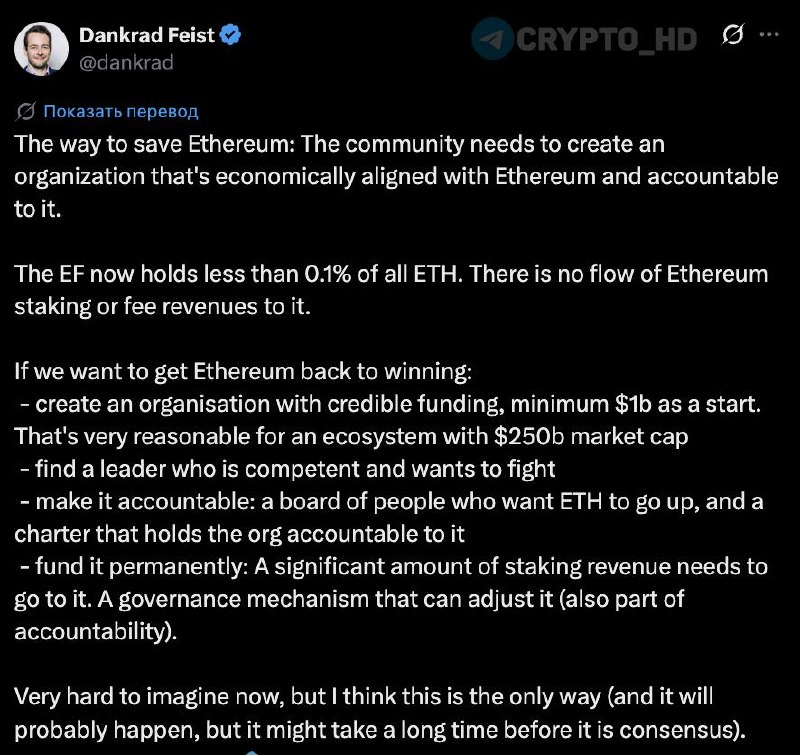
The argument is blunt. Dankrad Feist thinks a new organization should benefit if ETH rises, and that it should work in public to make Ethereum more valuable. He criticized the current Ethereum Foundation model because the foundation owns less than 0.1% of all ETH and receives no staking revenue or network fees. Traders noticed. Of course they did. ETH is not only a protocol token. It is the ticker investors use when they are voting on Ethereum’s roadmap, credibility, and execution speed.
Feist is not a random critic. The source identifies him as one of the developers behind Danksharding, Ethereum’s scaling technology, and as the person behind a proposal to raise Ethereum’s network load limit by 100 times. That gives the plan two separate hooks: technical legitimacy and market alignment. Most governance takes sound like process talk. This one is not. It asks whether Ethereum’s scaling work should translate more directly into value for ETH. The same post says major developers and researchers keep leaving the Ethereum Foundation, and it repeats the older complaint that EF sells ETH.
For ETH traders, adoption is the first thing to watch. If Ethereum wants banks, funds, rollups, and corporate builders to keep treating it as a settlement layer, its development engine has to look steady. Why does this matter? Because ETH’s investment case often depends on Ethereum being infrastructure, not just another liquid crypto trade. That case looked weak during the 2022 drawdown, when ETH fell from about $3,700 on January 1, 2022, to near $1,200 by December 31, 2022, along with the broader selloff in risk assets. It looked stronger around the September 15, 2022 Merge and the March 13, 2024 Dencun upgrade. My read: a $1b rescue-style group would tell markets that protocol development may need its own serious balance sheet.
The second issue is staking, especially with regulators watching. The source says the Ethereum Foundation does not receive staking revenue or network fees. That makes ETH holders ask a basic thing: when the network gets used, who actually benefits? Staking is one of the cleaner links between owning ETH and Ethereum activity. When U.S. spot ETH ETFs started trading on July 23, 2024, the debate was not only about access to ETH. It was also about whether regulated products could capture Ethereum’s yield-like features. If the foundation owns less than 0.1% of all ETH and earns nothing from staking or fees, Feist’s criticism gets uncomfortable fast. Should Ethereum’s core stewards stay neutral, or should they have money on the line?
There is a fair case on both sides. A foundation that sells ETH can fund public goods and avoid market politics. Counter to the usual trader complaint, that is not automatically bad. Neutrality has value. But it can also look badly misaligned when investors want scarcity, staking participation, and fee demand to show up in the asset. A $1b structure would make that tension harder to brush off. It would say Ethereum builders need an entity with a financial reason to push ETH higher, not just keep the protocol neutral. Traders may like the idea. Execution is the wall.
Macro still gets a vote. ETH remains a high beta risk asset when liquidity tightens, and governance changes usually do not outrun rates, dollar strength, or ETF flows for long. In 2022, ETH dropped about 67% during aggressive Federal Reserve tightening, while BTC and COIN also traded like risk assets rather than safe havens. That is the backdrop here. Yes, this cuts against the cleaner alignment story above. Bear with me. A $1b Ethereum-aligned organization could improve the ETH story, but it does not erase the macro trade. If rates stay restrictive or crypto liquidity fades, better incentives may not move price on their own.
Still, the proposal hits a real sore spot. Ethereum has spent years selling investors on a layered future: ETH as money, Ethereum as settlement, rollups as scale, staking as yield, fees as proof that people use the network. Feist’s criticism is that the main foundation sits outside that loop. Less than 0.1% ETH ownership is tiny for an institution with so much influence over Ethereum’s technical direction. No staking revenue. No network fee income. And, according to the source, more departures by major developers and researchers. That is a messy governance headline for ETH.
The source does not include a direct quote beyond the summarized proposal and criticism, so the market read matters more than the exact phrasing. My take: this is not a restructuring yet. ETH investors should not treat it like one. The post describes a proposal to attract $1b and create a new organization. It does not say the money has been raised, that the Ethereum Foundation supports it, or that a new entity already exists. That distinction matters. Crypto prices narratives early. Sometimes embarrassingly early.
For traders, the short term question is whether this becomes an ETH confidence story or an Ethereum governance risk story. If the market sees the $1b plan as a serious attempt to connect development, staking economics, and network value, ETH could catch a narrative bid against BTC. If the same plan reads like evidence that the Ethereum Foundation is losing talent and strategic control, the reaction could turn defensive. Is “rescue” language useful? For attention, yes. For confidence, maybe not. It also makes people wonder what exactly needs rescuing.
What this means
This event points to Ethereum’s next market debate being about institutional alignment, not only the next upgrade. The affected ticker is ETH because the proposal ties a $1b organization to the goal of raising Ethereum network value, while criticizing a foundation that owns less than 0.1% of all ETH and earns no staking or fee revenue. I would watch three things before calling this bullish: whether this becomes an actual funding effort, whether more Ethereum Foundation developers or researchers leave, and whether ETH starts beating BTC on Ethereum-specific news instead of broad crypto beta.
The levels to watch are ETH’s reaction around major liquidity and positioning events: the next FOMC decision date, CME ETH futures open interest after the proposal spreads, and ETH/BTC if the market starts repricing Ethereum governance risk. A sustained ETH/BTC bounce would suggest investors see the $1b idea as an alignment fix. A breakdown would suggest the market cares more about developer exits and EF ETH sales. The proposal is not price action yet. But it gives ETH traders one blunt question to price: who is financially responsible for making Ethereum more valuable?