
















































Hyperliquid Long Position Loss Puts ETH Leverage in Focus
A reported Hyperliquid long loss has ETH traders staring at leverage again. The largest long holder on Hyperliquid is reportedly down $28,000,000. The position is not just large; it is awkwardly visible: 120,000 ETH, with an average entry of $2261 per coin and full liquidation at $1750 per ETH or lower. My take: that is the number traders will circle first. One oversized ETH long can turn an ordinary pullback into something that feels engineered.
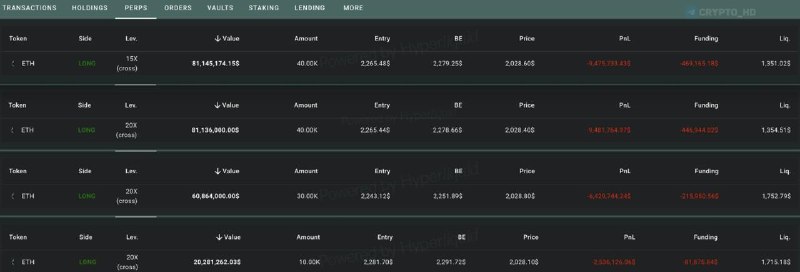
The wire/TG post does not include a timestamp, so on May 23, 2026, I would treat this as a snapshot of leverage, not proof that a market wide liquidation is already underway. The reported wallets are labeled only as 1, 2, 3, and 4. No trader is named. No fund, desk, country, or counterparty is named either. Still, 120,000 ETH is not background noise. It is a position big enough for other desks to plan around, especially when the market can see the average entry at $2261 and the liquidation line at $1750.
ETH traders do not need much encouragement to crowd around a visible setup like this. If the position is public on Hyperliquid, the market can price around it, hedge against it, fade it, or try to push price toward the liquidation zone. Most calm market commentary says price simply “finds liquidity.” That is only half right. Sometimes traders help it find liquidity. That is not a moral judgment on whoever owns the long. It is just how these venues behave. When a $28,000,000 unrealized loss sits on top of 120,000 ETH, liquidity providers will watch every move toward $1750. Forced selling below that level could spill into ETH spot, perpetual swaps, CME-linked hedges, and the risk books that connect all of them.
The macro backdrop matters here. ETH still trades like a high-beta risk asset, so Fed expectations, dollar strength, and rate volatility can decide whether traders defend $2261 or start hunting for $1750. The next scheduled FOMC meeting is June 16-17, 2026, according to the Federal Reserve calendar. Why does this matter? Because crypto positioning often gets tighter before those meetings. If U.S. yields rise into that date, ETH longs may face more funding pressure and fewer dip buyers. If yields cool, the same 120,000 ETH long looks less exposed, because risk appetite usually returns to BTC and ETH first. I will be honest: that second outcome can flip sentiment faster than the leverage math suggests.
Safe-haven flows also matter, though ETH is not BTC. In January 2020, after the Soleimani strike, BTC rose about 8% during a geopolitical shock window. People still argue about what that proved. Fair enough. It remains one of the cleaner examples in the Bitcoin safe-haven debate. Counter to the usual crypto shortcut, ETH does not carry the same monetary hedge story. It often moves with crypto beta when BTC catches a bid. Even so, a forced ETH liquidation at $1750 would be a real test. Does BTC strength steady the market? Maybe. Or traders could cut leverage across BTC, ETH, and major perp venues anyway.
This is not a regulation story in the narrow SEC or CFTC sense. The source does not mention an agency, lawsuit, ETF, staking rule, or exchange action. But it does touch a risk investors already understand: visible leverage on decentralized or offshore-style venues can drain ETH market depth when stress hits. If a 120,000 ETH long becomes a public target with a $1750 liquidation line, risk desks will ask a blunt question. How much of the move is real selling, and how much is liquidation machinery? That matters for COIN, ETH ETFs, and spot market makers, even without a new rule dated May 23, 2026. Yes, that sounds like a regulation-adjacent point after saying this is not a regulation story. Bear with me: the trigger is market structure, but the damage can still show up in listed crypto equities and ETF flows.
The source includes no quote and no named analyst reaction. Fine. That almost makes the setup cleaner. We are not parsing someone’s spin here. This is about a position, a loss, and one ugly price level: $28,000,000 down, 120,000 ETH long, $2261 average entry, $1750 liquidation. Traders will treat those numbers as levels now, not trivia. It works.
What this means
ETH leverage still looks concentrated enough to move short term price action on Hyperliquid. The ticker is ETH. The venue is Hyperliquid. The danger level is $1750 per ETH or lower. Is this overkill for one account? No, not when the account is tied to 120,000 ETH. If ETH trades into that zone, the risk is bigger than one account getting liquidated. Other traders may cut exposure. Hedges may unwind. Perpetual funding could get squeezed. The thing to watch is whether visible on-chain leverage keeps turning into a target map.
Watch ETH around $2261 first, then $1750 if selling picks up. Watch CME ETH futures positioning and funding rates into the June 16-17, 2026 FOMC meeting too. My view: macro pressure can turn a crowded long into a liquidation event faster than spot traders want to admit. Skip the drama. Track the levels. Source for the FOMC date: https://www.federalreserve.gov/monetarypolicy/fomccalendars.htm