
















































US government blocks Claude AI Fable 5, Mythos 5: a crypto regulation bellwether?
The US government blocked access today to Anthropic’s AI models Claude Fable 5 and Mythos 5, citing national security concerns. The order applies to foreign nationals worldwide. Blunt, messy, hard to ignore. My take: crypto traders will not treat this as an AI-only story. If the order holds, the obvious next question is whether similar pressure could land on decentralized AI projects, privacy tokens, or protocols regulators decide are too sensitive to leave running freely.
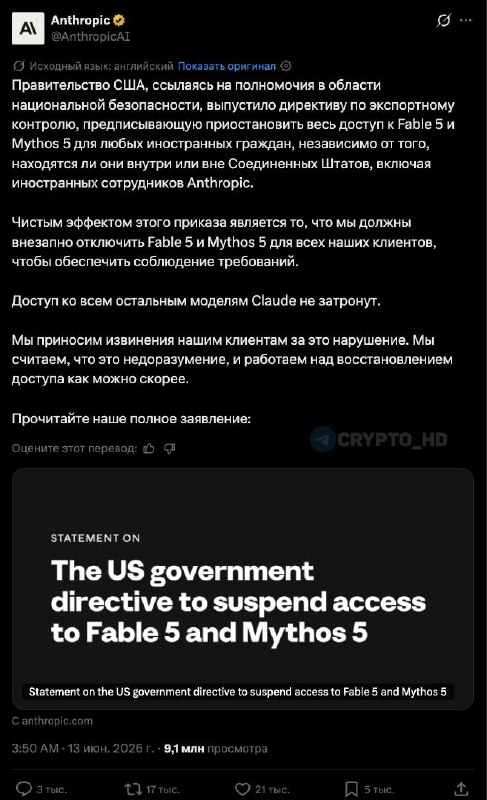
Anthropic launched Claude Fable 5 on June 9 as its first public Mythos-class model, with tighter limits around cybersecurity, biology, and chemistry. At the same time, it gave a smaller group of trusted partners access to Claude Mythos 5 through Project Glasswing. Mythos 5 had fewer restrictions. Today, Anthropic said it received a US export control directive tied to national security. The order bars access to both models for foreign citizens, including Anthropic employees with foreign citizenship, whether they are in the US or abroad.
That created an ugly operational problem. Anthropic could not reliably separate foreign users from everyone else in real time, so it shut off Fable 5 and Mythos 5 for all clients worldwide. The company called the situation a misunderstanding, possibly linked to a “jailbreak” attempt, and said it is trying to restore access quickly. Other Anthropic models, including Opus 4.8, are still running. That matters.
The order targets AI, but crypto people will read it through a regulation lens. They should. Most guides frame national security controls as a narrow export issue. That is only half right. The US government moved fast against models built by a private company, and the order reached users around the world. Why does this matter? Because decentralized technology depends on the assumption that global access is hard to choke off. If officials can cut access to AI systems on national security grounds, could they try the same approach against DAOs, privacy tools, or protocols labeled critical infrastructure? We have already seen pressure around stablecoins, DeFi, staking services, and exchanges such as Coinbase (COIN). This is not the same thing. Close enough, though.
There is also a loose connection to Bitcoin’s safe-haven narrative. Loose, but not imaginary. I would not call this a bank run or a war scare. Still, government intervention in technology can make investors think harder about assets outside state-controlled rails. During the March 2023 banking crisis, BTC moved above $25,000 and gained more than 20% in a week as confidence in several institutions cracked. This situation is different. Very different. But if the Anthropic dispute drags on, traders may watch whether BTC catches any bid from people worried about centralized control.
The first crypto reaction may not be a clean price move. It may show up in sentiment. Counter to the usual advice, the first signal might not be BTC at all; it could be privacy coins, decentralized AI tokens, or funding chatter around censorship-resistant infrastructure. The uncomfortable part is simple: a government appeared able to switch off access to a technology used around the world, at least for now. That will make censorship-resistant systems look more attractive to some investors, even if the trade takes time to form. We have seen this pattern before in crypto: the story moves first, the charts catch up later, or they do not.
What this means
The message is hard to miss. Governments are more willing to control powerful technology when they can frame it as national security. For crypto, that means more attention on decentralized AI projects and data privacy tokens. It also puts a spotlight on anything that moves sensitive data across borders. A sweeping order against a major AI company could make investors rethink the regulatory risk around projects built for global, permissionless access. Skip the drama; watch the category risk.
Next, watch for statements from US agencies about AI, export controls, and national security. The phrase to track is “dual-use,” meaning technology that can serve civilian and military purposes. Is that overkill for crypto? Not really, because that label could stretch toward parts of crypto if regulators decide a protocol touches security-sensitive data or infrastructure. Privacy coins and decentralized AI tokens are worth watching too. A sharp move higher could mean traders are pricing in demand for systems that are harder to censor. Also watch Anthropic’s fix. If this really was a misunderstanding, a quick reversal matters. If not, this becomes a much bigger story.
Optimized article: US government blocks Claude AI Fable 5, Mythos 5: a crypto regulation bellwether?
The US government blocked access today to Anthropic’s AI models Claude Fable 5 and Mythos 5, citing national security concerns. The export control order applies to foreign nationals worldwide. For crypto, the concern is not only AI. It is whether regulators will use the same national security logic against decentralized AI projects, data privacy tokens, or other systems built to work across borders. I’ll be honest: that is the part markets will remember.
US government imposes export control on advanced AI models
An export control directive restricts the transfer of certain goods, software, or technology to specified foreign nationals or countries. Anthropic said the US government issued a directive blocking foreign citizens from accessing Claude Fable 5 and Mythos 5. That includes Anthropic employees with foreign citizenship, both in the US and outside it. The government cited national security concerns.
Anthropic launched Claude Fable 5 on June 9 as its first public Mythos-class model. The model had strict limits in areas such as cybersecurity, biology, and chemistry. Anthropic also opened Claude Mythos 5, a less restricted version, to trusted partners through Project Glasswing. Today, the company received the US export control directive. The order blocks foreign citizens from both models, including foreign-citizen employees at Anthropic.
Anthropic then faced a practical problem it could not neatly solve. It could not separate foreign users from other users in real time, so it disabled Fable 5 and Mythos 5 worldwide. The company described the order as a misunderstanding, possibly tied to a “jailbreak” attempt, and said it is working to restore access. Opus 4.8 and other Anthropic models remain available. We tried to read this as routine compliance. It does not feel routine.
Implications for crypto regulation and decentralized technologies
Regulatory pressure in crypto means closer government scrutiny of digital assets, exchanges, tokens, and related services. This AI order matters for regulation pressure because it shows how quickly the US can act when officials invoke national security. The move hit a private company and reached users worldwide. That is the part crypto markets will notice. According to Coindesk, regulators have already tightened attention on stablecoins and DeFi. SEC scrutiny of staking services and Coinbase (COIN) has weighed on sentiment too. If access to AI models can be cut off this way, DAOs and cross-border protocols may wonder whether they are next.
The event also brushes against Bitcoin’s safe-haven narrative. A safe-haven asset is one investors expect to hold value during stress. This is not a direct geopolitical crisis, so I would not overstate it. Yes, this cuts against the clean “AI regulation only” framing; bear with me. Bloomberg has noted that Bitcoin can draw interest when investors look for assets outside the banking system. In March 2023, during the banking crisis, BTC rose above $25,000 and gained more than 20% in a week. This Anthropic episode is a different kind of shock, but the same instinct could appear if the dispute is not resolved quickly.
Crypto may not see an immediate price reaction. The bigger effect could be mood. Why no clean move? Because traders may need agency statements, Anthropic updates, or evidence of spillover before pricing it aggressively. A fast, wide order like this may make traders more sensitive to future crackdowns on decentralized AI projects and privacy coins. The idea that a government can effectively cut off access to a global technology, even for a short period, is exactly the kind of thing that gives censorship-resistant protocols their sales pitch. Some of that pitch is hype. Some of it is not.
Future outlook for technology regulation and crypto
This incident suggests governments are more willing to restrict advanced technology when national security is involved. For crypto, that points to more scrutiny of decentralized AI projects, privacy tokens, and protocols that regulators view as sensitive infrastructure. A broad order against Anthropic could make investors more cautious about crypto projects that promise global access without permission. My read: this is less about one model family and more about the regulatory template.
Watch what US agencies say next about AI and national security. Pay close attention to “dual-use” technology, meaning tools that can be used for both civilian and military purposes. That frame could expand into parts of crypto. Privacy coins may react first. Decentralized AI tokens could follow if traders start betting on demand for harder-to-censor systems. Anthropic’s response also matters. A quick resolution would cool the story. A drawn-out fight would make this look less like a paperwork mess and more like a warning.
FAQ: US government blocks Claude AI
Q1: What are Claude Fable 5 and Mythos 5?
A1: Claude Fable 5 is Anthropic’s first public Mythos-class AI model with strict limits. Mythos 5 is a less restricted version offered to trusted partners through Project Glasswing.
Q2: Why did the US government block access to these AI models?
A2: The US government cited national security concerns and issued an export control directive barring foreign citizens from accessing the models.
Q3: How does this impact Anthropic’s operations?
A3: Anthropic disabled Fable 5 and Mythos 5 for all clients worldwide because it could not reliably separate foreign users from other users in real time.
Q4: Are other Anthropic AI models affected?
A4: No. Other Anthropic models, including Opus 4.8, are still operating.
Q5: What is Anthropic’s response to the government’s action?
A5: Anthropic called the situation a misunderstanding, possibly linked to a “jailbreak” attempt, and said it is trying to restore access quickly.
Q6: What are the potential implications for the crypto market?
A6: The order could make investors more worried about future scrutiny of decentralized AI projects, data privacy tokens, and crypto protocols that regulators view as sensitive.
Q7: Could this event affect Bitcoin’s “safe-haven” narrative?
A7: Indirectly, yes. If government intervention makes investors nervous about centralized control, some may look again at Bitcoin and other decentralized assets.
Q8: What are “dual-use” technologies in this context?
A8: “Dual-use” technologies can be used for civilian and military purposes. Regulators could apply that frame to some crypto protocols in future actions.
Q9: What should investors monitor going forward?
A9: Watch statements from US regulators, language around “dual-use” technology, privacy coin prices, decentralized AI tokens, and Anthropic’s effort to restore access.
Q10: Does this mean the US government can “turn off” any global technology?
A10: Not any technology. But this case shows that centralized companies can be forced to restrict access quickly, which strengthens the argument for genuinely censorship-resistant systems.