
















































Starknet Tops L2 Dev Activity, and Traders Should Notice
Santiment’s latest data, released June 26, 2026, puts Starknet first for Layer 2 developer activity over the past 30 days. My take: traders should not treat that as trivia. Dev activity is not a price chart, and it will not tell anyone what happens tomorrow morning. Good. It should not. What it does show is which teams are still writing code when the market gets messy, boring, and half-distracted by macro headlines. For ETH and L2 tokens, that is a useful adoption clue.
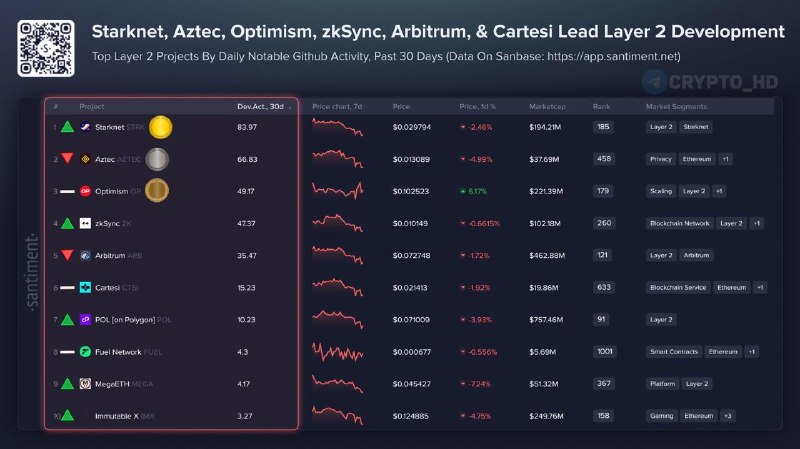
Santiment ranked the top 10 L2 blockchains by developer activity over the last 30 days. Starknet took first place, followed by Aztec, Optimism, and zkSync. Arbitrum ranked fifth. Cartesi, Polygon, Fuel Network, MegaETH, and Immutable X made up the rest of the list. That gives traders a rough map of where code commits and developer work are actually landing across the L2 market. Not perfect. Commit counts can be padded or gamed, and I would not build a trade around one metric alone. Most guides say developer activity is a clean health signal. That is only half right. Still, it beats staring only at candles and pretending price explains everything. Santiment has tracked this metric before, so this fits into a longer read on developer interest, not just one stray post.
L2 developer activity matters because Ethereum still has the same basic problem: users want transactions that do not feel expensive or slow. Why does this matter? Because scaling is still the main pitch for most L2s, and gas fees have pushed users away before. Starknet, Optimism, and Arbitrum are past the whitepaper phase. People are building on them. I will be honest: that is a stronger signal than another polished ecosystem thread. It does not guarantee a token rally, but it does help Ethereum’s long term case, because ETH benefits when scaling looks less theoretical. In August 2023, when PayPal launched its stablecoin, adoption news helped the market mood even with ugly macro conditions. Development is quieter than a PayPal headline, but quiet building is usually more useful than loud marketing.
There is a capital flow angle too. When traditional markets get nervous, crypto usually feels it quickly. The Fed’s hawkish turn in late 2022 was a good reminder. Counter to the usual advice, though, macro is not the only lens here. Inside crypto, money often rotates toward projects that look useful and active. The steady work on these L2s suggests some traders are looking past the next CPI print and trying to position for later growth. During ETH’s sideways stretch around $1,800 to $2,000 in Q3 2023, developer metrics were worth keeping in the background. Boring, yes. But boring data sometimes says more than the loud stuff. Sustained building points to confidence in scaling, even when short term price action is flat or messy.
What this means
Strong L2 developer activity points to a simple trend: more decentralized apps are being built on networks that can handle cheaper, faster transactions. The market is paying more attention to usage and throughput now, not only the promise that a chain might work at scale someday. Is this enough by itself? No. But it helps Ethereum as the base layer, and it matters for L2 tokens such as OP and ARB if network usage keeps rising. The developer work suggests these projects are still alive and improving. That may sound obvious, but in crypto, “still shipping” is not a minor detail. We have seen enough dormant chains to know the difference.
Traders should watch whether developer activity turns into real usage. The next numbers to track are daily active users and total value locked on Starknet, Optimism, and Arbitrum. If those rise while developer activity stays high, the signal gets much stronger. Network upgrades matter. Partnerships matter too, especially when they pull attention and liquidity into a token for a while. Yes, this sounds less exciting than chasing a breakout candle. Bear with me. Ethereum Foundation updates on scaling are worth watching too, because they affect how these L2s fit into the roadmap. The next major FOMC meeting in late March could still move the whole market, because macro always gets a vote. Underneath that, though, L2 development remains one of the better long term signals traders have.