















































Aptos drops $50M on AI trading and DeFi infra
The Aptos Ecosystem Fund is a $50 million commitment from Aptos Foundation and Aptos Labs, split across protocol infrastructure, in-house products, research, and a strategic fund for outside teams building AI and trading apps on the Aptos Layer-1. The joint announcement names two priority verticals: AI and on-chain trading. That’s the pitch. My take: this is not a cute ecosystem-growth memo. For a Layer-1 still fighting Solana and Sui for developer mindshare, it reads like a survival pivot with a budget attached. Either Aptos chases the narratives pulling 2026 capital, or it keeps drifting. Crypto venture flow has tilted hard toward AI-adjacent infra since Q4 2025, and chains without a credible AI story have watched developer counts shrink in real time.
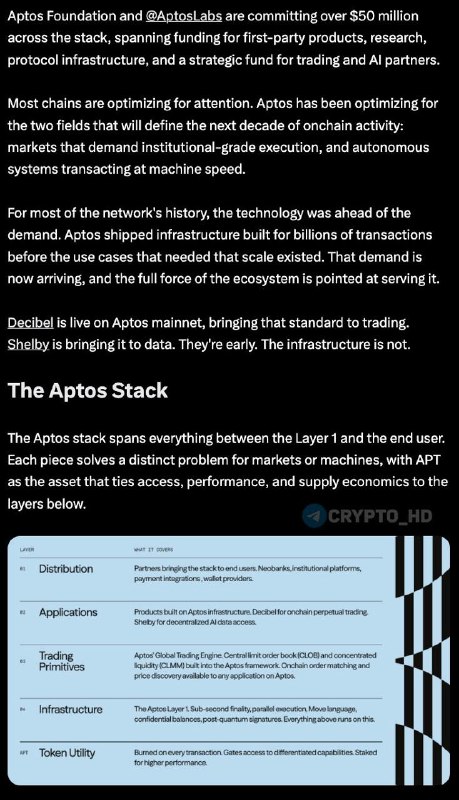
The $50,000,000 commitment is split across four buckets: Aptos’s own products, internal research, protocol-level infrastructure, and a strategic fund for outside partners working on trading and AI. Per-bucket allocations were not disclosed. I’ll be honest: that vagueness is probably intentional. It gives Aptos room to move capital toward whatever actually ships instead of locking itself into a tidy chart from day one. No deployment timeline. No per-grant ceiling. No partner names. Just the $50M figure and the two verticals.
APT has historically traded as a high-beta proxy for Solana, with price action correlated to SOL on both upside and downside. This is the part token holders should care about. When SOL ran, APT usually followed at a discount. When SOL bled, APT tended to bleed harder. Most guides frame ecosystem funds as developer subsidies. That’s only half right. A $50M push aimed at AI agents and on-chain trading is also an attempt to manufacture native demand instead of living off borrowed SOL beta. Solana’s ecosystem funds and Foundation grants have already deployed several hundred million cumulatively, and SOL’s developer count tracked that spending with about a two-quarter lag. Why does this matter? Because if Aptos lands even a handful of credible AI-trading protocols, the adoption signal flows straight into APT staking demand and TVL. Both still sit well below where the chain’s throughput marketing implies they should be.
On-chain perpetuals and intent-based DEX architectures are the only DeFi category posting consistent volume growth into 2026. The trading-fund piece is the more underrated half. I keep coming back to it because it is blunt. Most perp DEX flow sits on Hyperliquid, dYdX, and a thin Solana long tail. Aptos has no flagship perp venue with serious open interest. Zero. Counter to the usual advice, this is not just about “more DeFi apps.” It is about one or two venues that traders actually use every day. Earmarking strategic capital for trading partners is the Foundation quietly admitting that gap exists and trying to buy it closed. Still, liquidity follows incentives for a quarter or two, then leaves if the chain economics do not hold. This is a clock.
The AI bucket covers a wide scope: agent frameworks, on-chain inference, data marketplaces, and AI-driven trading bots. The AI allocation is harder to read but potentially larger. The announcement only says “artificial intelligence,” which is broad enough to cover agent frameworks and AI-driven trading bots, then stretch into on-chain inference or data marketplaces if Aptos wants it to. We should be careful here. A broad AI mandate can become either a real platform wedge or a dumping ground for polished demos. Developer activity data tracked since late 2025 shows chains that wired AI narratives into their funding, including NEAR with its agent stack and Solana with its inference and oracle integrations, have outperformed pure-DeFi L1s on developer growth. Is this overkill for Aptos? No, not if the chain wants to be discussed in the same room as Solana and Sui. If Aptos lands one breakout AI agent protocol that actually clears volume, $50M will look cheap. If the money funds a dozen demos that never ship past testnet, it will look like every other foundation grant program of the last cycle. We’ve seen that movie.
No external reaction, partner list, or deployment schedule was published with the announcement. That matters. The rest is the market’s job to fill in, and markets are not patient with blank spaces for long.
What this means
The Aptos Ecosystem Fund is a competitive repositioning bet: deploy $50M to build native AI infrastructure and a serious on-chain trading venue, and break APT’s correlation with SOL. Strip the marketing and this is a bet that fund deployment can pull APT out of pure-beta status against SOL by building two things the chain currently lacks: native AI infrastructure and a serious on-chain trading venue. Yes, this contradicts the softer “ecosystem support” framing from the announcement. Bear with me. The signal is competitive, not charitable. Aptos is conceding it cannot ride generic DeFi narrative anymore and needs vertical-specific traction. APT trades and stakes on the assumption that ecosystem activity eventually translates to fee burn and validator demand. A $50M push gives that assumption something to point at over the next two to four quarters. Holders should treat this less as an immediate price catalyst and more as a thesis test. Does deployed capital convert to TVL and active addresses, or does it sit announced and undeployed like several past Layer-1 fund commitments? I’ve seen both outcomes, and the announced-but-undeployed version is the more common one.
Three on-chain metrics determine whether the $50M commitment translates into APT revaluation: partner quality, Aptos DeFi TVL growth, and perp/intent-DEX trading volume. Watch the next ninety days closely. First: partner announcements. Names matter more than the headline number, and a credible AI-agent or perp-DEX team landing on Aptos is the trigger that could revalue APT independently of SOL. Second: TVL on Aptos DeFi, currently a fraction of Solana’s. If the trading-fund piece is real, there should be a measurable lift inside one quarter. Third: on-chain volume for any new perp or intent-based venue funded by this program. That is the cleanest read on whether trading capital attracted liquidity or just bought headlines. Until at least two of those three move, $50M is still a press release. Not a thesis.
Frequently asked questions
What is the Aptos Ecosystem Fund?
It’s a $50 million capital commitment jointly announced by Aptos Foundation and Aptos Labs. The money splits across four buckets: in-house products, internal research, protocol infrastructure, and a strategic fund for outside AI and trading partners.
How much money is in the Aptos Ecosystem Fund?
The fund totals $50,000,000. Per-bucket allocations were not disclosed by Aptos Foundation.
What are the priority verticals for the Aptos Ecosystem Fund?
The announcement names two: artificial intelligence and on-chain trading. The strategic partner fund is earmarked for teams building in those categories.
How does the Aptos Ecosystem Fund compare to Solana’s ecosystem grants?
Solana’s ecosystem funds and Foundation grants have cumulatively deployed several hundred million dollars, materially larger than Aptos’s $50M commitment. SOL developer count has historically tracked that spending with about a two-quarter lag.
Will the Aptos Ecosystem Fund affect APT token price?
Not directly, and not immediately. APT revaluation depends on whether deployed capital converts to TVL, active addresses, and credible partner announcements over the next two to four quarters.
What should APT holders watch over the next 90 days?
Three signals: named partner announcements, especially AI-agent or perp-DEX teams; a measurable TVL lift on Aptos DeFi; and on-chain volume on any new perp or intent-based DEX funded by the program.
Does Aptos have a flagship perpetuals DEX?
Not as of the announcement. Aptos has had no flagship perp venue with serious open interest, which is part of the reason strategic capital is being earmarked for trading partners.
When will the Aptos Ecosystem Fund start deploying capital?
No deployment timeline, per-grant ceiling, or partner names were published with the announcement. The Foundation has not given a public schedule.