
















































Google’s Camera ReCAPTCHA: A Privacy Problem for Crypto Adoption
Google is testing a camera based ReCAPTCHA that asks users to wave a hand instead of clicking traffic lights. The logic is obvious: AI bots are harder to stop than they were even a year ago. Fine. But a camera prompt is not just another CAPTCHA variant. It changes the bargain. My take: once a basic “not a robot” check asks for a live camera, crypto apps and Web3 services have a credibility problem if they still market themselves around privacy and pseudonymity.
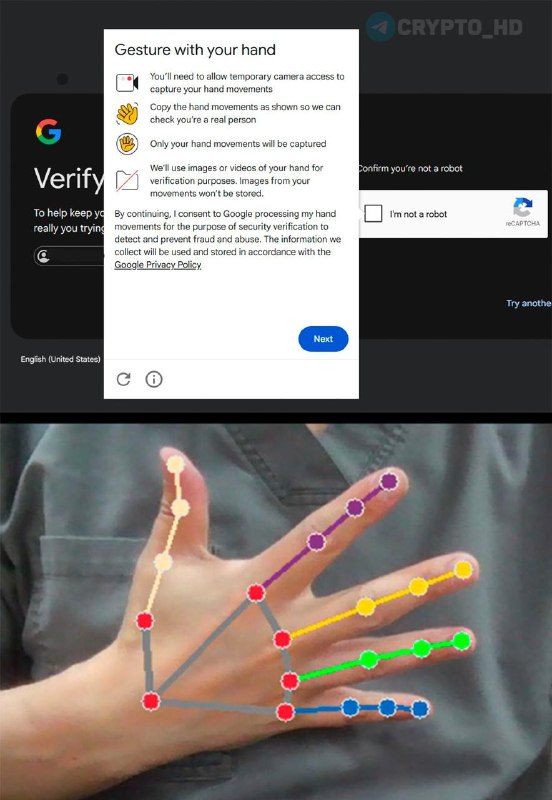
The new ReCAPTCHA system is only being shown to a small group of users for now. It asks for camera access, then asks the user to make a short hand gesture. Reports say it reads 21 points on the hand, including joints, fingers, and position, before deciding whether the user is human. Google says it checks hand movement only, records no sound, does not connect the video to a person, and deletes the recording after verification. Maybe that is all true. I’ll be honest: the promise matters, but the prompt matters more. “Please enable your camera to enter this website” is exactly the kind of line that makes people close the tab. The Twitter (X) reaction was predictable. Also fair.
This matters for crypto because the industry is already trapped between two incompatible pressures. Regulators want more identity checks. Users came to crypto, in large part, because identity checks had spread everywhere else. Agencies such as the SEC and CFTC have been watching Know Your Customer (KYC) and Anti-Money Laundering (AML) rules across crypto markets more closely. Google’s ReCAPTCHA is not a KYC product. Most guides will stop there. That is only half right. A camera based “prove you are human” flow can still normalize biometric-style verification, even if Google anonymizes and deletes the data. Why does this matter? Because the next step is easy to imagine: a dApp or exchange adding a camera based “proof of humanity” gate before users can trade, mint, bridge, or vote. For anyone who values blockchain’s pseudonymity, that is not a small UX tweak. It is an onboarding wall. We have already seen how quickly regulation anxiety can hit prices. In late 2023, when the SEC delayed decisions on several spot Bitcoin ETF applications, BTC fell from about $44,000 to $40,000 within a week. Extra verification friction could drag on user interest too, even if the market response is slower and harder to measure.
It also runs into the safe haven story around Bitcoin (BTC). Plenty of crypto investors are there because they distrust centralized control, surveillance, or both. A huge company asking for camera access before basic web use does not match that instinct. Counter to the usual advice, this is not only about whether the data is stored. It is about whether users feel watched at the front door. This is not the same as a geopolitical shock, such as the January 2020 Soleimani strike, when BTC gained 8% as some investors looked outside traditional finance. It is quieter. More irritating, maybe. But privacy loss often works like that: one small permission prompt at a time. I would not dismiss that as paranoia. If users feel watched, they may move toward more decentralized and privacy focused protocols. That could help privacy coins or dApps built around user data control. It could also put off newcomers who already find crypto confusing and now see another layer of surveillance dressed up as security.
What this means
Google’s camera ReCAPTCHA test points to a tougher verification environment online. AI bots are improving, so platforms are reaching for checks that feel more personal. For crypto, that creates a direct clash between identity rules and the privacy pitch that brought many users in. Privacy tools in Web3 could get more attention, including Monero (XMR) and Zcash (ZEC). So could dApps that prove a user is real without asking for biometric-adjacent data. Centralized exchanges (CEXs) face a harder tradeoff. They already operate under regulatory pressure, and if camera based verification becomes normal, some platforms may add stronger identity checks even if privacy-minded users hate it. Is this overkill? For a 50-page hobby site, probably. For a regulated exchange handling deposits, withdrawals, and voting access, no.
Investors should watch whether this debate changes sign-up behavior for new crypto projects. They should also watch regulator comments on digital identity and biometric data in financial services. Yes, this contradicts the neat “Google is not doing KYC” line above, but bear with me: markets do not wait for perfect category labels. A clear statement from the SEC or CFTC on acceptable “proof of humanity” methods would matter. Decentralized identity (DID) projects are worth tracking as well. If they offer a usable alternative to camera checks, they may get a real opening. My take: the real test comes after the next large biometric data breach, because that is usually when privacy arguments stop sounding theoretical.
FAQ: Google ReCAPTCHA Camera Privacy Concerns
What is Google’s new camera-based ReCAPTCHA?
Google’s new camera based ReCAPTCHA asks users to turn on their camera and make a short hand gesture to prove they are human, instead of solving a visual puzzle. Short version: the checkbox is becoming a camera prompt.
What data does the new ReCAPTCHA system collect?
Google says the system reads 21 points on the hand, including joints, fingers, and position. It says it only checks hand movement, records no sound, does not link the video to a person, and deletes the recording after verification.
Why is this new ReCAPTCHA raising privacy concerns?
People are worried because it asks for camera access during a routine web interaction. Even with Google’s promises, many users see that as too much for a simple bot check. I get the security argument. I still think the camera line feels different.
How could this impact crypto adoption?
It could make onboarding harder for dApps and Web3 services that rely on user trust, pseudonymity, and low friction access. It may also turn off users who came to crypto to get away from centralized surveillance.
Does Google’s ReCAPTCHA act as a KYC tool?
No. Google’s ReCAPTCHA is not a Know Your Customer (KYC) tool. The concern is narrower, but still serious: camera based verification could make similar “proof of humanity” checks feel normal for crypto platforms under regulatory pressure.
What is the “safe-haven narrative” in crypto and how does this relate?
The “safe-haven narrative” is the idea that crypto, especially Bitcoin, gives users some distance from centralized control and surveillance. A camera based web check works against that idea and may weaken trust in the digital systems around crypto.
What are the potential implications for privacy coins and dApps?
The test could bring more attention to privacy focused Web3 tools, including Monero (XMR), Zcash (ZEC), and dApps that verify users without collecting biometric-adjacent data. That does not mean every privacy coin rallies on a CAPTCHA headline. Markets are messier than that.
What should investors monitor regarding this development?
Investors should watch user adoption data for new crypto projects, regulator comments on digital identity and biometric data, progress in decentralized identity (DID) systems, and any major biometric data breach that pushes this debate into mainstream finance.